Yearly Archives: 2016

#60 The Sherman Tank Site Glossary: Because sometimes words are confusing

Sherman Terms: A glossary of Sherman words and some of the other lingo this site uses.


When I started the site, I assumed most readers would be fairly familiar with tanks, and the terms associated with them.  That’s probably not a very good assumption, so I decided to do a site glossary.


A57:

The motor used in the M4A3 and Sherman V tanks. It used five inline 6 car motors tied together on a common crankcase. For more information on this motor, see this post!

Armor Rolled:

Flat plate armor, this type of armor was used on the M4, M4A2, M4A3 and M4A4 and all the Sherman based TDs. For more information on WWII Armor, see this link. 

Armor Cast:

Armor made by pouring molten steel into a mold. For more information on WWII Armor, see this link. 

ARV:

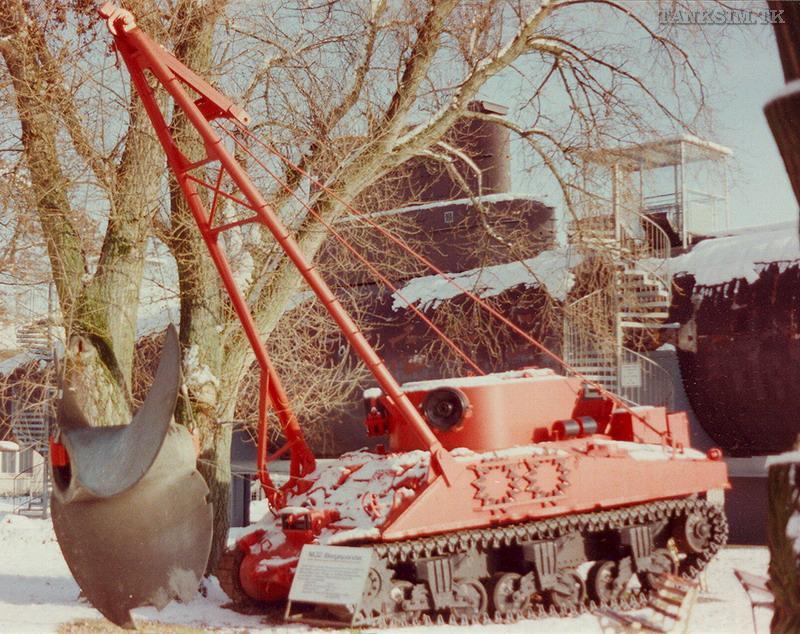
The abbreviation for Armored Recovery Vehicle, usually a modified tank use to tow other tanks out of the places they went and got stuck. For more info on Sherman based ARVs Click here

Applique Armor:

Armor added over the ammo racks in the hull sponsons, and this spot on the front right of the turret on the M4 series. More info, click here

Auxiliary motor:

A small gas motor mounted in the sponson of Shermans used to charge the tanks batteries when the tank isn’t running and heat the tank. For more info on the Auxiliary motor click here

Bogie:

The complete bogie assembly, including the two wheels, suspension arms, return roller and skid. Each Sherman had three bogie assemblies. For more information about the suspension and tracks see this post

Bogie wheels:

The wheels the tanks tracks run on. There is a wide variety of types of bogies or road wheels. The Sherman has at least 5 different, interchangeable types, and each tank has its own type as well.  For more information about the suspension and tracks see this post

Bow Machine gun:

The machine gun mounted in the front right of the Sherman tanks hull and manned by the co-driver.  For more info on the this click here

Co-axial Machine gun:

The machine gun mounted next to the main gun in a tank. For more info on the this click here

Composite Hull:

A Sherman that had a cast portion of the hull and welded portion, a very advanced technique used to simplify the number of welds needed to build a Sherman, without the need for the huge complete hull casting that not all Sherman makers could do. For more info on this hull type, click here

Crunchy:

The term tankers use for infantry, usually the enemy’s but can be slang for all things on two feet.  See this post for more info.

Cupola:

The name for the hatch the commander used, it usually had some form of extra viewing device built into it, and later ones allowed the Sherman to have nice all around view without cracking the hatch. This was one of the few truly excellent features of the German cats, the later production Tigers, Panthers and King Tigers all had very nice ones. Click here for more info

Direct Vision:

Early Sherman tanks had actual armored flaps that could be opened and closed from inside the tank for the driver and co-driver to look out from during combat, along with the periscope in the hatch above them. It was found that bullet splash could enter even when closed and it was a weak spot in the frontal armor.  They started welding the DV ports shut and covering them up with extra armor in the field and factory, and then the hull casting was improved to remove the DV ports, replacing them with an extra periscope for the driver and co-driver. For more info on the this click here

Dozer Sherman:

A Sherman with the Dozer blade kit attached. For more info, see this post

Dry Storage:

Early Shermans had their ammunition stored in racks around the hull, in the sponsons, under the floor and around the base of the turret.  These tanks were found to be very prone to fire if the ammunition,  much of it exposed around the turret was hit.  Once they figured  out this was the main reason the Sherman burned, they added armor around all the ammo racks, removed all the exposed round around the base of the turret, and added a small armored ready  rack at the loaders feet. These changes made the Sherman safer, but the ammo was still in easy to hit locations in the sponsons. These changes also were not universally popular with the crews, who in many cases wanted as much main gun ammo as they could pack in the tank. For more info on the this click here

Drive Sprocket:

The spiked wheel that applies engine power to the tracks, they can be found on the front or rear of tanks, depending on the layout of the automotive components. Most modern tanks put the motor, transmission and final drive with the sprocket in the back. In WWII, most allied and German tanks had the transmission and final drives in the front, with the motor in the back,  this causes tanks like the M4 Sherman, Panzer III and IV, Panther, Tiger, and Tiger II all taller than they needed to be. The Soviets adopted rear power packs before the war. For more information about the suspension and tracks see this post

Duckbill End Connector:

Track blocks are held together with end connectors that hold two track pins together. Duckbill end connectors were a standard end connector with a long duckbill like extension welded to it to help spread the tanks weight out in soft and muddy conditions.  They were both factory produced and installed, and locally sourced in France and installed on tanks already in the field. For more information about the suspension and tracks see this post

Duplex Drive:

A add on kit that would allow a Sherman tank to float, and self power from a LCM or LST to shore, if he conditions were right.  For more info see this post. 

End Connector:

The steel connector that holds the track pins together. These have to be lighted all the time and they wear out. When a tank comes to a halt, and it’s not under fire,  if the crew has the time several will jump out and start tightening them. For more information about the suspension and tracks see this post

Exhaust Deflector:

A large armored steel vent assembly mounted on late model Shermans to have deflect the exhaust gases away from the ground, so the tank doesn’t stir up as much dust.  Click here for an image of a Sherman, you can clearly make out the exhaust deflector on the back.

Fighting Compartment:

On the Sherman, the turret and co drivers position were all part of the fighting compartment. In a modern tank it’s just the turret. For more info, click here

Final Drive:

The gears used to transfer power from the transmission to the drive sprockets.  They were extremely robust on the Sherman, and able to take numerous upgrades that added weight without their failure rate going up. They were good enough to take the power of every power pack put into a Sherman.  They must have been a tad overdesigned and were much stronger than the final drives in the Panther tank.  The Panthers Final Drives were the tanks main Achilles heel. Not only were the gears weak, the housings were also weak and flexed, causing already weak gears to implode that much faster.  The Panthers spur gear final drives, even with the improved housing was so weak, it wouldn’t have been a choice for a 30 ton tank, let along the 45 ton disaster it ended up. The Shermans final drivers were stronger than the Panthers by a pretty big margin. For more info on the transmission and final drives, click here.

GAA:

The V8 motor that powered the M4A3 Sherman tank and several other vehicles based on the Sherman chassis. This motor was designed by cutting down an aircraft V12 Ford tried to sell the air force. When that didn’t work out and the Army told Ford it needed tank motors, they made some huge changes to the design, and the Ford GAA V8 tank motor arrived. This motor was generally viewed as the best motor the Sherman used. It was also a very advanced design, all aluminum dual overhead cam V8 capable of much more than it’s rated 500 horsepower. For more information on this motor, see this post!

Glacis Plate:

The frontal sloped plate of the Sherman tank or other tanks.  More info, click here

GM 6046:

The twin supercharged diesel motor that powered the M4A2 version of the Sherman thank, and the M10.  This motor got good mileage, had very good torque characteristics and was reliable and tough. The motor was well liked by all users, though the US Army only used it for training. The US Marine Corps used them for most of the war, and they were the preferred version of the Russians. For more information on this motor, see this post!

GM Twin Diesel:

The same motor as the GM 6046 For more information on this motor, see this post!

Grouser:

A grouser is a large metal bar that can be strapped onto the tanks tracks for extra traction in snow, mud or ice. They were stored in special compartments on the rear of the Sherman. They usually ran 12 per track. For more information about the suspension and tracks see this post

Grouser Cover:

This was the scoop like cover that went over the grouser compartment on the rear of the Shermans hull.  For more information about the suspension and tracks see this post

High Bustle:

Later 75mm Sherman turrets had the bustle in the back, that the radio was mounted in, raised slightly, to clear the hinge protrusions on the new large hatch hulls. For More info, click here

Hunnicutt:

Richard P. Hunnicutt, pretty much the number one authority in print on US Armor for decades. His books, long out of print, are just not coming back into print, and are must buys. He wrote the definitive book on the Sherman tank, Sherman, a history of the American Medium tank.   For more info, click here

HVSS:

An abbreviation for Horizontal Volute Spring Suspension, the improved, later wider suspension and tracks used by the ‘Easy 8’ Shermans.  For more information about the suspension and tracks see this post

Idler:

The assembly at the back of the hull on the Sherman, that includes the idler wheel, and used to adjust track tension.  For more information about the suspension and tracks see this post

Jumbo:

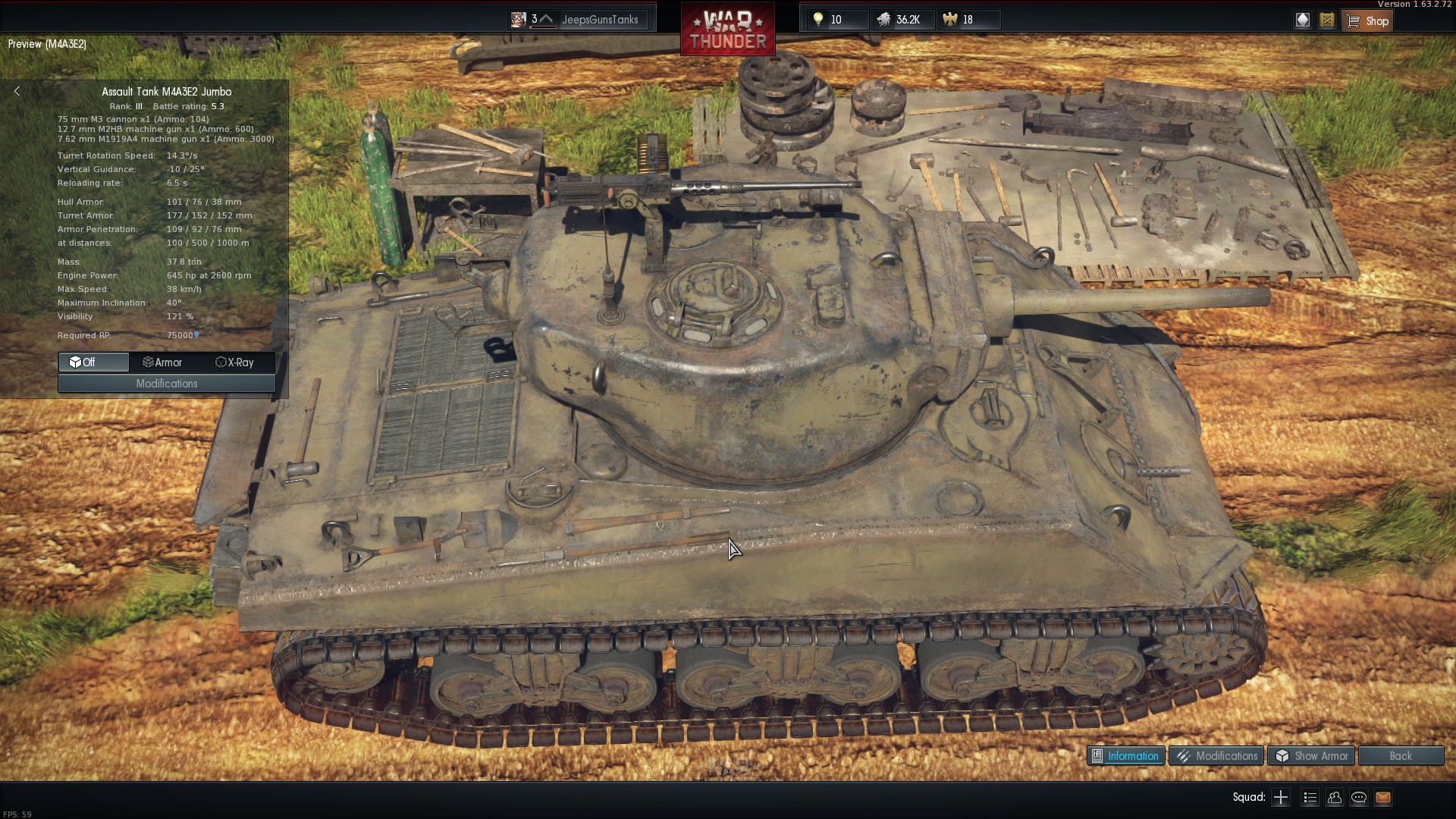
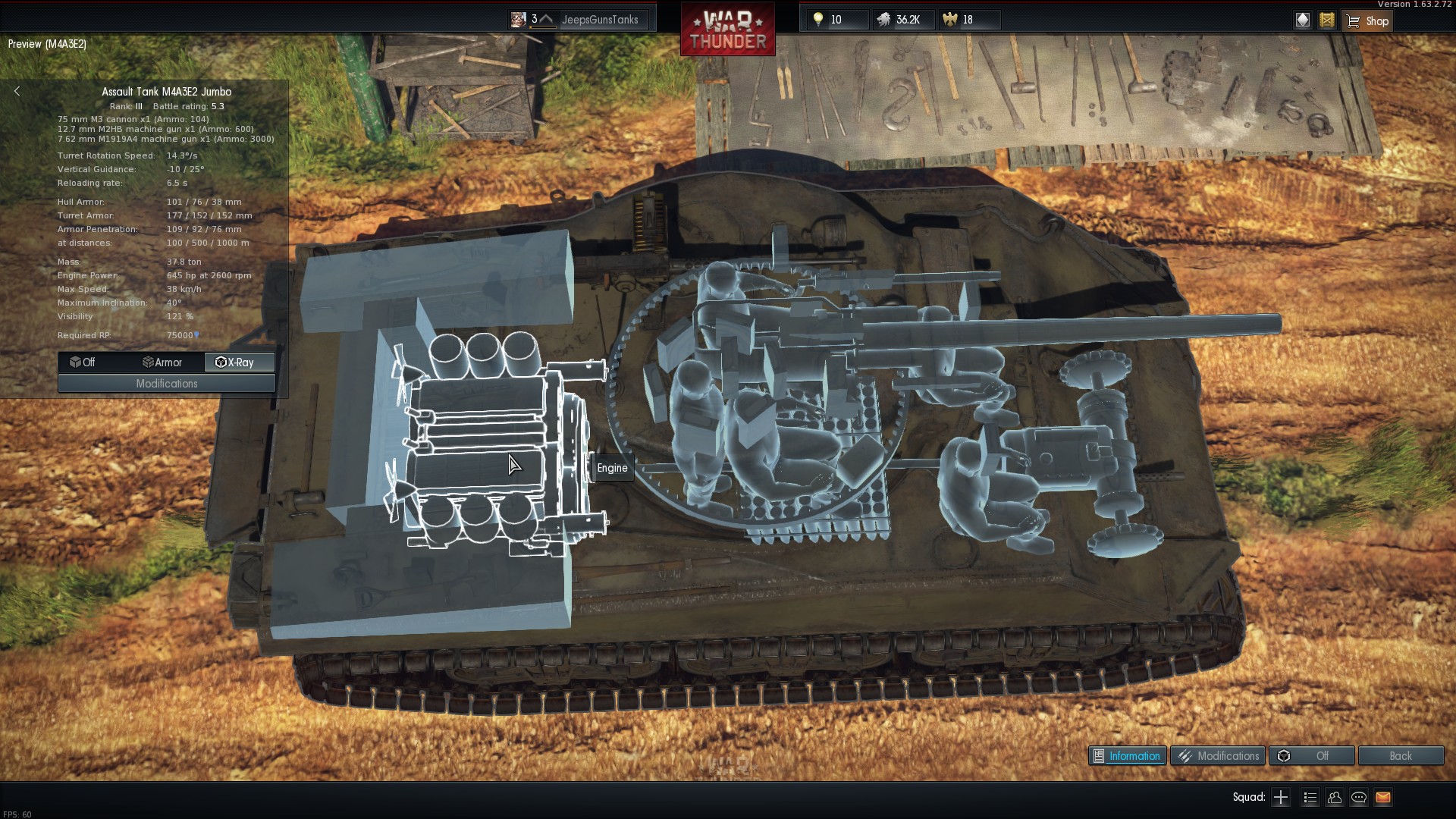
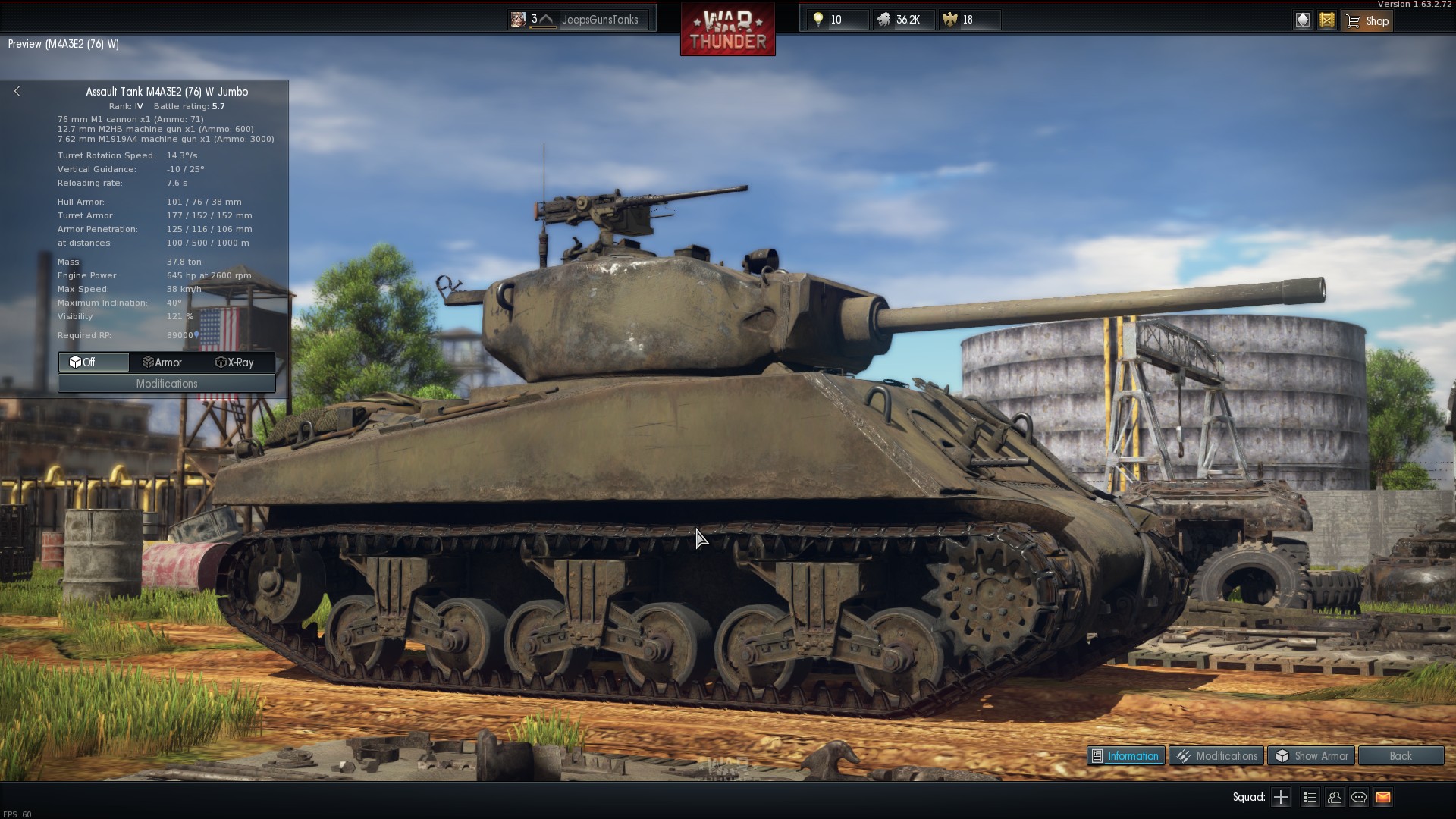
This was the nickname for the M4A3E2 Sherman tank with much heavier armor that was developed late in the war. Click here for more info. 

LCT:

A Landing craft large enough to take one or two tanks ashore, with a ramp in the front. Often operated from a Landing Ship Tank.

LSD:

Landing Ship Dock, is a large ship, that doesn’t land anything directly, but has a large internal well deck that allows the internal loading of landing craft. These ships were a bottleneck in the invasion capacity of the allies.

LST:

The Landing Ship tank is a smallish ship that can carry a large number of tanks or other large vehicles directly to the beach or onto other landing craft. These Ships were not designed to hit beaches during the initial assault, but to deposit large amounts of cargo on already secure beaches. For more info, click here

Large Hatch:

A term used to identify later improved Shermans that had larger hull hatches that made it easier for the driver and co-driver to get in and out. For more info on the this click here

Lifting ring:

A large ring cast or welded into the hull or turret of a tank to lift it or a large part of it. For more info on this subject, click here This link takes you to the Sherman Minutia site.

Low Bustle:

A term used for early Sherman turrets that had the low bustle, most Sherman turrets produced had the low bustle design, and it could even be modified slightly to work fine on large hatch hull tanks, they just to a small notch out of the bottom of the bustle armor.  For More info, click here

M1A1/A2:

The main gun of the later 76mm armed Shermans. For more info on this gun click here.

M3 75mm:

The main gun of early 75mm Shermans.For more info on this gun click here.

M3 90mm:

The main gun of the M26 Pershing and M36 TD.For more info on this gun click here.

Periscope:

A device that used mirrors that allowed the crew to look outside the tank from inside, with no exposure. The Sherman had a lot of these for the crew, and as the tank was improved more were added. The Shermans used replaceable heads and could be raised and lowered, rotated in some cases and pivoted up and down. Every crew member had at least one. For more info, click here

Periscope housing/hatch:

The housing the periscope fit into, with a small armored flap to cover the hole when the periscope was removed. For more info, click here

Pistol Port:

The armored port on the side of many 75mm Sherman turrets and all 76 T23 based turrets. It could be used to fire small arms out of, drop grenades, or throw out garbage, or shell casings. It also let in light and fresh air when things were not hairy. At some point it was decided the port in the 75mm turrets was a weak spot, and it was removed from the casting. After much complaining from the field, it was put back in, but almost a years’ worth of Sherman production didn’t have them. For More info, click here

Power Take Off:

This means power take off, a mechanical port on the transmission, transfer case or motor that can be used to power other things off power of the main device. Often used for things like winches, the Germans used PTO from a transfer case to power the turret drive on several of the big cats. The Shermans Ford GAA used a form of PTO to power many of the engines accessories, but its turret drive was hydroelectric or electric drive.

R975:

The Sherman tank motor that started life as a Wright Aircraft motor, and was then licensed to Continental, and improved by them for use as a vehicle motor and it wasn’t bad. This radial motor was reliable, powerful for its weight, ran on standard grade gas, and was the Army choice motor until the GAA arrived and got reliable. For more information on this motor, see this post!

Registration Number:

The number on the tank that the government used to keep track of the steel beast, this number is key to figuring out the tanks manufacturing date, so if you run into a Sherman, jot it down and email it to the Sherman minutia site.

Remanufactured:

Many Shermans were rebuilt after being worn out in training. The remanufacturing process updated the tanks to the latest standards and returned them to new condition, so they could be re-issued to troops. Most existing Shermans have been remanufactured at least once, and many three or four times. This is why the serial number is important to figure out how it was produced.

Rotor:

The base of the main gun, a delicate area, and easy to damage even by small arms fire.

Rotor Shield:

The armor that covers the rotor, on early Shermans it was small and stubby, later it covered the face of the turret, when the telescopic site was added to the tanks. Armor could be added to the early stubby rotor shields, to cover the scope and the barrel of the co-ax mg, and these can be identified by the weld lines, later factory rotor shields are one large casting.

Track Block:

The part of the track that supports the tanks weight, a large number of these, 80 plus depending on the model of tank, held together with pins, and end connectors make up a track run.  For more information about the suspension and tracks see this post

Turret drive:

The system used to rotate the Sherman. Most tanks had at least manual gears to do this and many had a powered system. The best of these systems, like the preferred units in the Sherman used a powerful electric motor to power a hydraulic pump, which ran hydraulic motor to spin the turret at varying speeds. The Sherman had three types that could be found installed in various models, two combination hydraulic electric, and one pure electric. If you are bad at tank design, like the Germans, you use PTO or power take off, to power your turret drive.

Small Hatch:

This is used to refer to early Shermans that had the smaller drivers and co-drivers hatches along with hood bulges. The switch from small to large hatches was one of the major changes in Sherman production. For more info on the this click here

Splash Guard:

Welded or cast in sections of armor placed to protect things like the periscopes, turret ring, and gas cop covers. The type of splash guards found on a Sherman can help identify what factory made the tank.

Sponson:

The portion of a tanks hull found above the tracks, a feature done away with on most modern designs, including the follow on to the Sherman, the M26.

Stabilizer:

A system installed on the main gun that held the gun in the same vertical position as the tank moved. Modern systems allow a tank to shoot very accurately on the move. The Sherman’s system did not, but, it did let a crew who knew how to use it, get the get sited in after coming to a stop much faster than a tank that did not. It would also allow the tank to engage area and building size targets while on the move.  All American medium tanks from the M3 Lee, (both guns) to the Sherman and M26 had stabilizers. No German tanks had them, German tank technology was just too far behind the curve, and they didn’t even have prototypes versions.

Sturgeon House:

An information based forum that this whole thing started on as a thread. The thread is still there, and I still post all articles there first, for discussion before I post them on the web site.

VVSS:

The early narrow Sherman suspension, it stands for Vertical Volute Spring Suspension. There were four major versions of this suspension. For more information about the suspension see this post

Wehraboo:

A term a group of frustrated history buffs from all walks of life came up with, though the actual word was made up by the Sturgeon of Sturgeon House, to describe a person obsessed with the supposed superiority of WWII German technology. I was pushing for Panzerfile, but wehraboo stuck, and I’m fine with it. The word has its origins in weaboo the slang people came up with for the person into Japanese anime or culture in the same way.

If you have ever posted to a History based forum, or a game forum for a game based in WWII, you’ve dealt with this guy. He’s the guy that thinks the Tiger II was never penetrated in combat, and when shown otherwise denies it. He’s the guy that is convinced the German army played no part in the Holocaust and was made up of honorable white Knights, saving Europe from the evil red hoards and communism. They are the guys that whine about the rape of German women by the soviets, but deny that the German armed forces raped and murdered their way all the way across Russia, waging a horrific war of genocide not just against the Jews, but all Russians! The worst of these guys are borderline holocaust and war crime deniers, and will always try and defend the honor of the German soldier by pointing out every atrocity they can find committed by the allies.

In a small part the wehraboo inspired me to put this site up. The Wehraboos have control of much of Wiki, they have sites like Attention Tiger and other websites dedicated to glorifying Nazis and their equipment, with little worry about the actual truth. Most gaming forums are overrun with them, and they are so vocal, and often been around so long, and in some cases are the moderators, getting the truth out is hard. This site is all about the truth about the Sherman.

This word is spreading; there are threads that use it tracking the stupid things wehraboos say on something awful and Reddit. Websites like Archival awareness and even the World of tanks website help crush the myths these guys cling to. So go forth and use the word, use it to label the nasty people who glorify Nazis equipment. These are not the people who are interested in the equipment, and history, if they are looking for the

Wet Storage:

Late model Shermans had the ammunition storage moved to the floor of the hull and encased in water jackets filled with basically coolant. Not all large hatch hull tanks got wet ammo racks, the large hatch composite hulls and large hatch M4A2 75mm tanks still had dry racks, as did all 105 tanks.

WOT:

World of Tanks, the best tank Arcade game on the market, yes, even now. You can find a review here

WT:

The poorly done, but pretty copy of WOT that includes airplanes.

#59 Subjugated Shermans: Shermans in Nazi hands

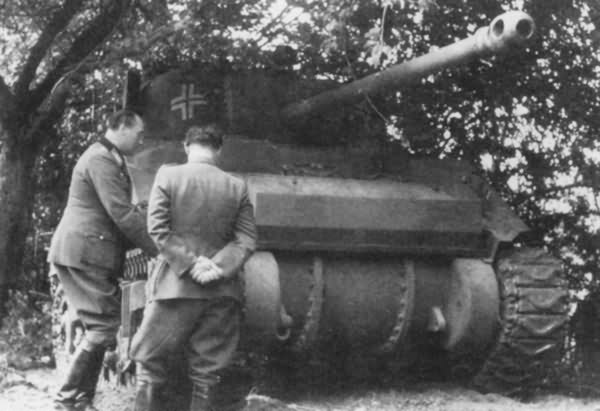
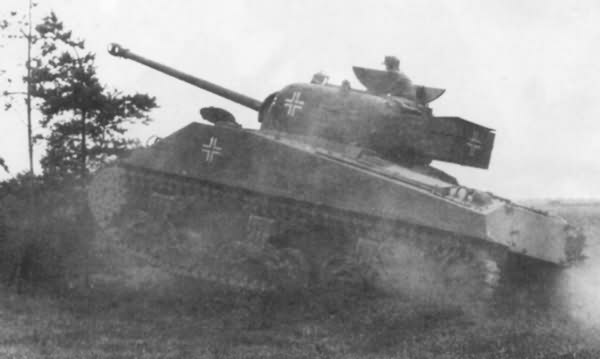
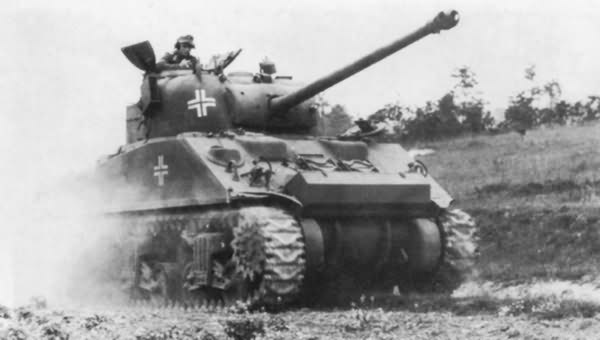
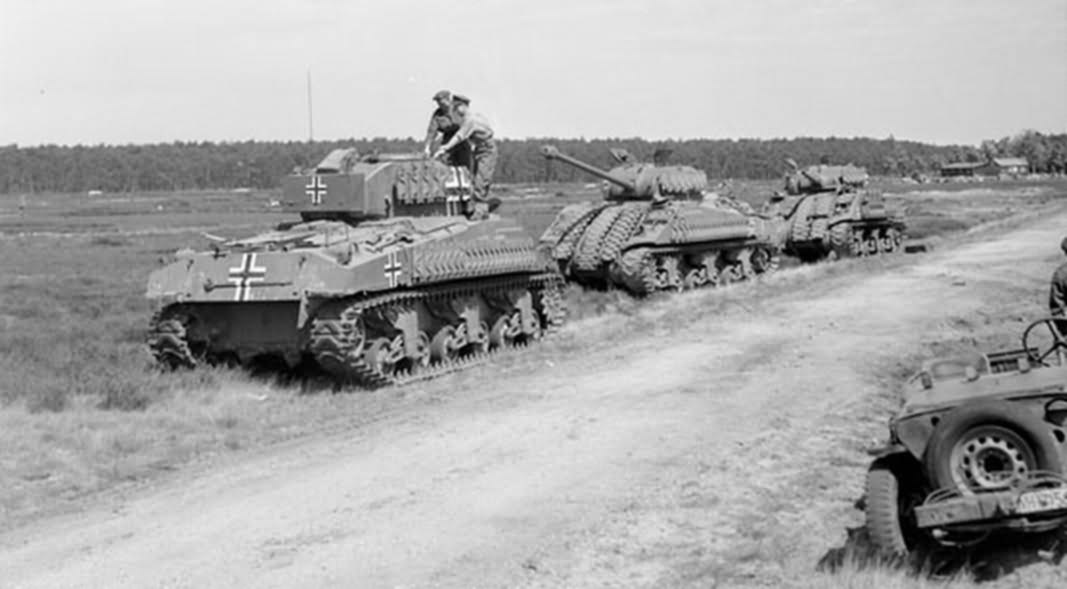
Subjugated Shermans:  Sherman tanks captured and used by the Nazis

Updated 9/23/18

M4A1, and M3 Lee in Nazi hands
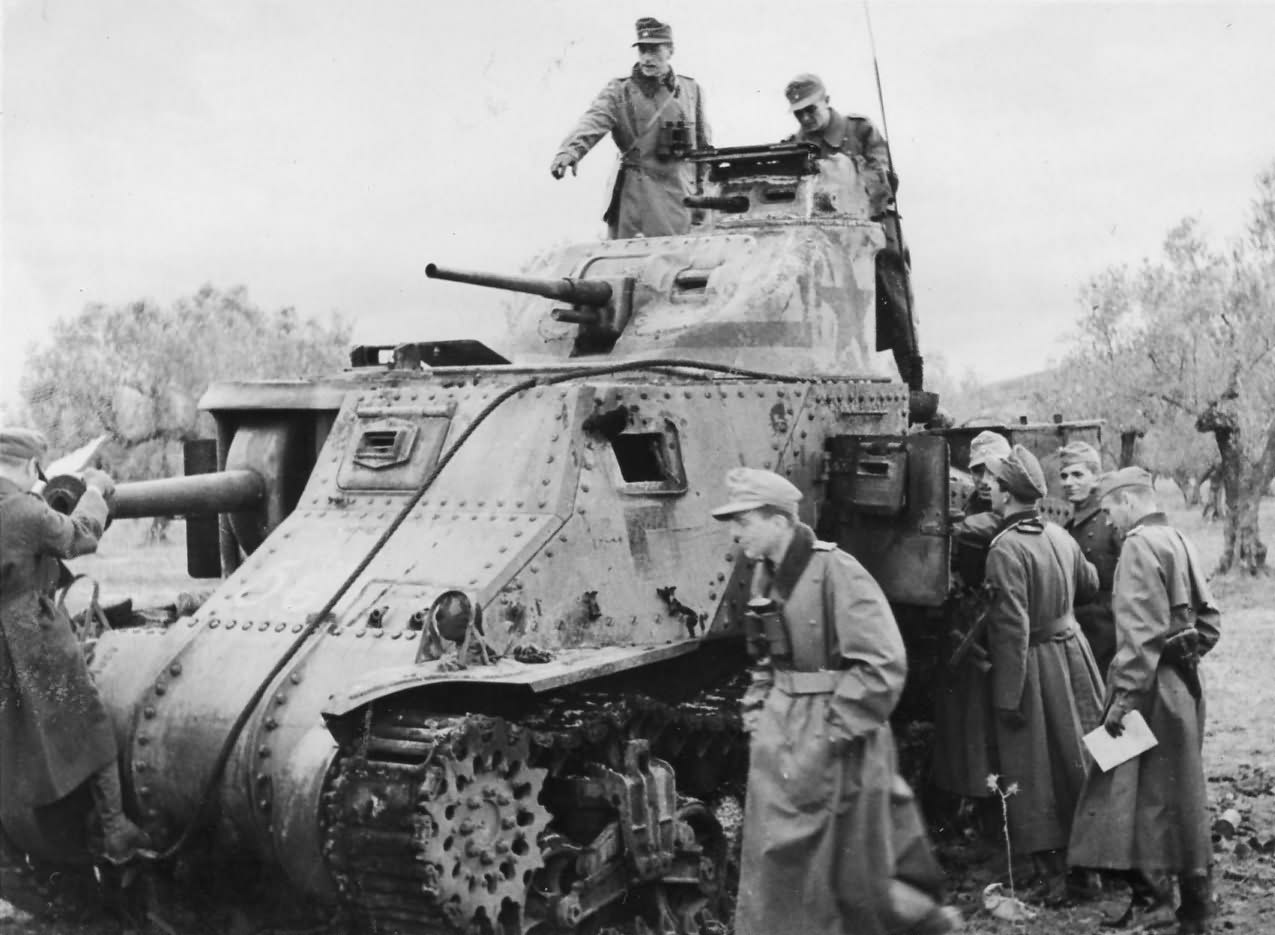
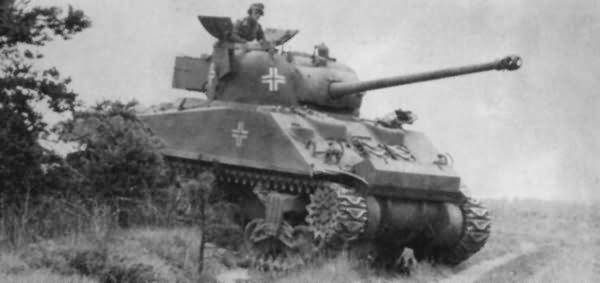
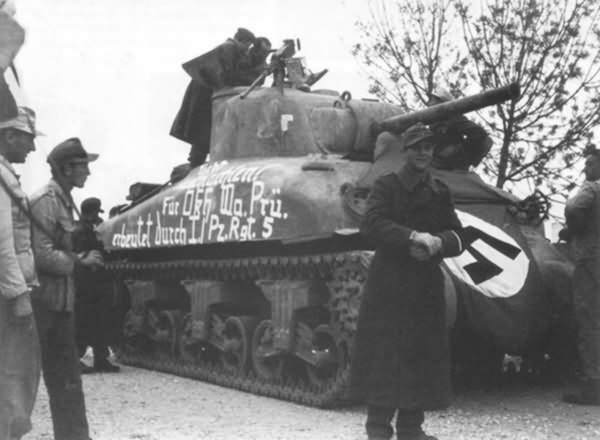
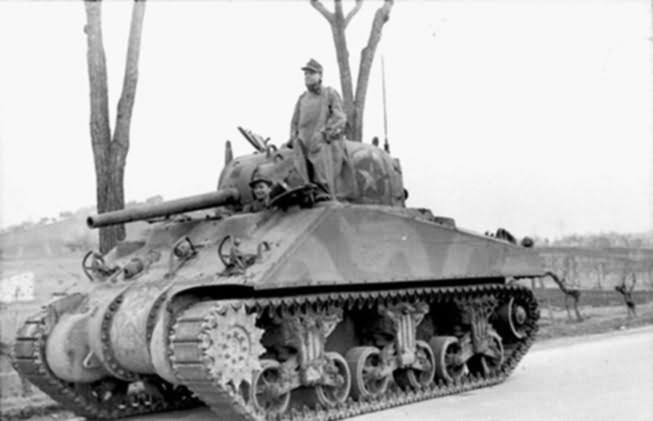
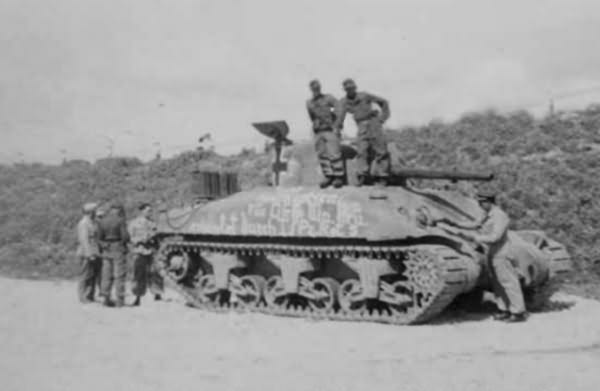
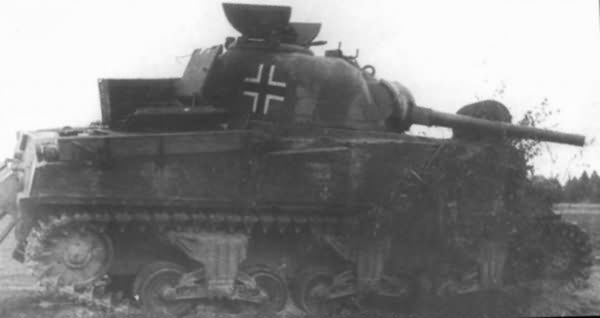
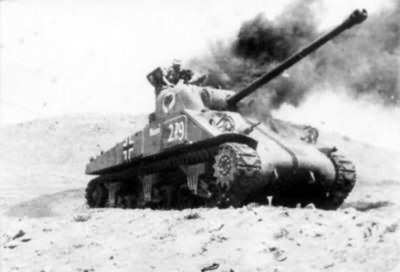
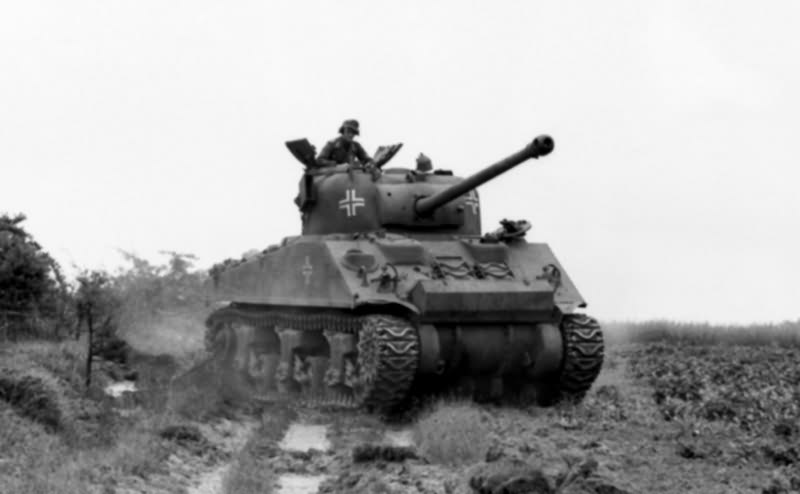
1. This early production M4A1 75 tank has DV ports, and the stubby mantlet. it was captured from the 1st Armored Regiment of the First Armored Division of the US army, in Tunisia in 1943 and is being tested in Germany at Kummersdorf. Note the armor thickness and angle stenciled on the tank, the Germans were giving it an extensive workout during their testing. The tank was named War Daddy II. I think the most interesting part of this photo is the two Germans on the tank. Look at their faces, they look so sad, they were probably really depressed the allies had such a great tank, and they were stuck with the junk they were issued. 

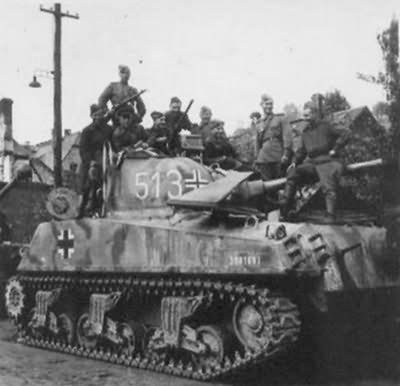
Sometimes a tank crew can get spooked and bail out of a functional tank. Or a tank can be left disabled on the battlefield and be repaired by the bad guys. The Germans were so desperate for tanks they happily used any Shermans they captured, and unlike the T-34 they didn’t feel the need to modify the tank in any way. The Germans managed to capture Shermans from the Russians, UK, and Americans. The Japanese never captured an intact Sherman. I don’t think the Italians managed to capture one either.

Depending on the crew quality, little things can cause them to abandon the tank, and it seems to be a universal problem since I’ve read of just about all of the warring nations having crews bail out from fright when the tank had sustained only minor or cosmetic damage.  In other cases, the tank takes real damage, like a lost track, an engine problem or a hit that took out an internal fixture, but an experienced crew might stay in the tank.  The crew has a duty to destroy the tank before leaving it behind. There is a whole procedure covering how to do it, and what to destroy if you only have a short amount of time, including many methods.  The methods range from blowing the tank up with special grenades to just destroying the machine guns, main gun, and radios.  This is covered in FM17-67 Crew Drill and Service of the Piece Medium Tank M4 Series.

There are many reasons why a crew might not be able to destroy their tank. If the crew is killed as they bailed out or after, or captured, if they are under fire while they get out, the tank falling into enemy hands isn’t going to be on a soldier’s mind in most cases. In some cases, the green crews could panic and bailout, and not bother even checking the tank over heading for the rear, but this was not a common thing for American tank crews once North Africa was done.  I’ve read of many cases of German crews just leaving the tank, hatches all open, without booby traps and walking off when their Panther inevitably broke down or ran out of gas. I’ve read cases of them bailing out after the tank was hit a few times but still technically functional. Unlike for the American and Allied tankers in General, as the war went on, German tanks, like all their troops, declined in quality, and by late 44 Tank crews got very little training in their vehicles.

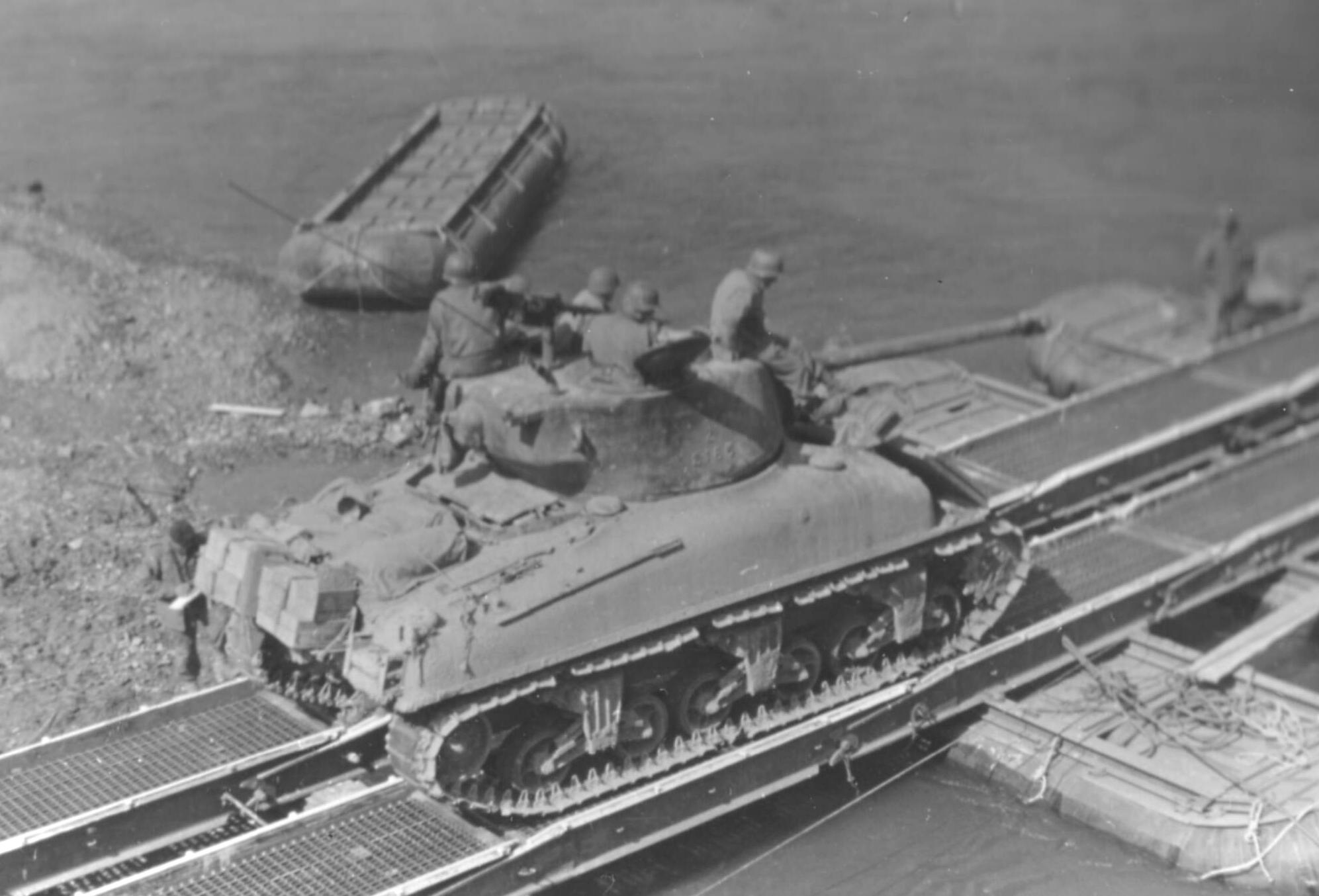
The Sherman was an automotive masterpiece the Germans could only dream of producing, they were still capable of keeping them running, it was that good. A German tank mechanic would find even the A57 a breath of fresh air in ease of troubleshooting and reliability. They also liked to use the captured Shermans as ARVs, often with the turrets removed. Having a very tough powertrain and a reliable and robust motor is a very nice thing in an Armored Recovery Vehicle, and the Shermans were just that. It must have been terribly frustrating for the Germans to get a Bergepather in place to try and tow a broken down Panther, only to have it break down too!

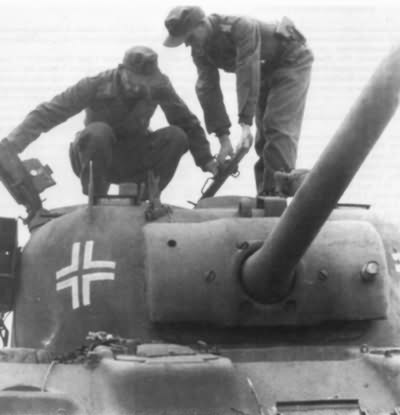
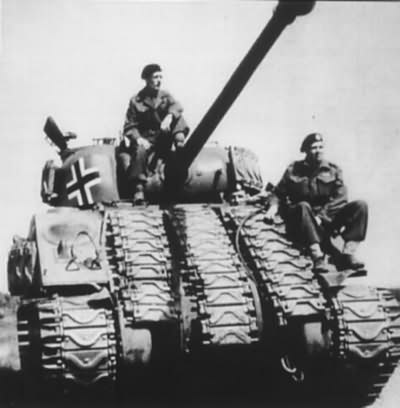
Now onto the photos, sorry, but the Germans seem to be as bad at photography, at least of captured Shermans, as they are at tank design, so many of the images are small and blurry. The captions have been updated in great extent to the efforts of Roy Chow, who sent in a very nice comment correcting my many mistakes.  Thanks again, Roy!

German_M4_Sherman_and_crew
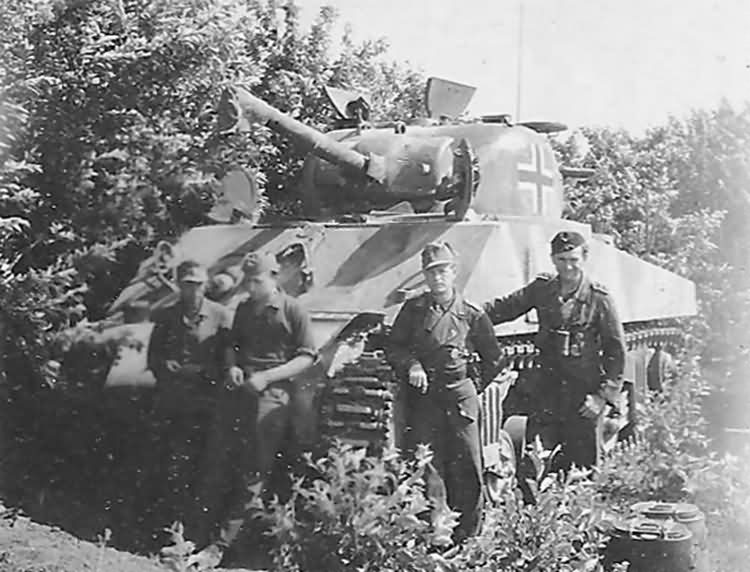
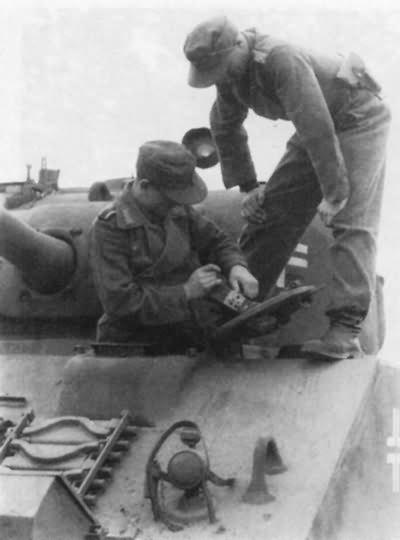
2. An M4A2 75 dry, large hatch Sherman, this was a very late production 75mm tank, near the end of the run. Note the armored patches on the hull, it has the large hatch hull but still had the dry ammo racks. The crew looks pretty pleased with their tank, it was more reliable, got better gas mileage and was more comfortable than the Panzer III or IV that were stuck in before. This tank even has a loaders hatch.
m3_lee_10
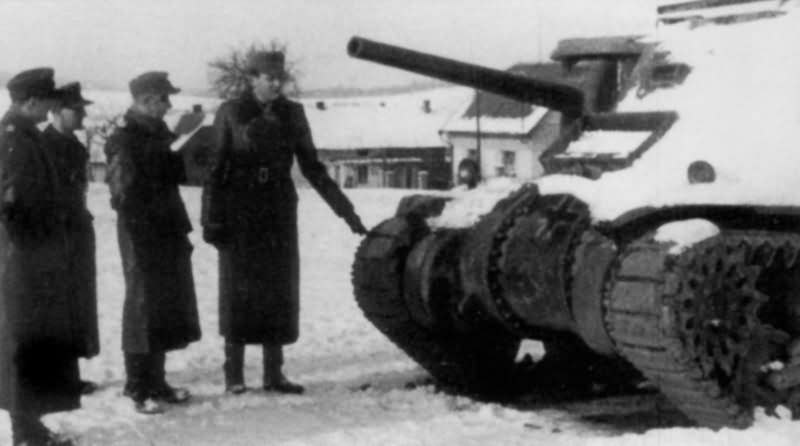
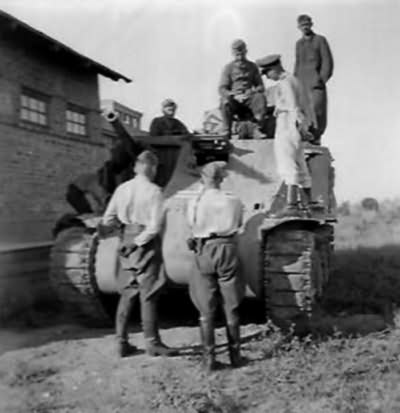
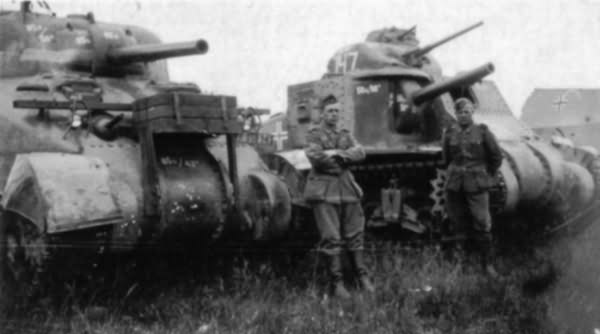
3. Germans looking at a captured Lee they got to crew and ‘probably’ wondering why their nation couldn’t produce a tank as reliable as this one. Though to tell the truth, the main tanks of Germany were still the PIII and IV at that time, and these tanks were decently reliable, though not on par with the M3/M4 series. They were not giant RVs of Death, like the Lee, so not as cool. 
m3_lee_07
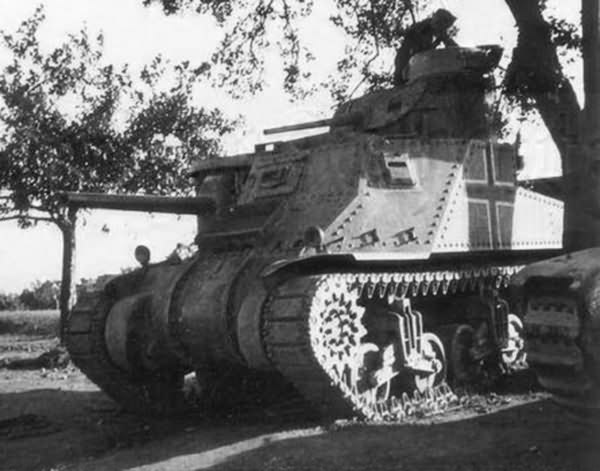
4. This M3 Lee is the same one as pictured in image 3.  Note the lack of side door, meaning this was a later production Lee tank. Like all things American of WWII origin, the Lee saw lots of production changes to improve the design, and they got put into the production line as long as it didn’t slow the line down. 
m3_lee_06
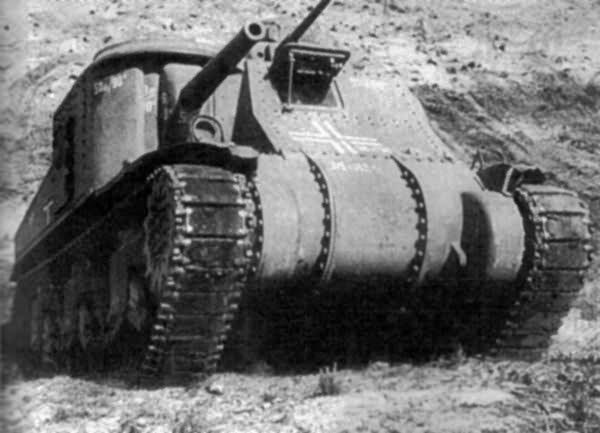
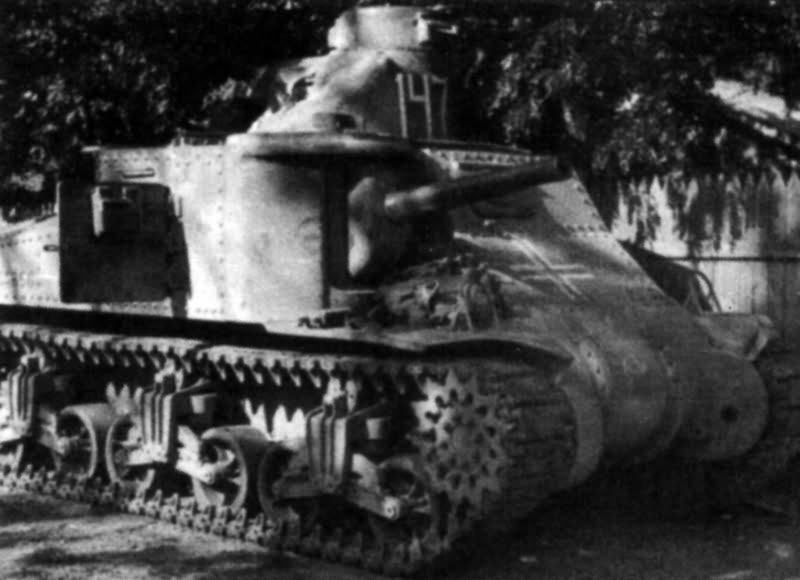
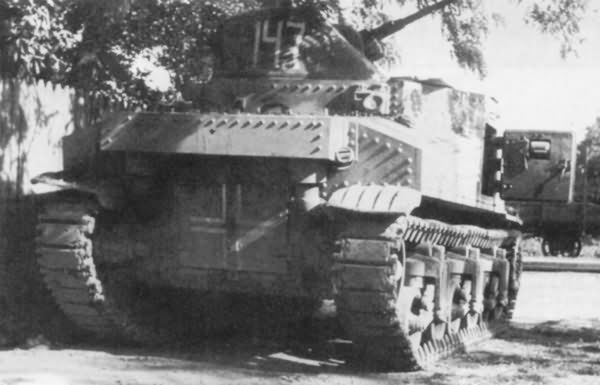
5. An M3 Lee being tested by the Germans at kummersdorf.  This tank has 147 painted on the side of the turret. The next six images are all of  M3 Lee 147.
m3_lee_15
6. Another shot of 147, it appears to have an M3 gun.
m3_lee_09
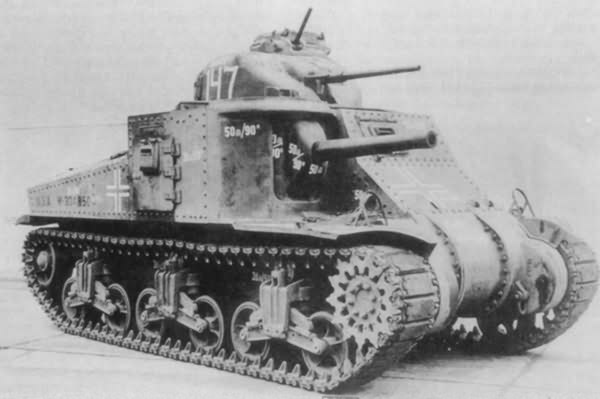
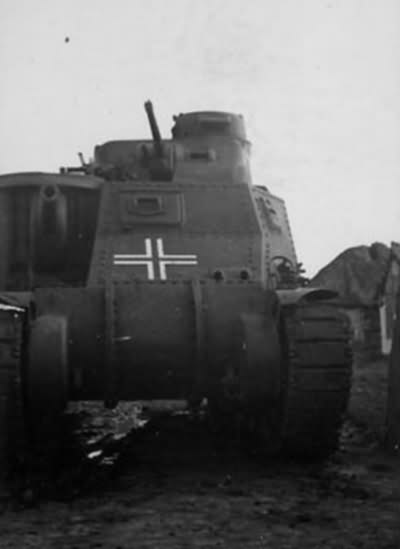
7. In this shot, we can see it’s a fairly early Lee, it has the Machine gun portholes in the front hull, and the 37mm gun lacks the stabilizer counterweight. The main gun is an M3, not the earlier M2 though.
m3_lee_16
8. Another blurry shot of  Lee 147
m3_lee_03
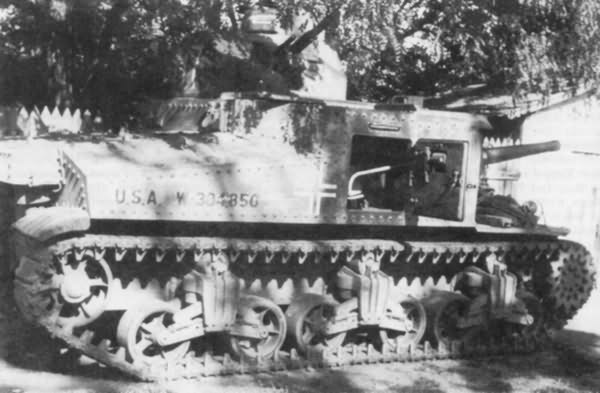
9. Another blurry shot of 147, this time from the side, the Germans seem to be keeping it clean and well maintained.
m3_lee_04
10. Maybe the best shot of 147, you can make out the lack of counterweight on the 37 ( it looks like another .30 barrel under the 37 when it’s there)
m3_lee_02
11. Three shots of the same captured M3 Lee, lend-lease tank, in Nazi hands.
m3_lee_11
12. Cross shape and general layout say this is 147 again, but no way to tell for sure.
m3_lee_05
13. Here is 147 again, with War Daddy II the M4A1 from the first image in this post, in the testing field at Kummersdorf,  the German Army Proving grounds.  I’d love to know what all that junk on the front of War Daddy II is.
m3_lee_13
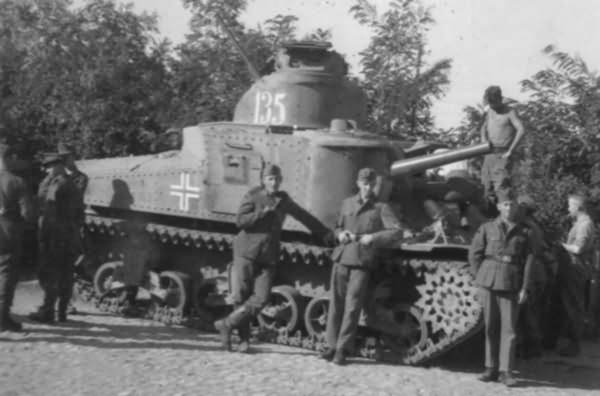
14. A Soviet M3 Lee lend-lease tank in the hands of the Nazis, who were clearly more than willing to use a tank with a decent gun that was reliable. This tank has 135 on the turret, does this mean 147 could have been a captured Soviet Lee?
M3_Lee_captured_in_Tunisia_DAK_Afrika_Korps (1)
15. Nazis marveling over the advanced M3 Lee tank. This was probably the first time they had seen a stabilized 37mm gun (note the machine gun barrel like thing under the 37mm gun). This tank also had a stabilized 75mm M2 gun. The Germans never managed to get a stabilizer in a tank during the war. The star and band on the turret lead me to believe this is a knocked out US tank.
m4_sherman_firefly-06
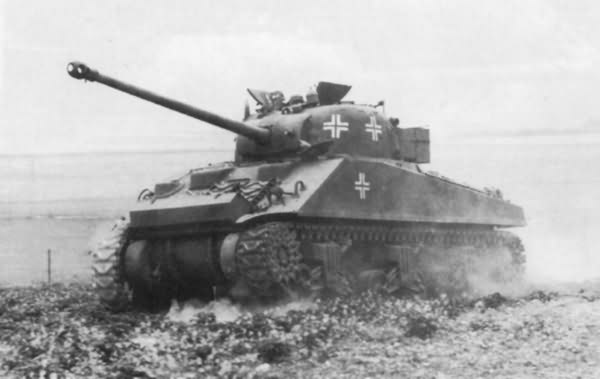
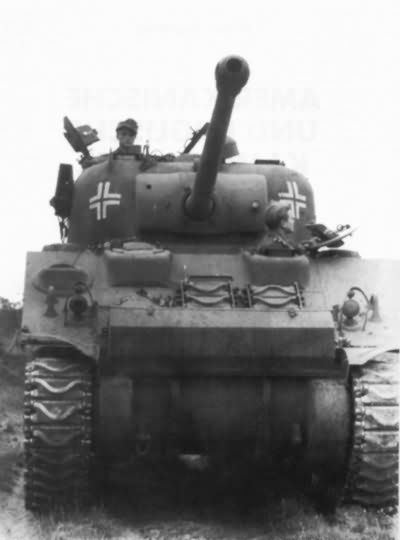
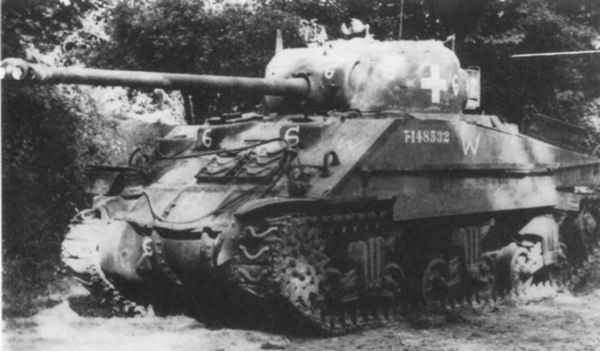
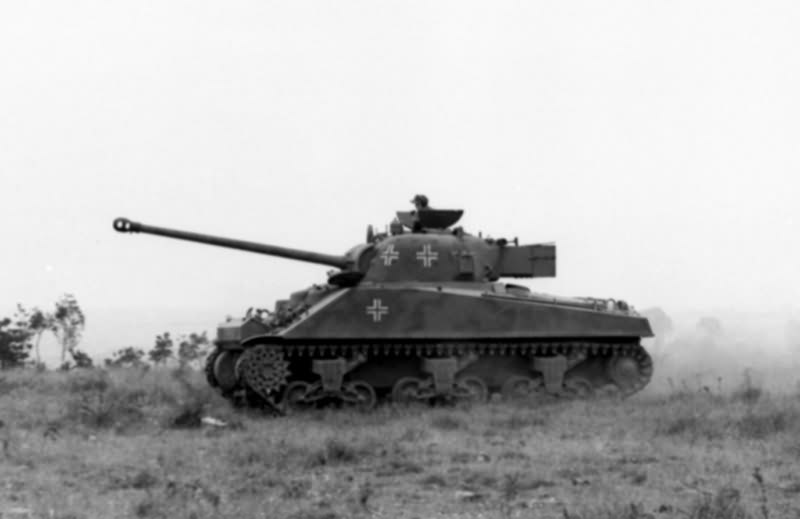
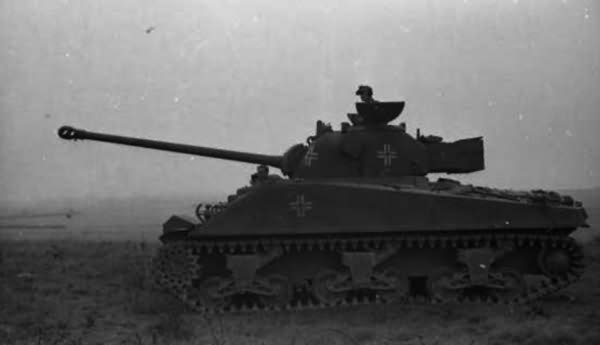
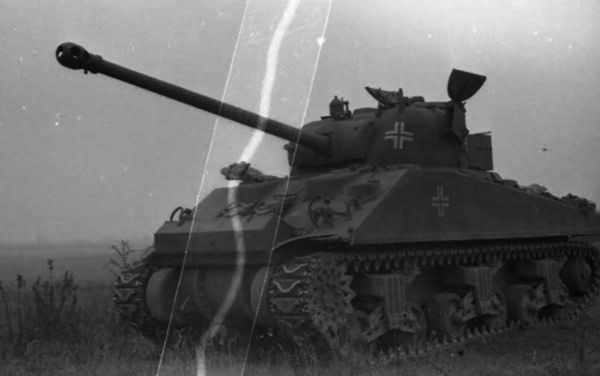
16. The Germans sure did like to take pictures of Shermans at just the right angle to make it really hard to tell what model it was. Thanks, Nazis. Anyway, this tank was photographed a lot and is a Firefly Vc.
m4_destroyed
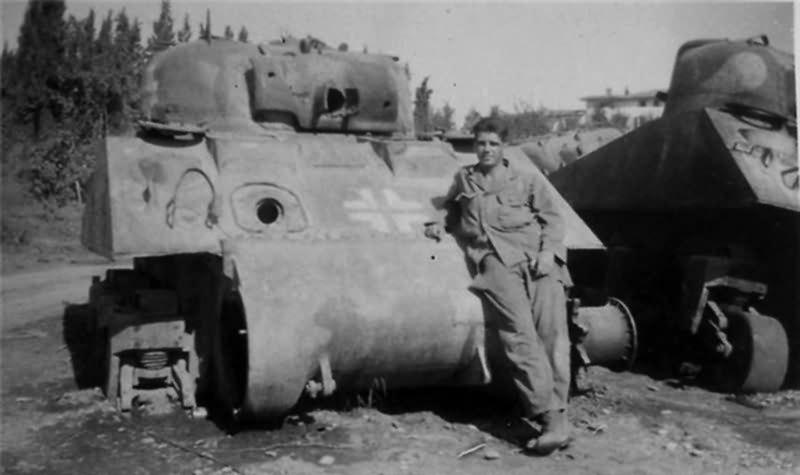
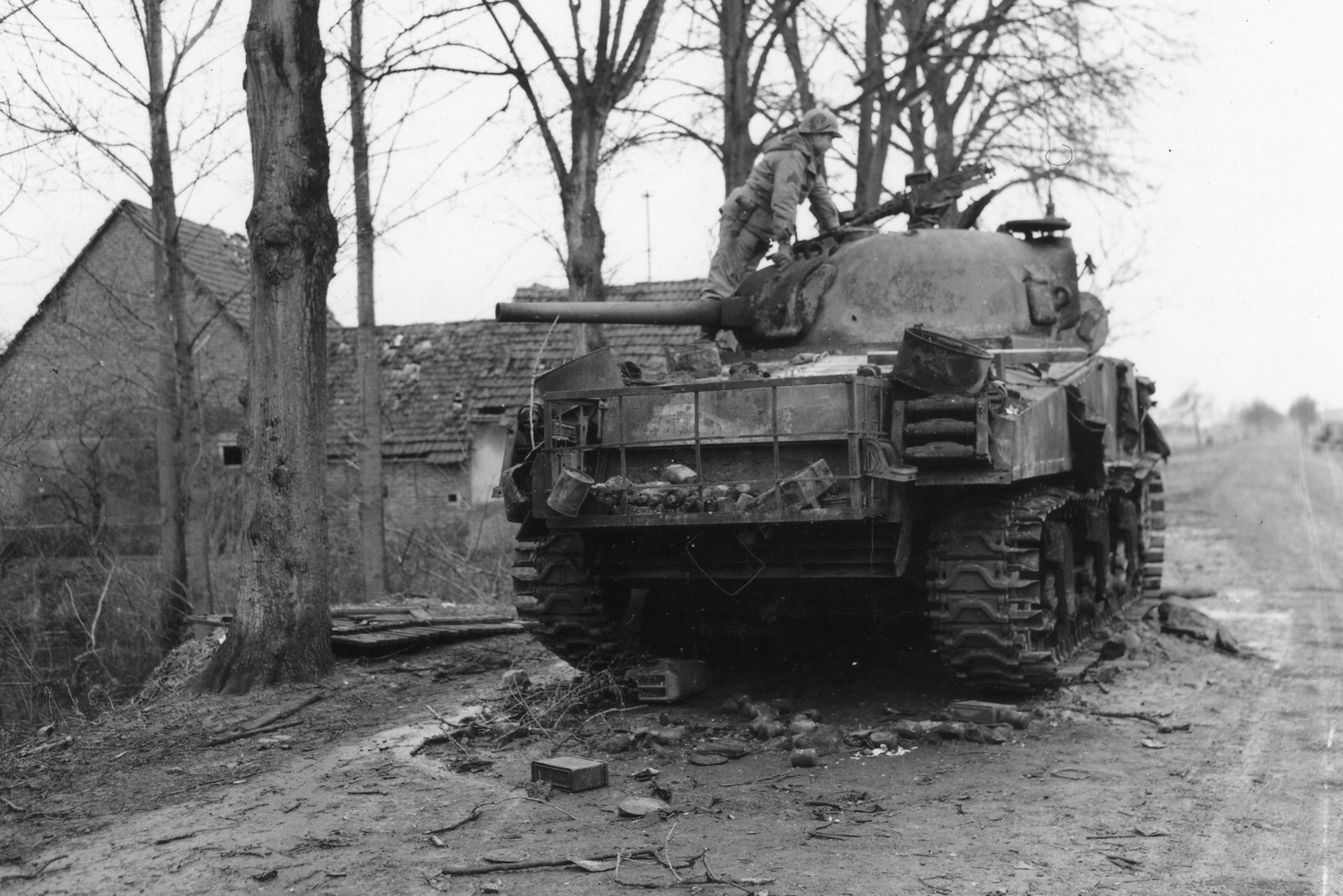
17. An M4 tank that the Nazis had been using, knocked out and back in American hands.
m4_sherman_firefly-04
18. A Firefly Vc in use by the Nazis, this is the same tank as in image 16. This is a pretty good image and shows the box normally mounted on the rear hull, mounted to the front on this tank, that and the cross placement make spotting it easier. It does not appear to have received any of the add-on armor over the ammo racks on a thin spot in the turret cheek.
m4_sherman_firefly-12
19. Same tank as above, this time on the move, only the driver and commander unbuttoned.
m4_sherman_firefly-11
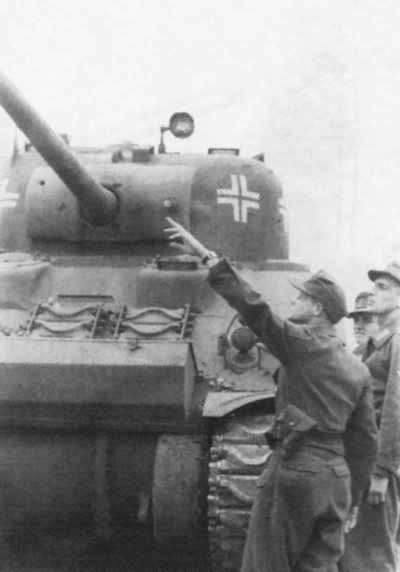
20. A Nazi tanker marveling at the superior design of the American periscope on this Firefly Vc. This is the same tank as above. Note the headlight guard has a bit of a dent in it.
m4_sherman_firefly-21
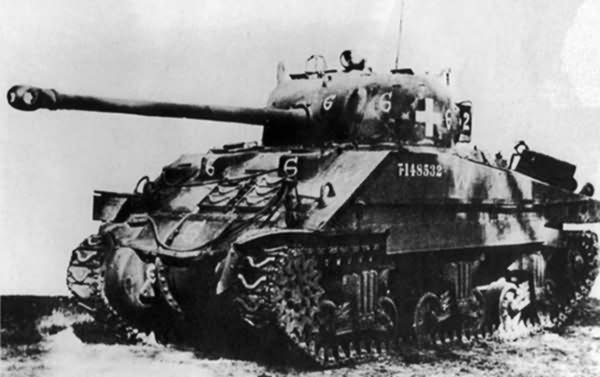
21. A Firefly Vc in Nazi hands. This one appears to be a different tank, from all the previous shots, the cross placement is different, the hull storage box is in the right place, and this one has the number six painted in several places the one from Pic 16 does not have.
m4_sherman-75-03
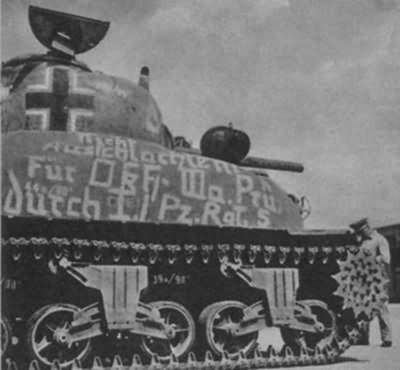
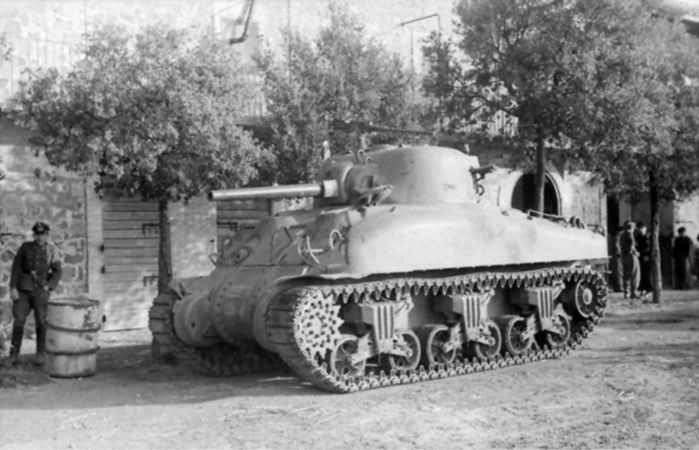
22. Captured M4A1 with writing on the side, the same tank is in the picture below. This tank is a mid-production small hatch tank.
m4_sherman-75-04
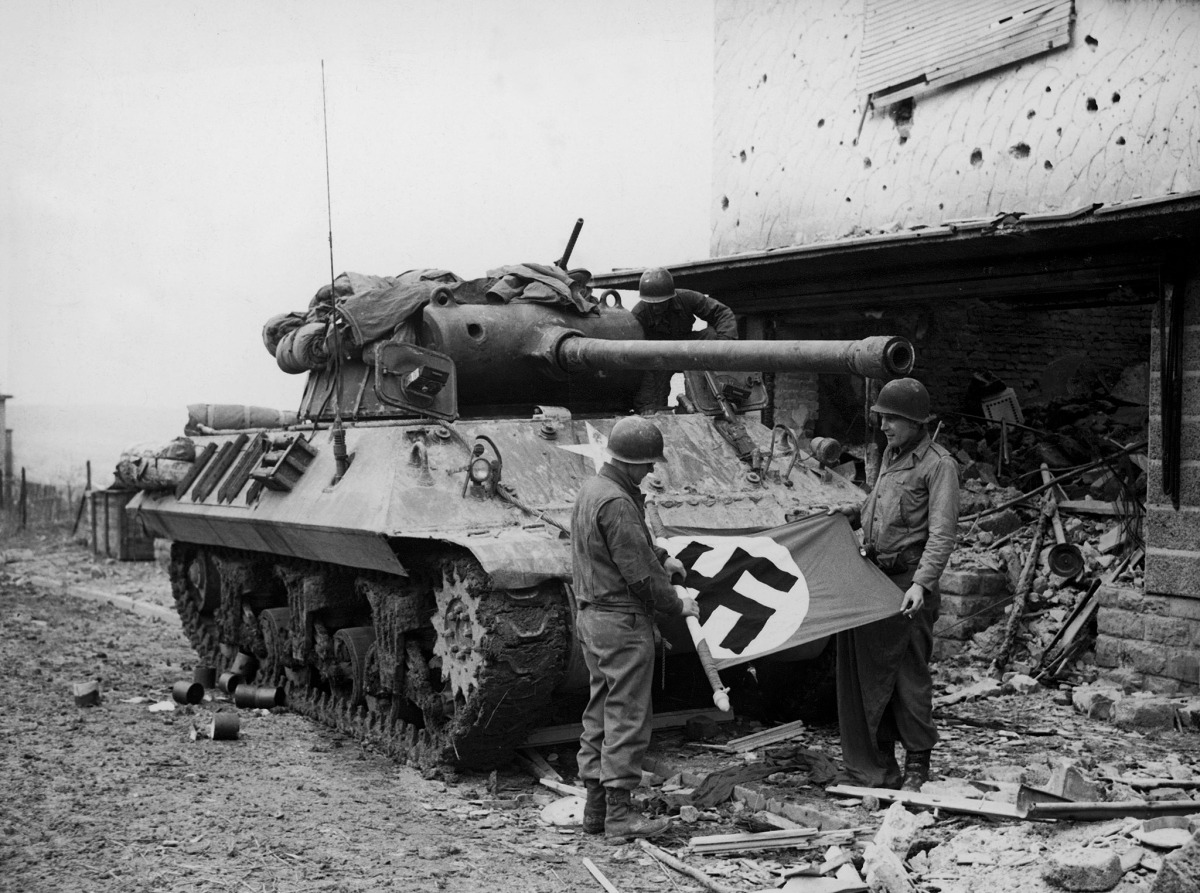
23. An M4A1 in the hands of the Nazis, with a Nazi flag soiling its front plate, if tanks had souls, this one would be crying out in pain for being subjugated by the Nazis! note the shorty gun mantlet meaning this M4A1 still only had a periscope main gun sight.
m4_sherman-76-01
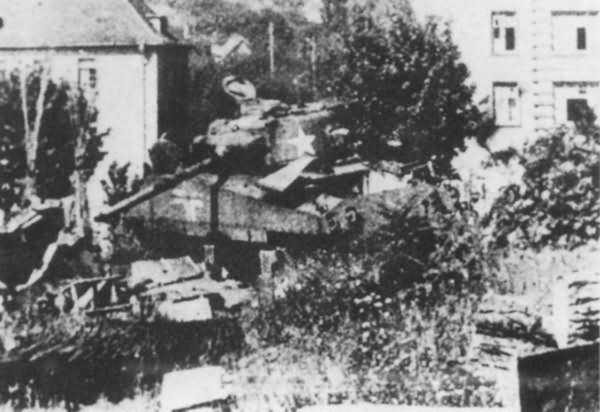
24. An M4A3 76w tank captured by the Germans and then knocked out, this shot is actually the last in a series of three, the earlier ones can be found further down. (I plan on fixing this).
m4_image002
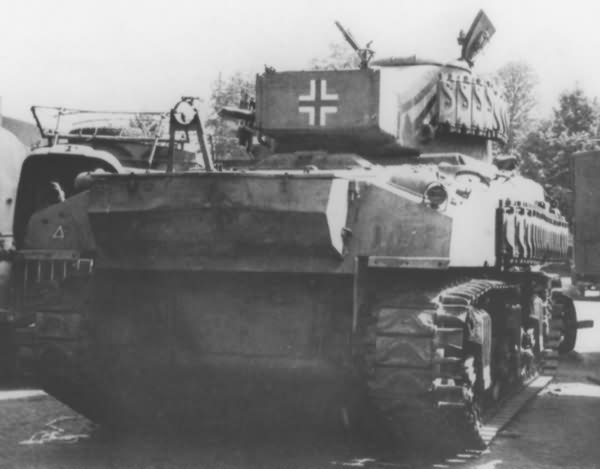
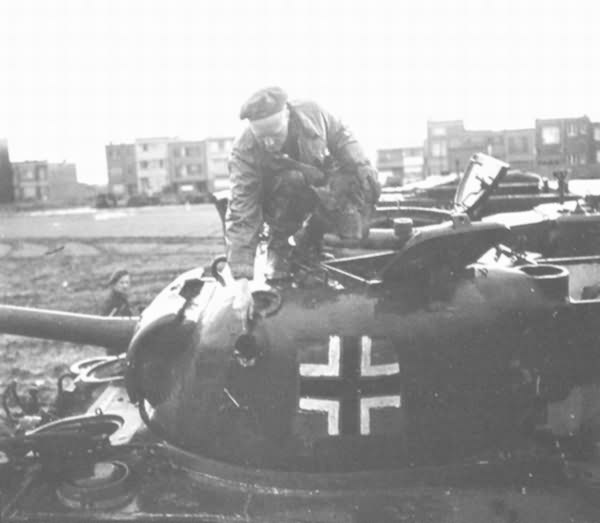
25. A Firefly Vc, see the big bulge behind the turret for the radiator, in Nazi hands. It must have bewildered the Germans a tank with an engine so complicated could actually be reliable! Anyway, thanks to reader Roy Chow, we now know this tank probably belonged to 2cnd Canadian Amd Bde, and was one of three captured by the Nazis, painted Yellow, and put back in action before being recaptured by Commonwealth troops. One of the tanks still survives in the Dutch Cavalry Museum in Amersfoort
m4_sherman_firefly-29
26. A captured Firefly Vc, in use by the Nazis, note a large number of German crosses, they really didn’t want to get friendly fired. This really appears to be the same tank from Image 16.
m4_sherman_firefly-07
27. A captured Firefly Vc with a pair of Nazis in front of it. This appears to be another shot of the Firefly in image 16.
m4_sherman_firefly-08
28. The same old Vc from image 16, you can see the armored box is clearly missing from the rear hull in this shot.
m4_sherman_firefly-05
29. our old pal, the Vc Firefly from image 16.
m4_sherman-75-15
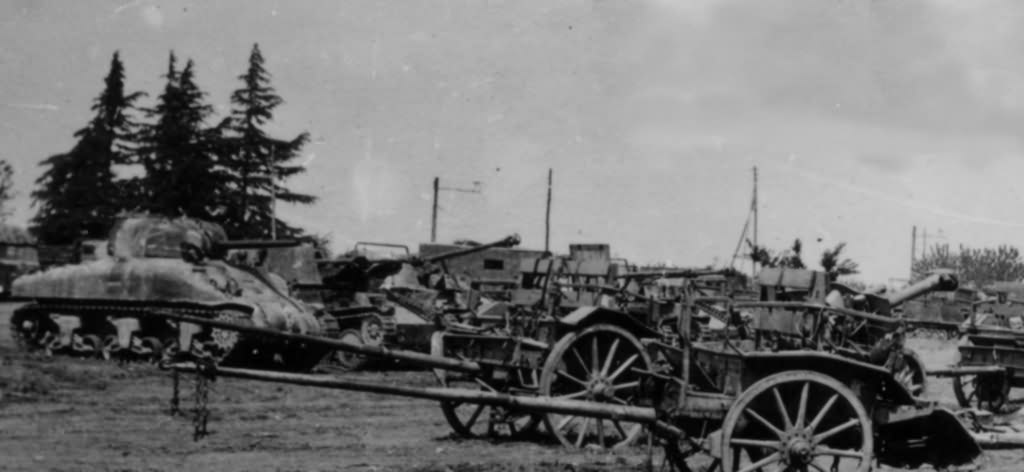
30. A captured M4A1 near a bunch of Nazi horse carts. Yeah, the Germans still depended on horses and horse carts for much of their supply chain. The Nazi was bad at logistics. 
m4_sherman_firefly-27
31. A  shot of a knocked out captured Firefly Ic or Vc, probably a captured Canadian Vc in Holland.
m4_sherman-03
32. AM4A3 76 w tank captured by the Nazis, and then destroyed by the US Army, being inspected by US Army troops
m4_sherman_firefly-20
33. A captured Vc Firefly in Nazi hands. The seems to be the same tank as the one in image 21. This tank is covered in the number six.
m4_sherman-75-00
34. A knocked out M4A2 large hatch tank, captured by the Nazis from the Soviets.
m4_sherman_firefly-31
35. A Vc Firefly in Nazi hands, this one looks like our old pal from image 16
m4_sherman_firefly-09 (1)
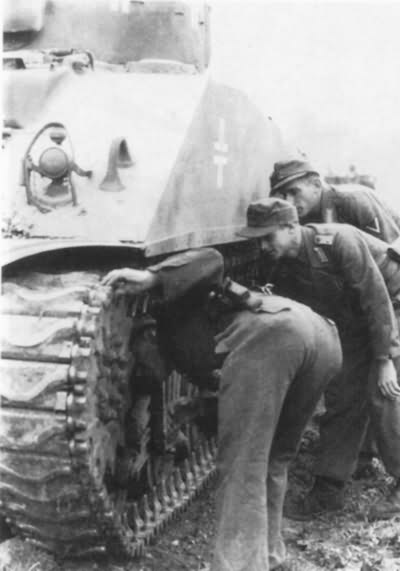
36. Nazi tankers look over the suspension of their Vc Firefly, this is another shot of the Firefly from image 16
m4_sherman_firefly-10
37. A captured Vc Firefly with Nazis looking at it. Image 16 strikes again.
m4_sherman_firefly-23
38. An Ic Firefly being used as a movie prop
m4_sherman_firefly-30
39. The Germans sure seem to have a lot of captured Firefly tanks, well, as Roy pointed out, not really, they just took a lot of photos of the same firefly from Image 16.
m4_sherman_firefly-32
40. This image has been flipped, you can see the armored plug and commanders hatches on the wrong side on this Vc Firefly. I’m betting it’s the same tank from image 16.
m4_sherman_firefly-28
41. This one is either an Ic or Vc Firefly in Nazi hands. I can’t tell on the wheel spacing at this angle. This seems to be the same tank as the one from images 21 and 33.
m4_image001f
42. A captured M4A1 75 tank. This is an interesting tank, an M4A1 with an updated hull with the DV ports removed, with three piece diff cover, and a turret with the short mantlet, but also later suspension.
m4_image003
43. An M4 in Nazi use.


m4_image004
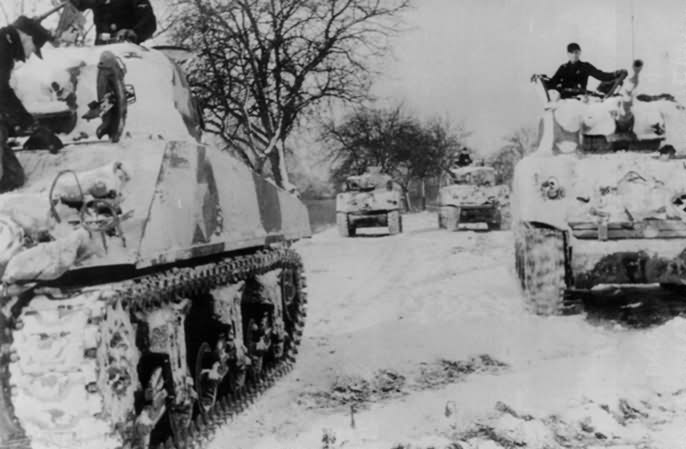
44. A late production M4A3 75w  and three other Shermans in Nazi hands, the two furthest right appear to be M4A1 75s. Tanks captured during the Battle of the Bulge? (I was super wrong on this caption)
m4_sherman-76-02
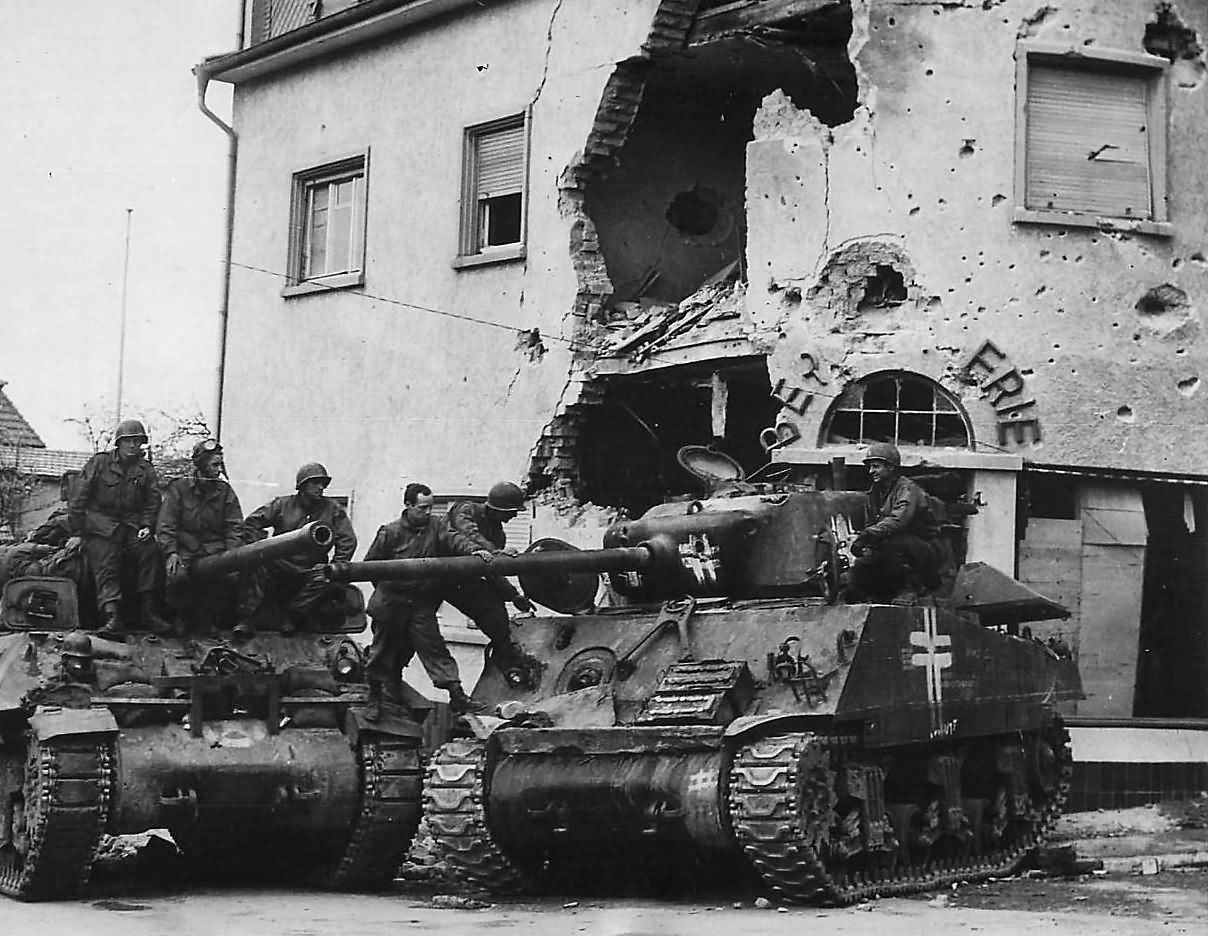
45. A captured and knocked out M4A3 76w with a dead German on the front of the hull. This shot was taken shortly after it was knocked out, this is the same tank as the M4A3 76 in image 24. This tank belonged to the 4th AD before capture and was being used by the Germans in the defense of the town of Aschaffenburg. It was taken out by a US M36  TD.
m4_sherman-01
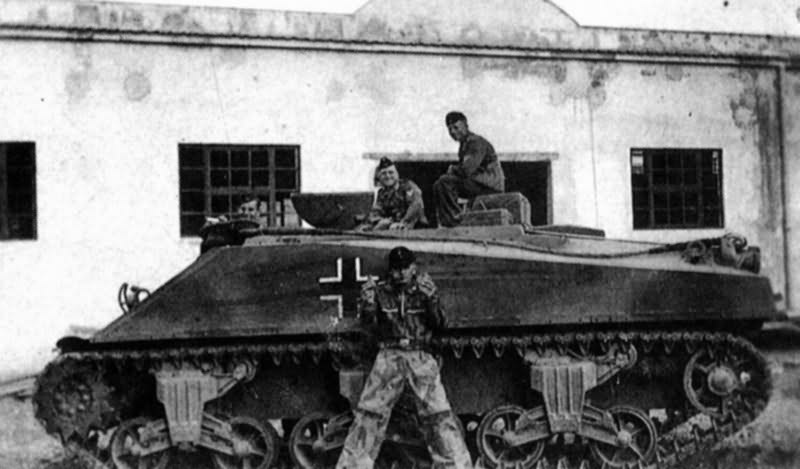
46. An M4 hull being, modified for use as an ARV, in Nazi use. The crew looks very pleased with itself, and this confidence clearly comes from having an awesome ARV at their disposal.
m4_sherman-75-09
47. A very bad shot of a captured small hatch M4A1, the same one from pictures 22 and 23.
m4_sherman-75-01f
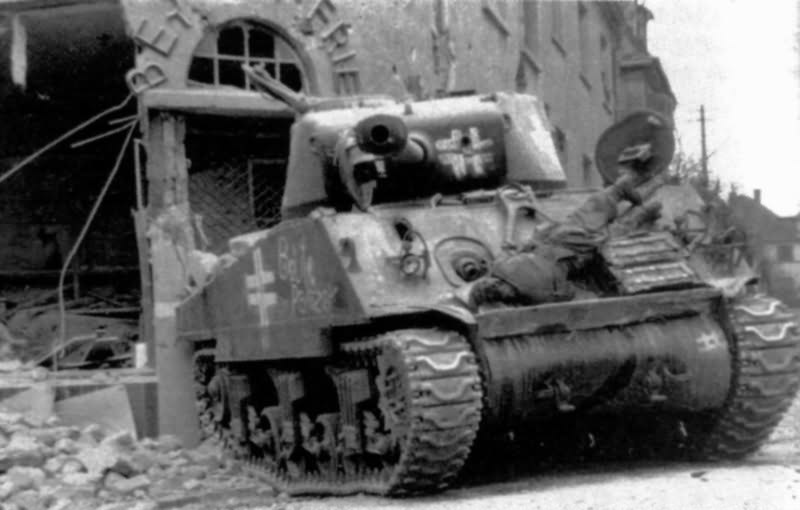
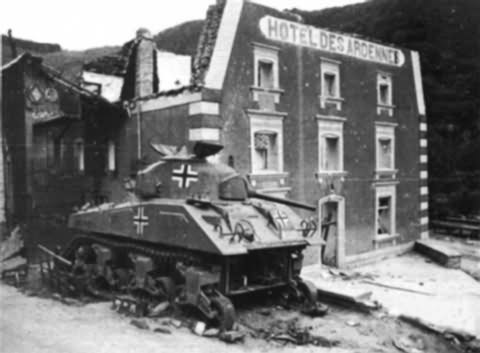
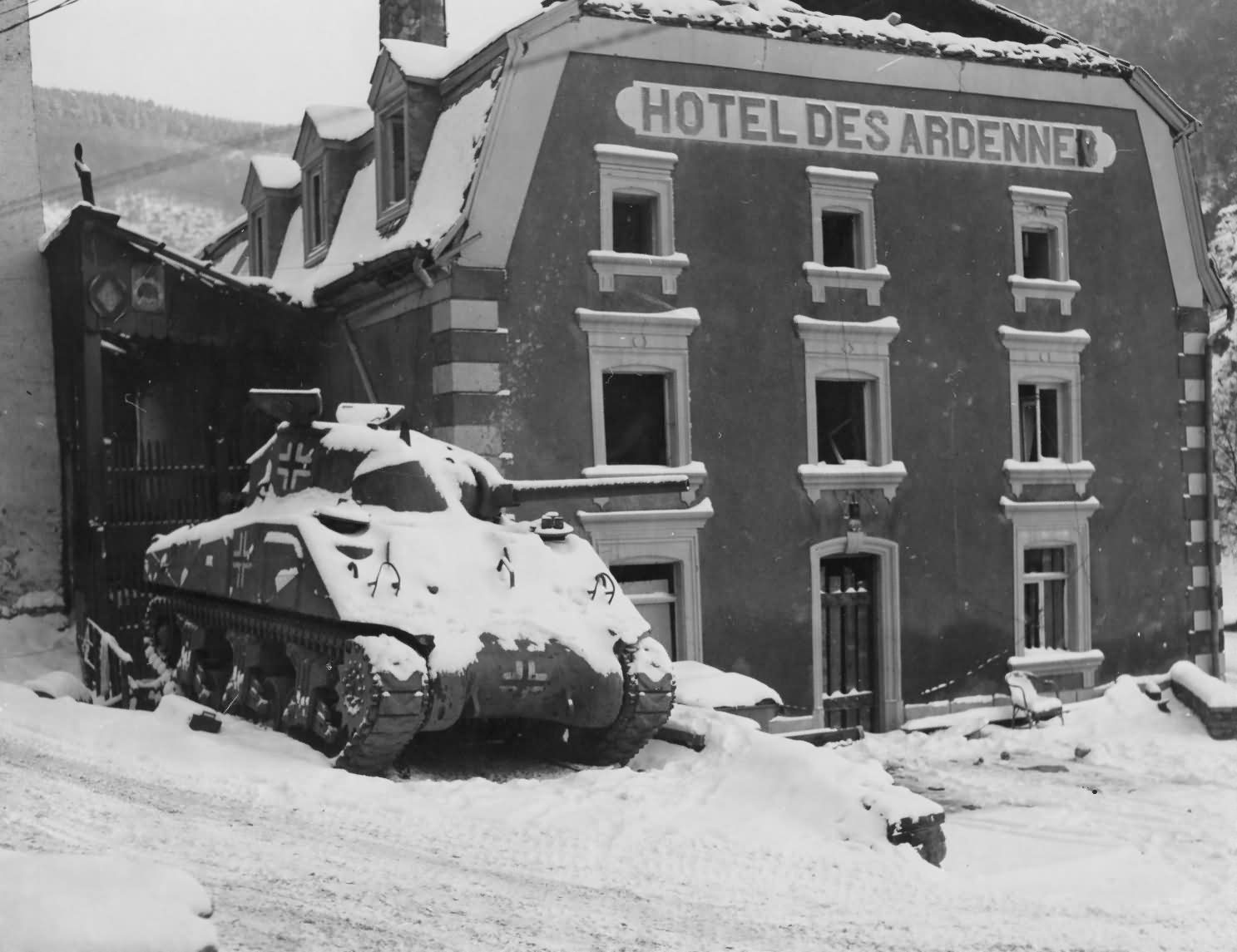
.48 An M4 captured by the Germans, it looks like they cannibalized it for parts. since the final tranny and final drives are missing. The name of the hotel leads me to believe this was during the Battle of the Bulge.
m4_sherman_firefly-13
49. A pair of Nazi tankers on their captured Firefly Vc, this looks like our old friend #16 again.
m4_image001bb
50. Vc Firefly with lots of extra track on the front, that was in Nazi hands and was recaptured by the Brits. This is reputed to be from the same group discussed in image 25.
m4_2-
51. Several captured Vc Firefly tanks and a Sherman V also captured and in use by the fascists. I’m betting this are also the ones captured from the Canadians Holland like from image 25 and 50
m4-german-2
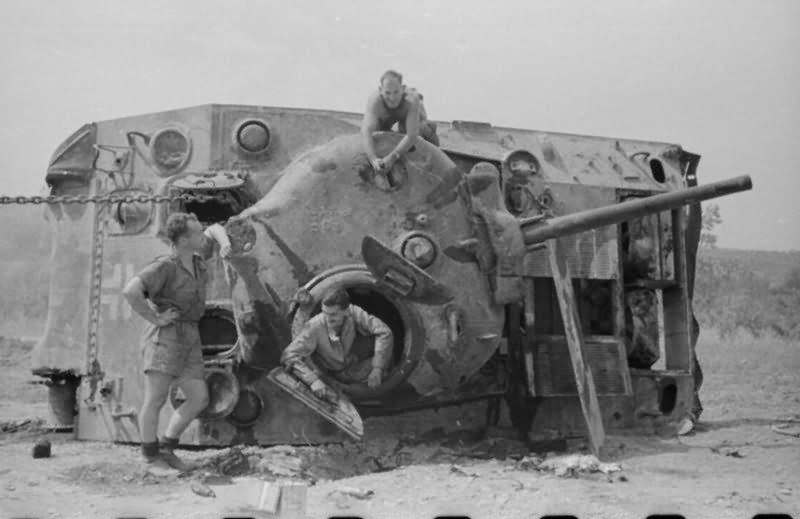
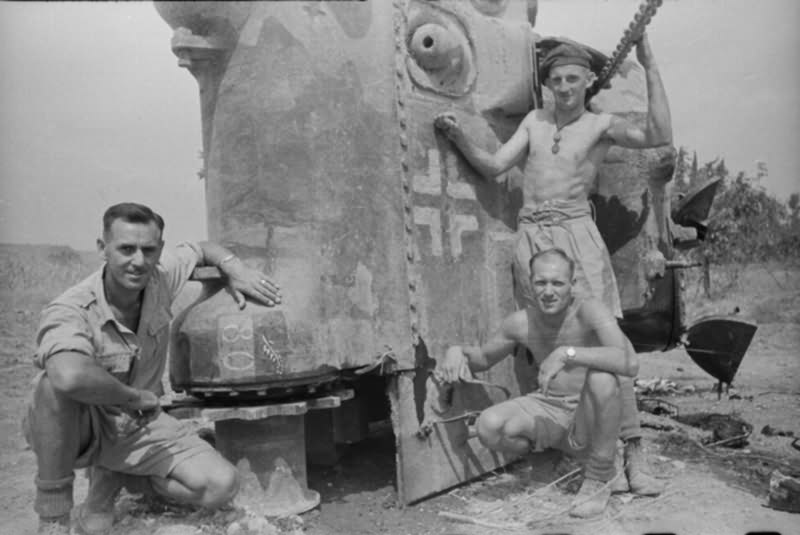
52. In these two shots, it looks like British Soldiers inspect a knocked out, captured M4A2, somewhere in Italy.
m4-german
53. In these two shots, it looks like British Soldiers inspect a knocked out, captured M4A2, somewhere in Italy.
m4-german-3
54. This looks like an M4A3 75w tank that fell into Nazi hands. This was probably another tank captured from Task Force Baum in late March of 45, this was the failed attempt by the 37TB of the 4th AD to get Patton’s son in law out of a POW camp.
m4-german5
55. A knocked out large hatch M4A2 75 dry tank, the Nazis captured from the Soviets.
m4_sherman_firefly-26
56. A captured Firefly Vc, it looks like it was freshly knocked out probably in Holland, this being one of the lost Canadian Vc discussed in image 25.
M36_Tank_Destroyer_Recaptures_M4A3_76_from_Germans_in_Aschaffenburg_1945
57. This image shows a Sherman that was in Nazi custody back in American hands. The Tank is an M4A3 76w. This is another image of the M4A3 76 knocked out by an M36, just after the dead Nazi was removed and parts began being stripped off. Note the missing muzzle break. You can also see this tank in images 24 and 45

Most of the images for this post came from WorldWarPhotos.com and many others came from Waralbum.ru. Both excellent sources for high-resolution images from the war.


#58 Special Gallery 2: Shermans at Fort Benning

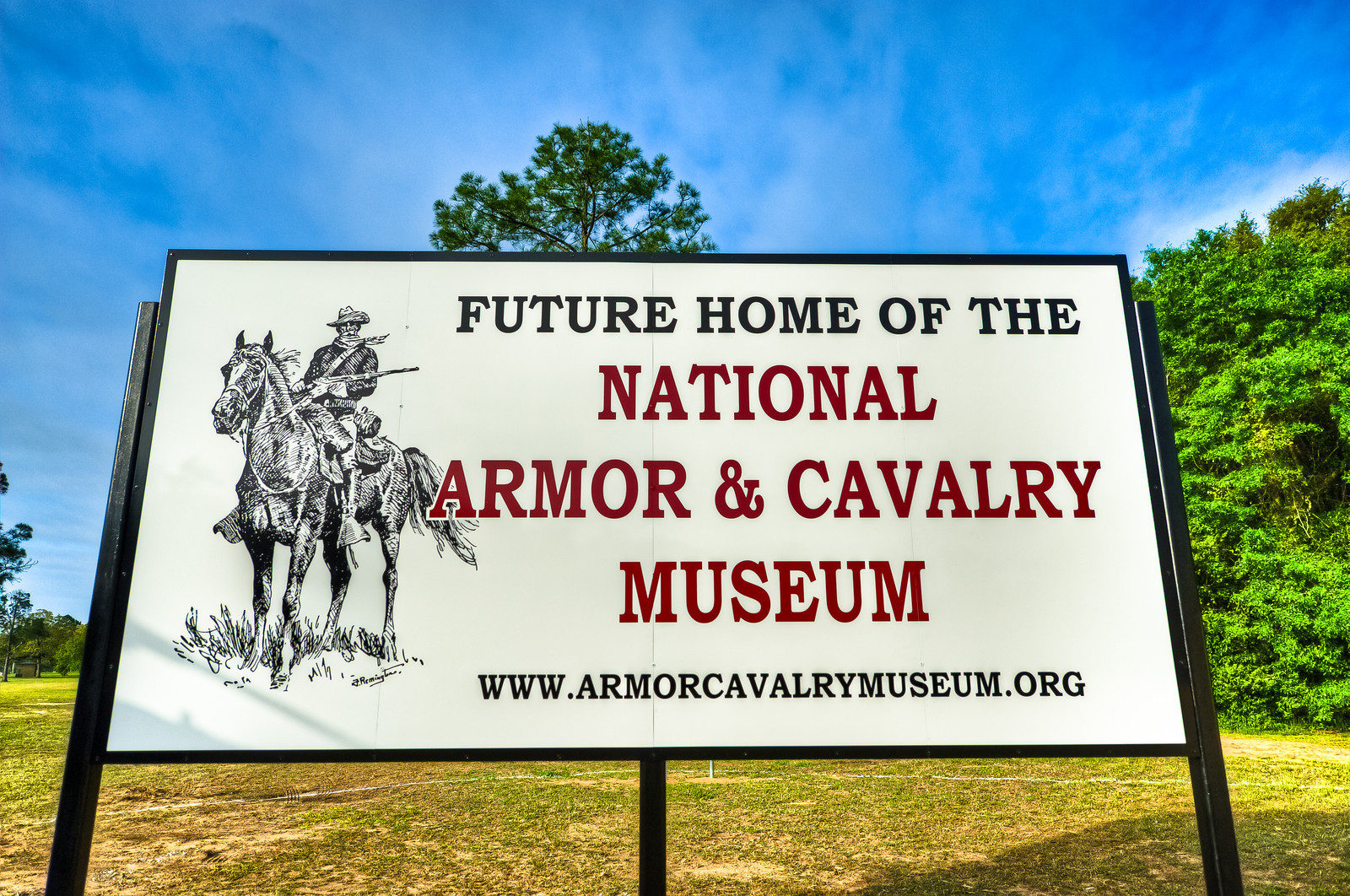
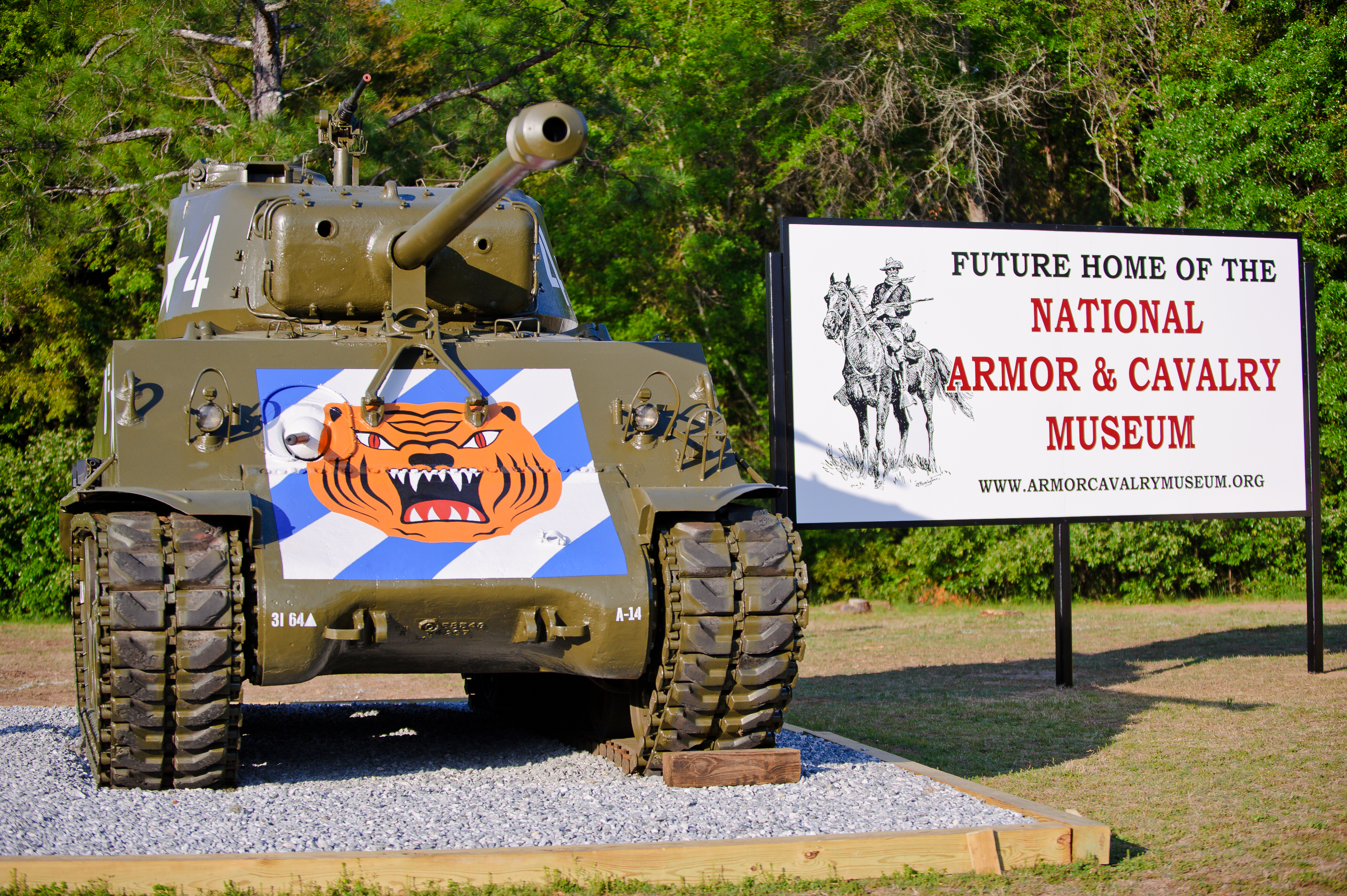
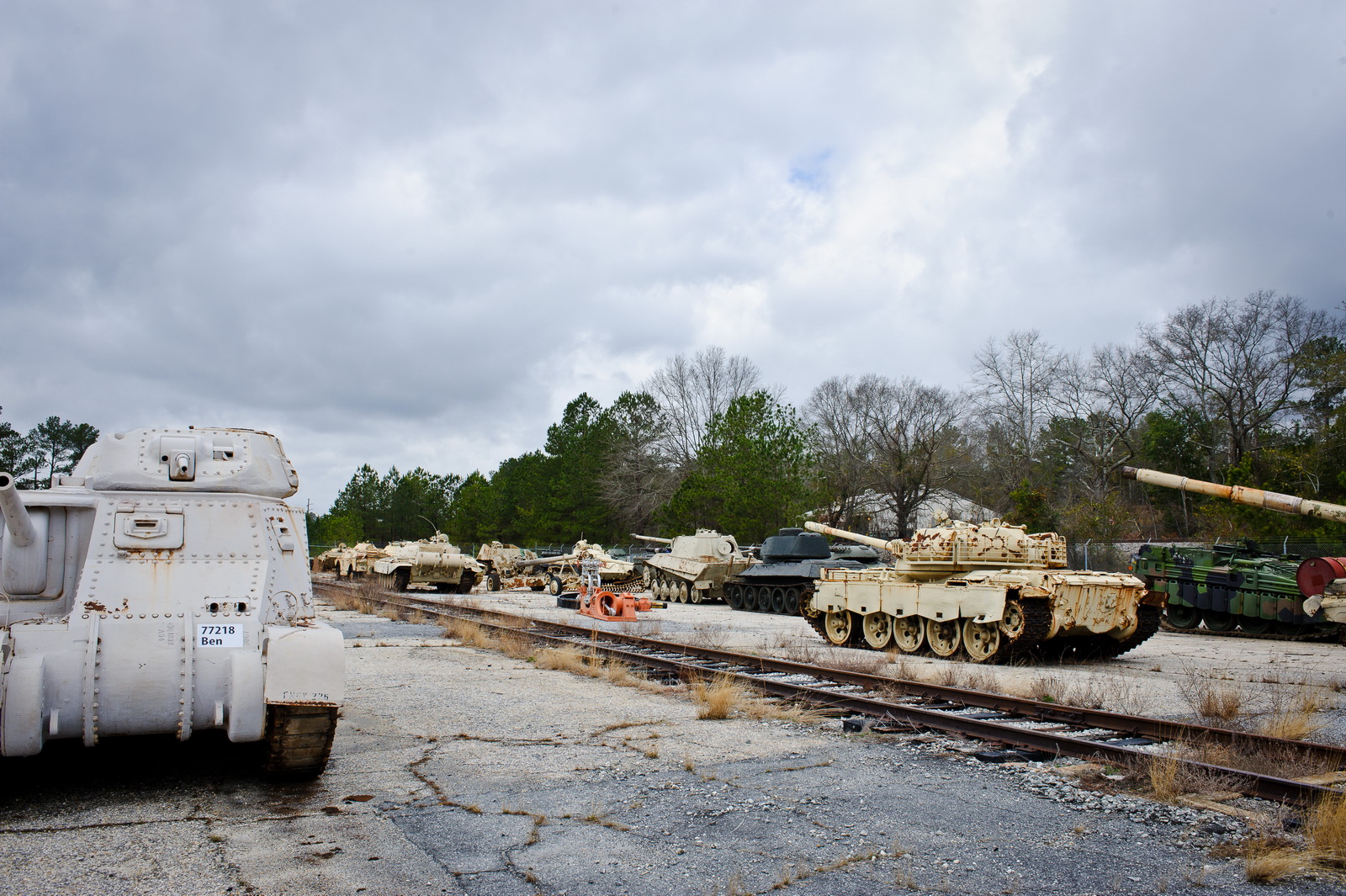
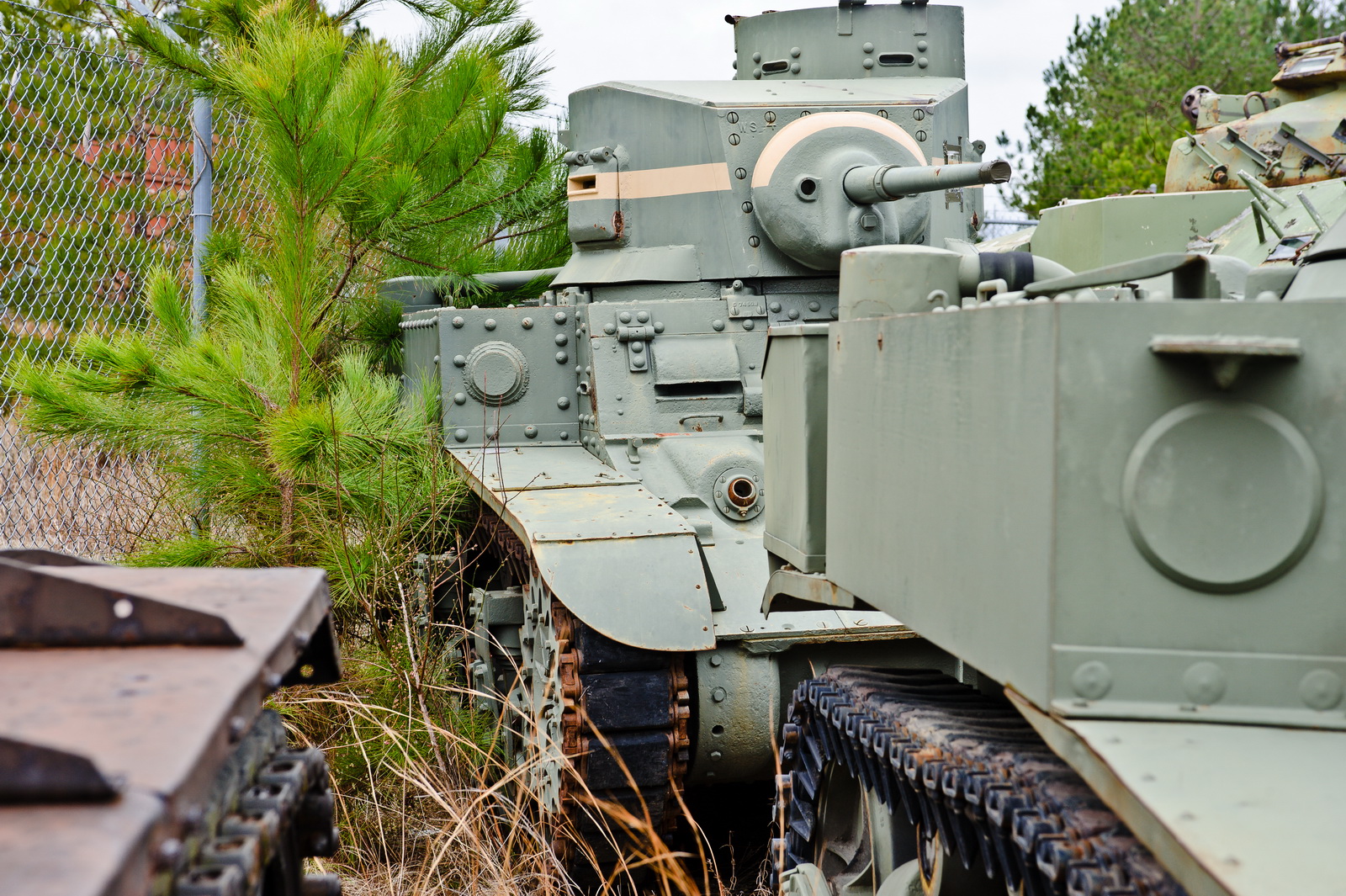
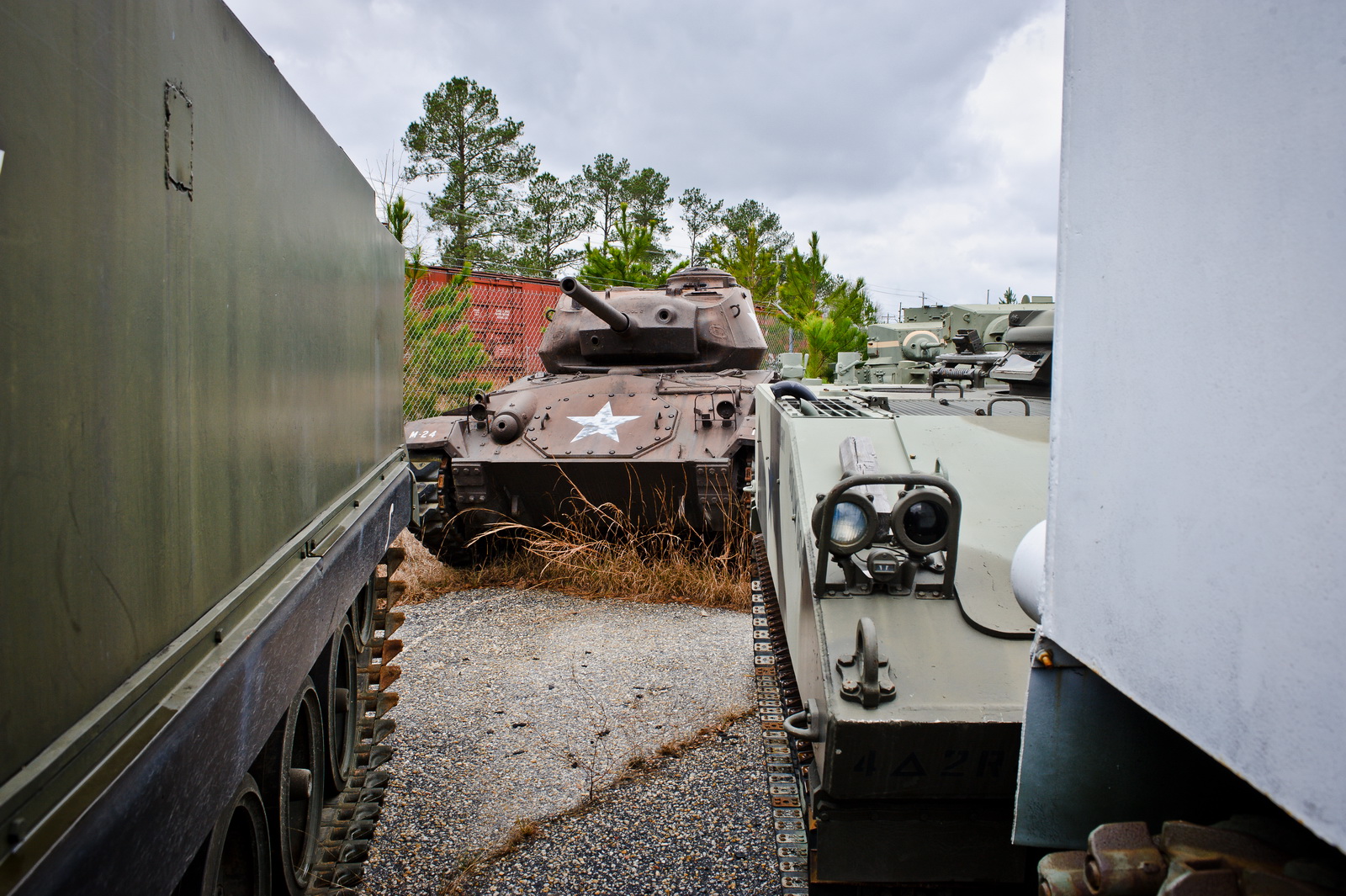
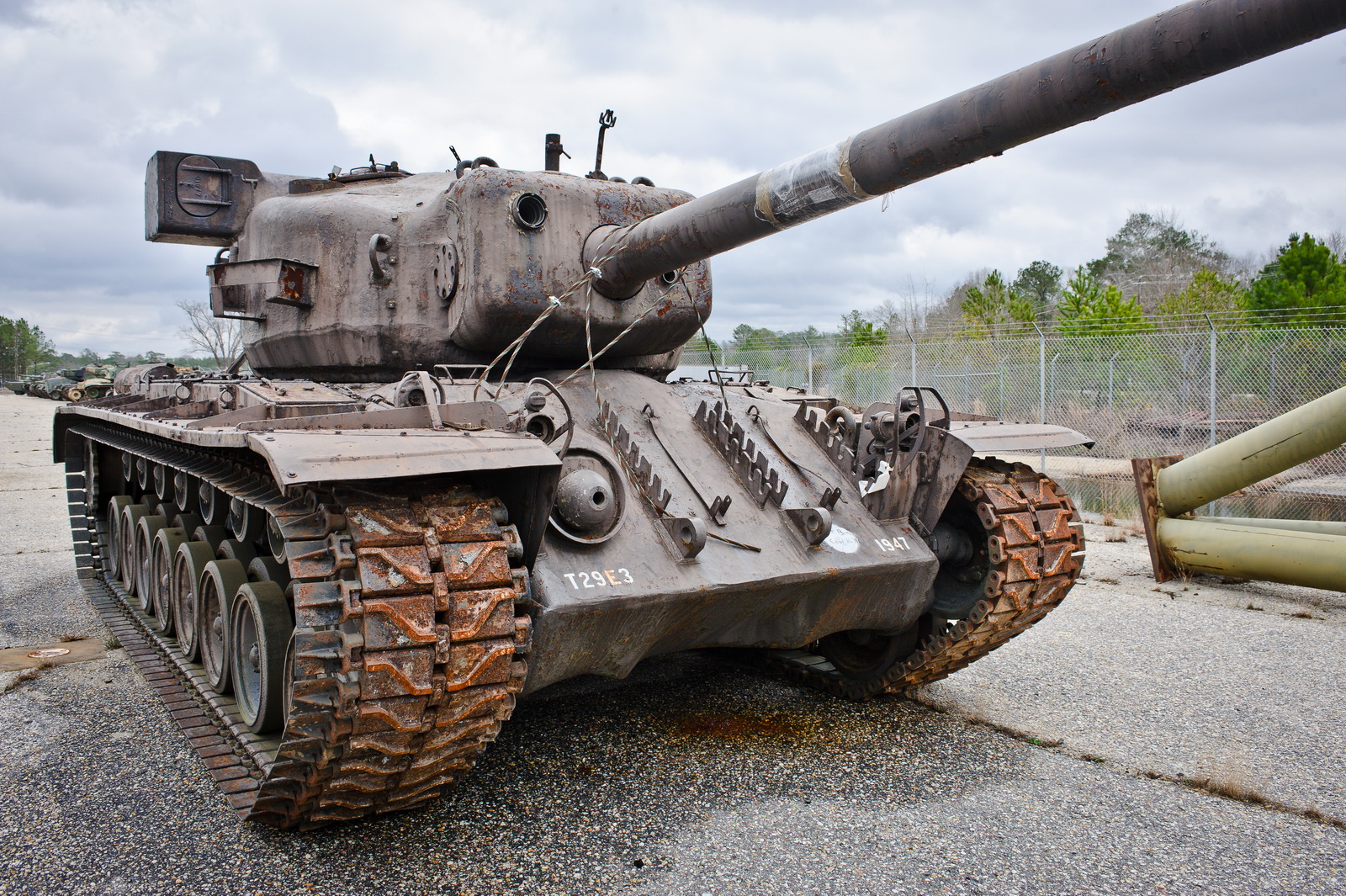
Special Gallery 2: Shermans at Fort Benning, the ones waiting to go the new National Armor & Cavalry Museum.

These images all came from the Fort Benning Photos Website, and these images were all taken by John D. Helms or Kristian Ogden, and you can find much larger version on the Benning site.  These Sherman tanks, and other historic vehicles will be displayed in the new Museum once it’s done.

110404-A-7341H-9781_Enhancer-X3

04 APR 2011 - National Armor and Cavalry Museum sign, MCoE, Fort Benning, GA.  Photo by John D. Helms - john.d.helms@us.army.mil
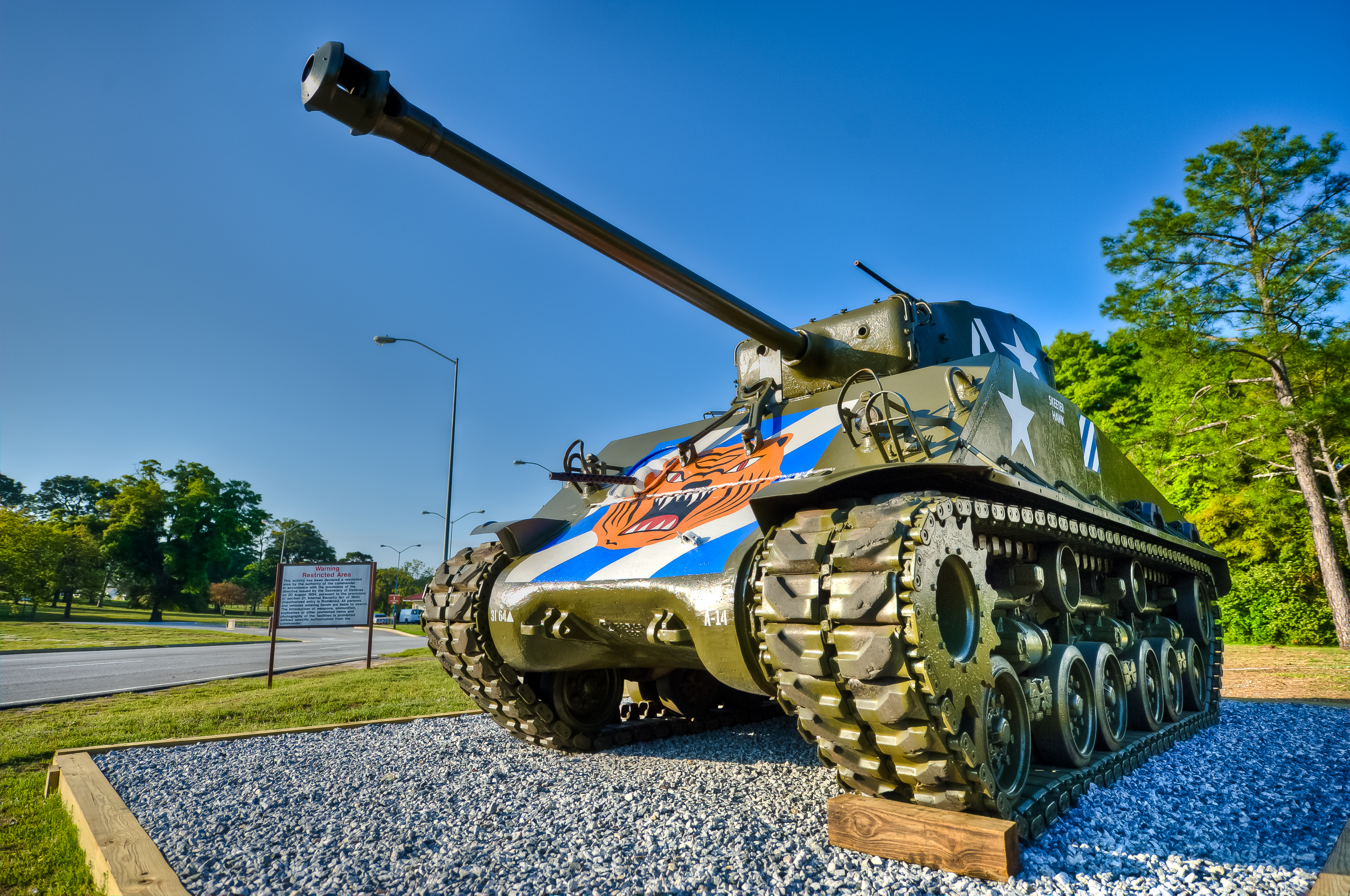
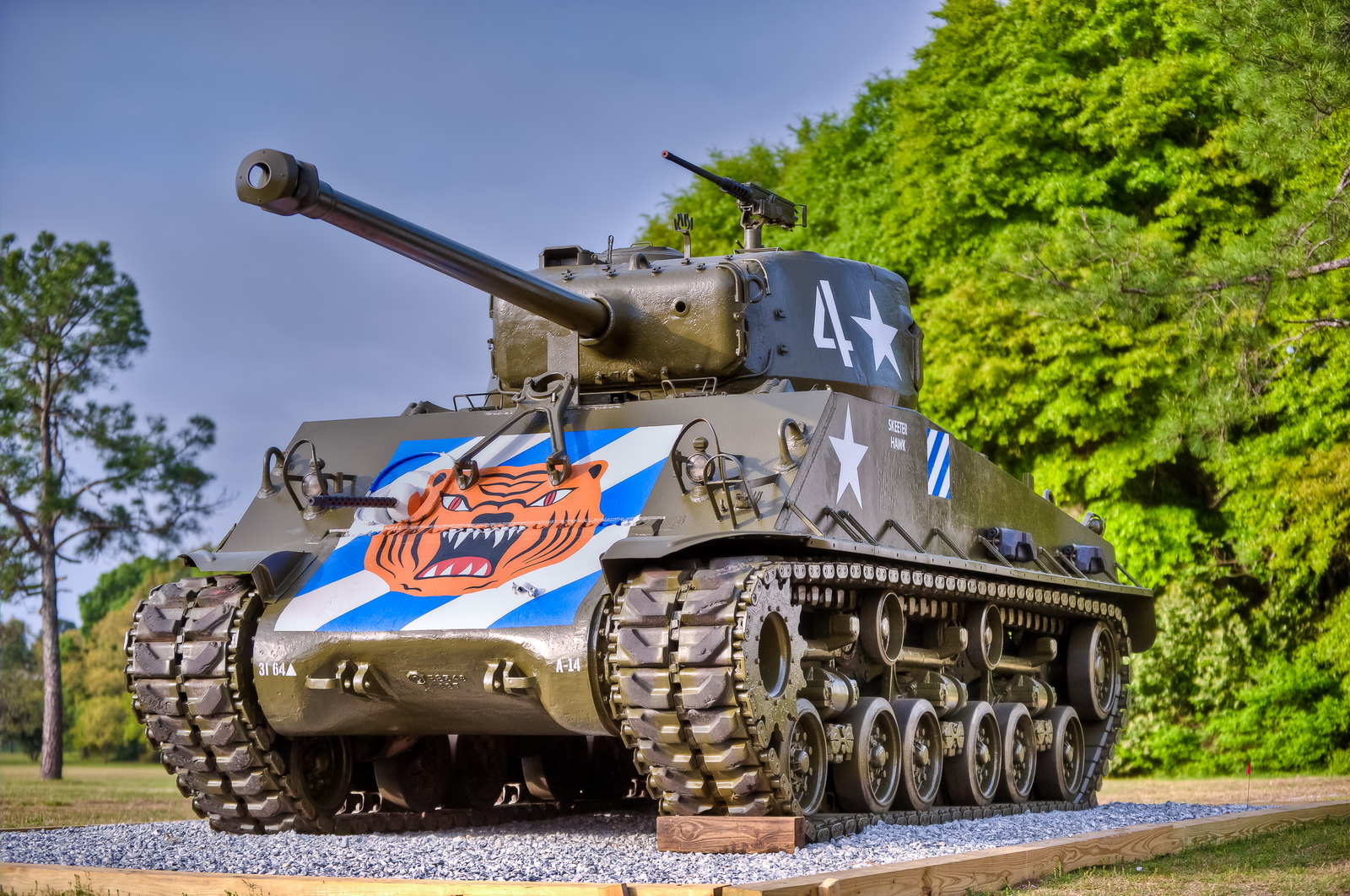
An M4A3 76 HVSS tank, done up in Korean war markings at the museum site. 
04 APR 2011 - National Armor and Cavalry Museum sign, MCoE, Fort Benning, GA.  Photo by Kristian Ogden.
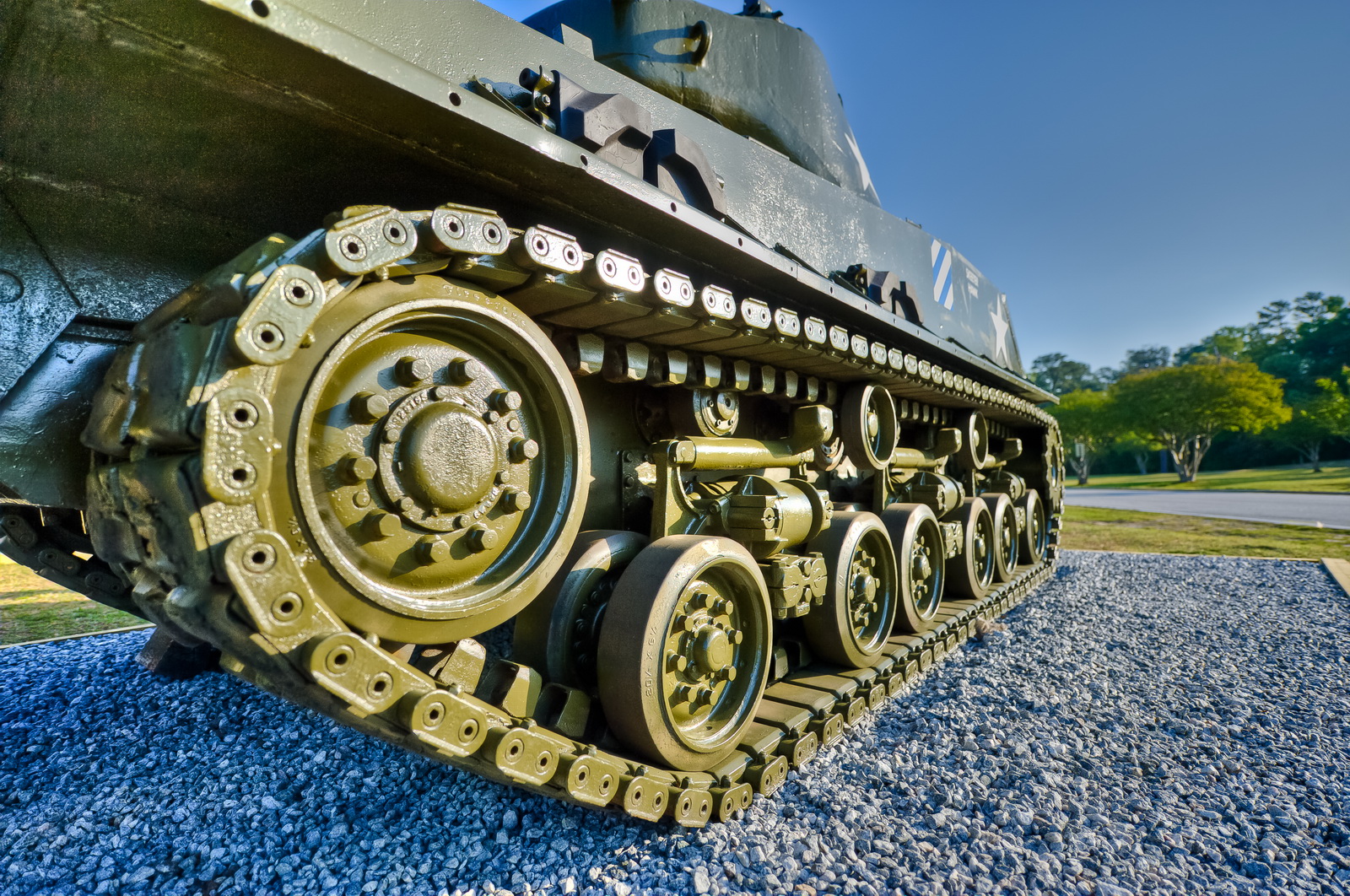
Close up of the suspension
04 APR 2011 - National Armor and Cavalry Museum sign, MCoE, Fort Benning, GA.  Photo by Kristian Ogden.
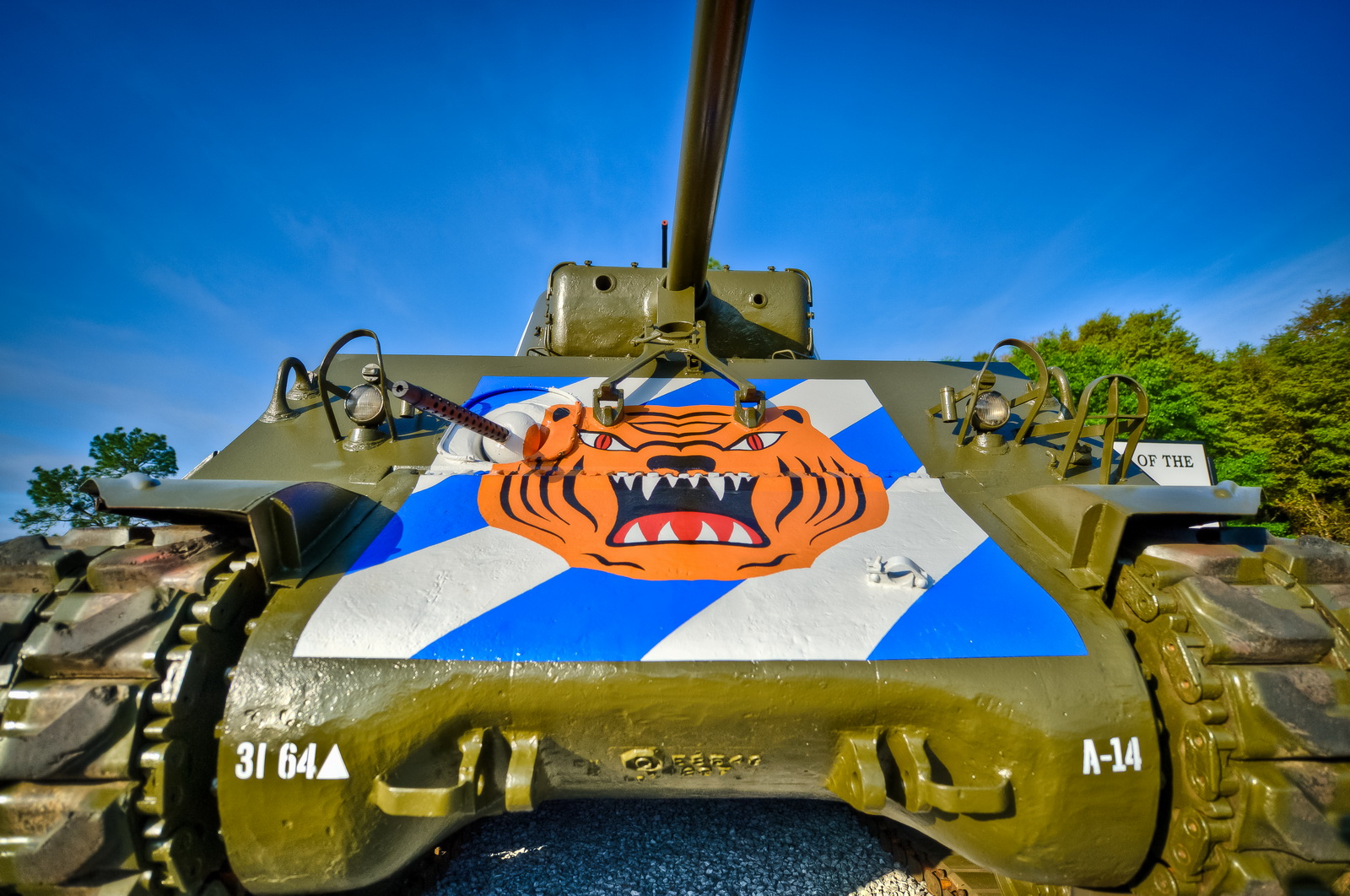
Close up from the front

04 APR 2011 - National Armor and Cavalry Museum sign, MCoE, Fort Benning, GA.  Photo by John D. Helms - john.d.helms@us.army.mil

25 FEB 2011 - Armor museum artifacts stored at the TMP on Main Post, MCoE, Fort Benning, GA.  Photo by John D. Helms - john.d.helms@us.army.mil
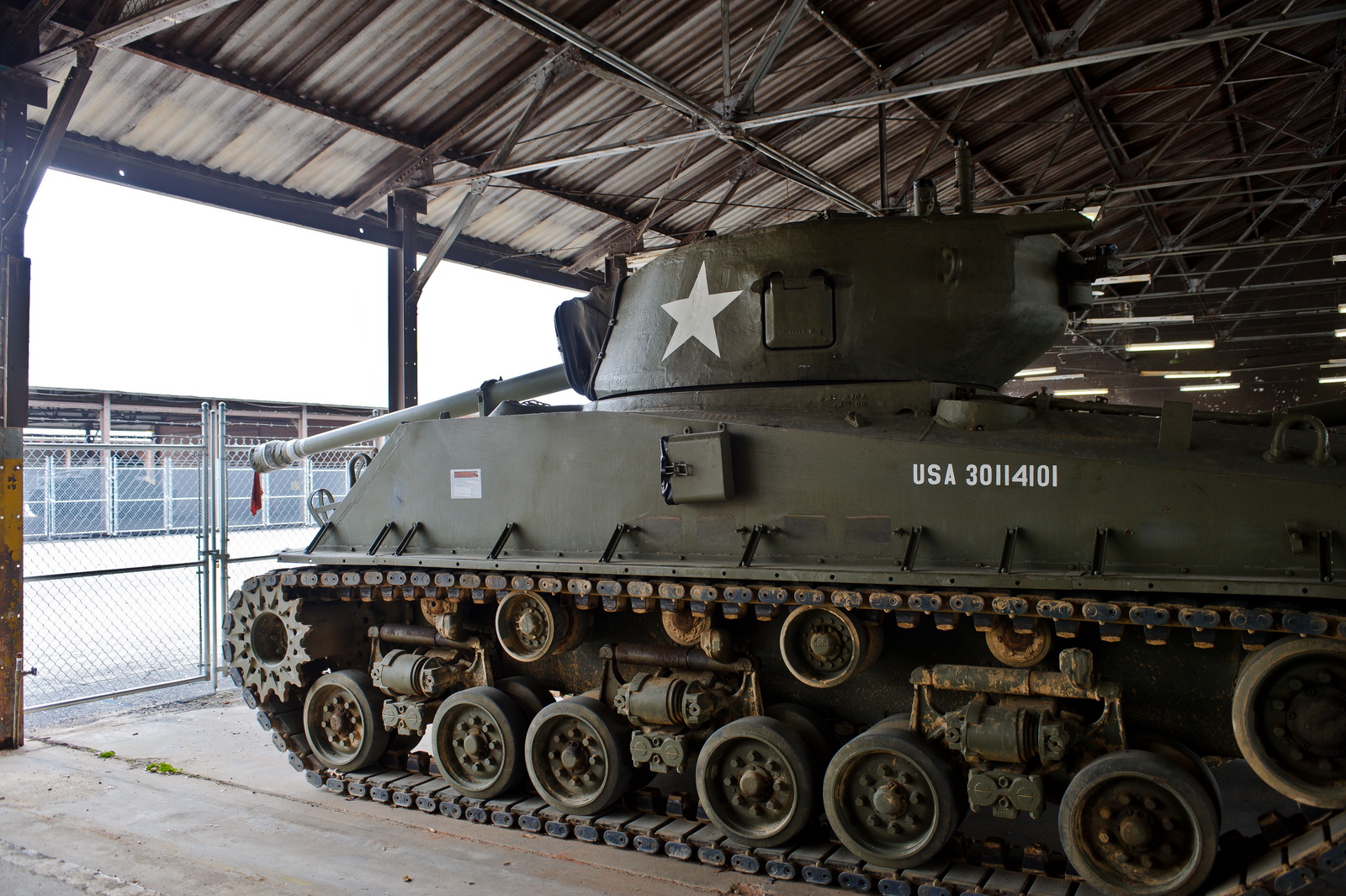
An M4A3 75w large hatch late production Sherman stored indoors. 
25 FEB 2011 - Armor museum artifacts stored at the TMP on Main Post, MCoE, Fort Benning, GA.  Photo by John D. Helms - john.d.helms@us.army.mil
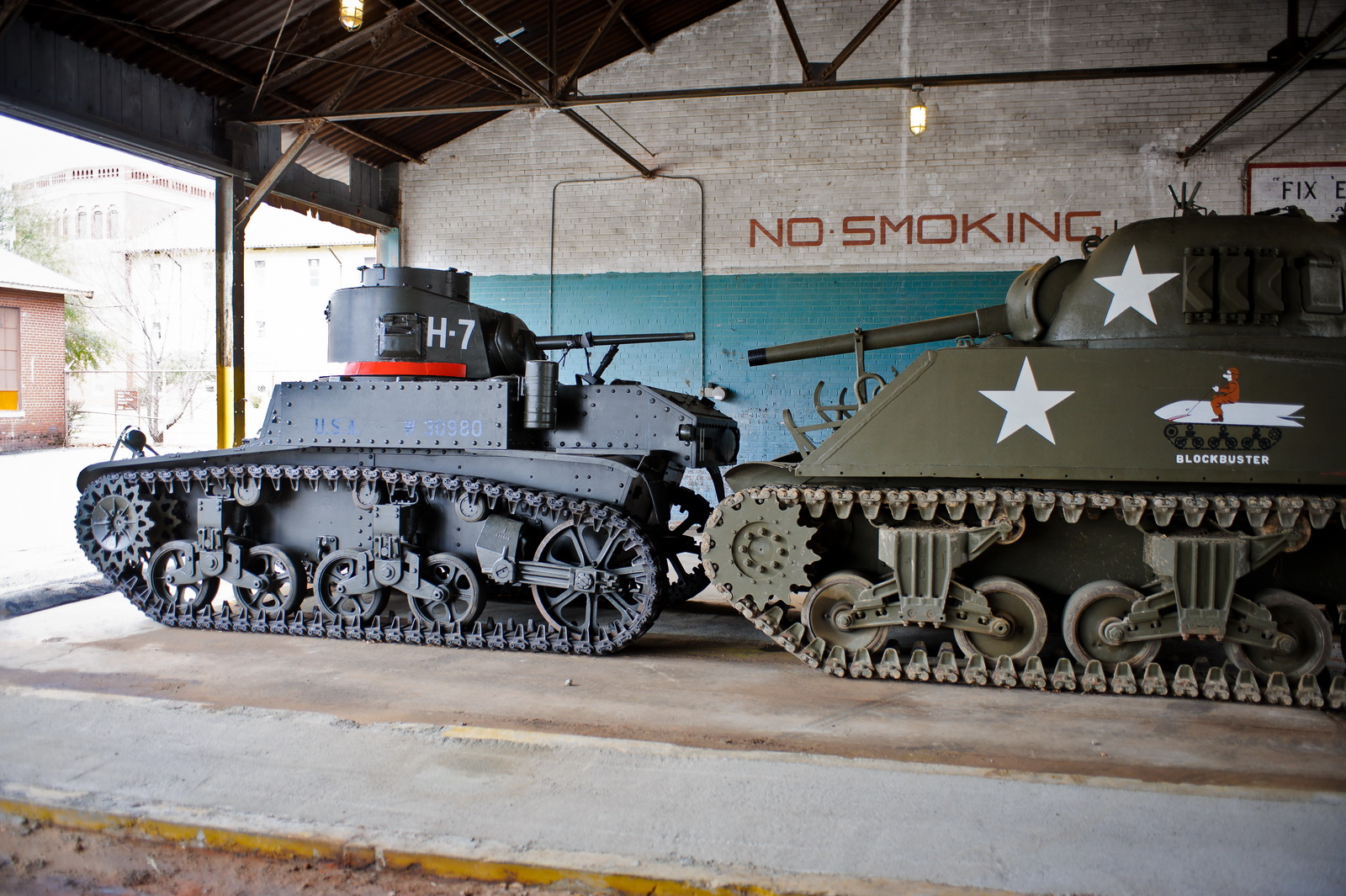
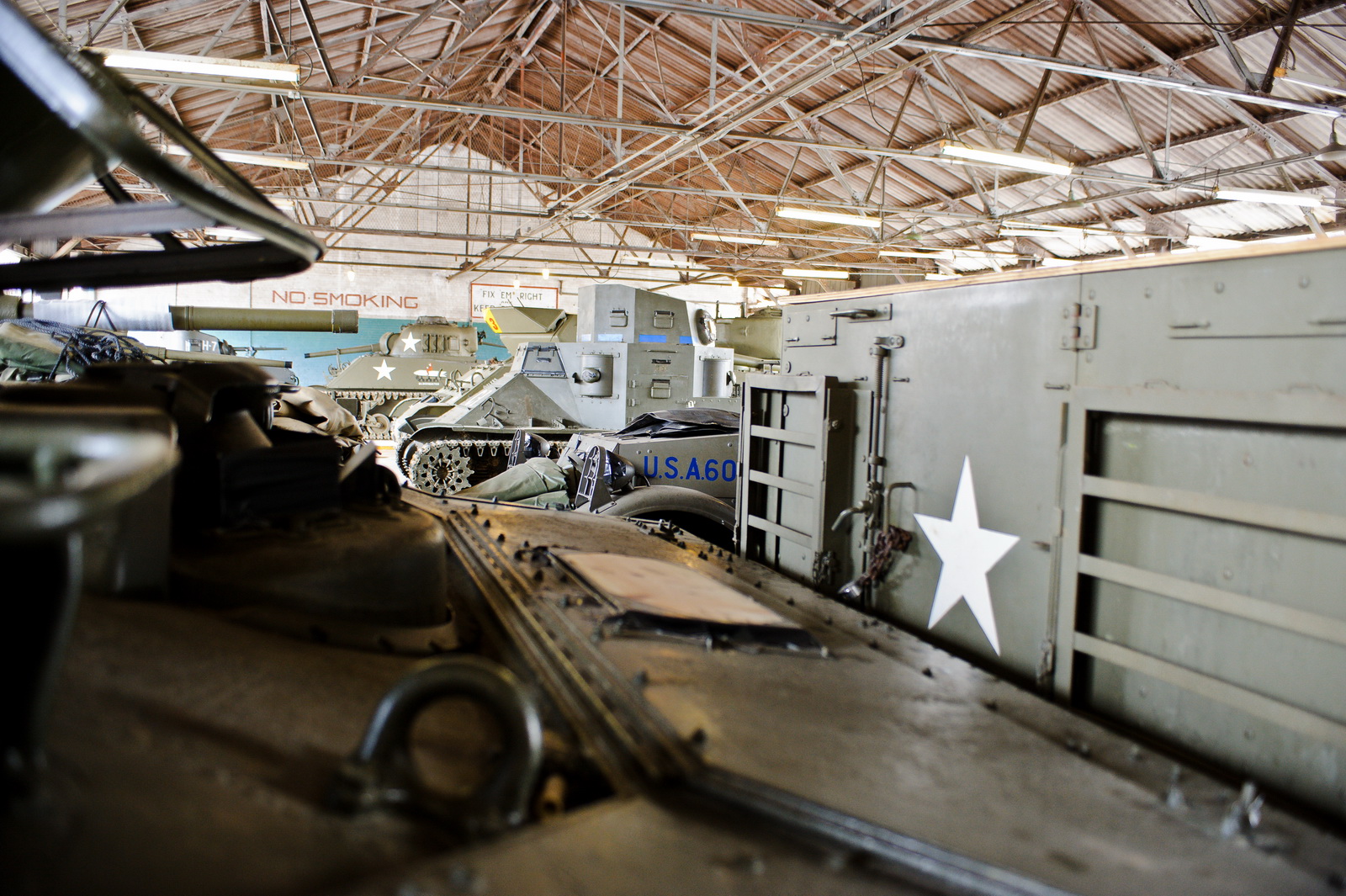
An M2 and M10
25 FEB 2011 - Armor museum artifacts stored at the TMP on Main Post, MCoE, Fort Benning, GA.  Photo by John D. Helms - john.d.helms@us.army.mil
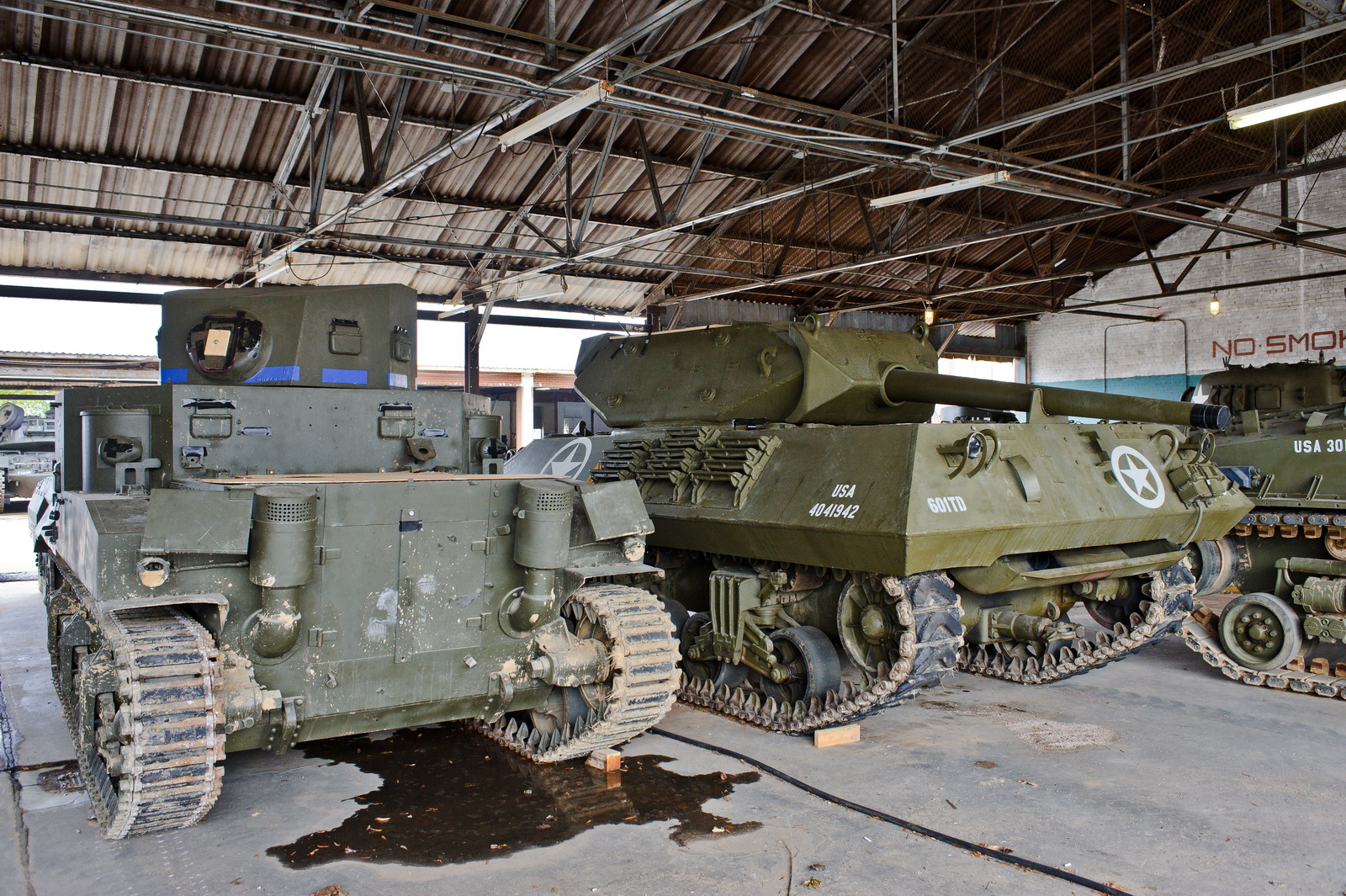
More detail on the M10, and a nice shot of a M4A3 76w HVSS tank, this may have been the one that Fort Knox had running?
25 FEB 2011 - Armor museum artifacts stored at the TMP on Main Post, MCoE, Fort Benning, GA.  Photo by John D. Helms - john.d.helms@us.army.mil
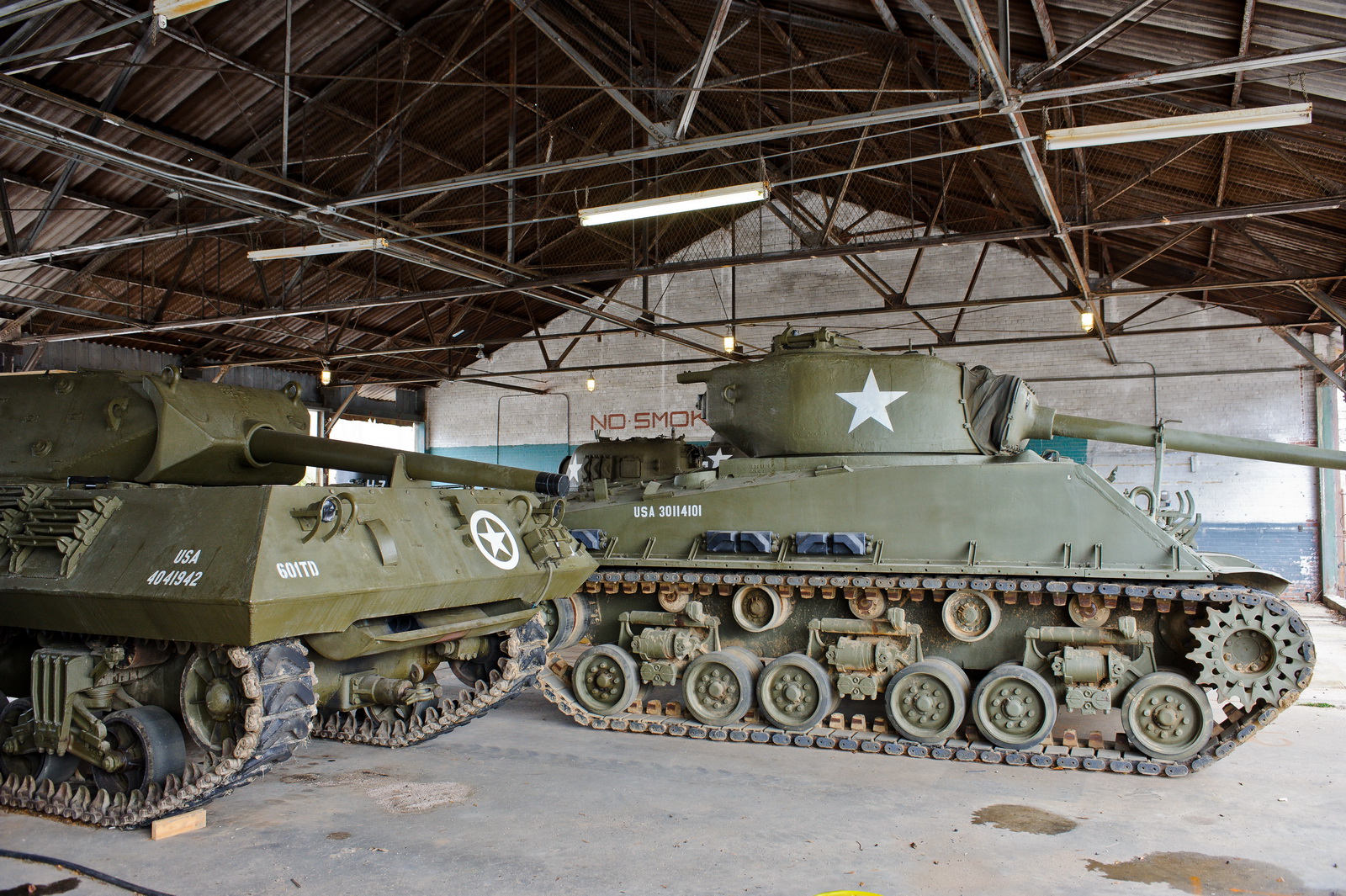
Side shot of the indoor M4A3 76w HVSS tank
25 FEB 2011 - Armor museum artifacts stored at the TMP on Main Post, MCoE, Fort Benning, GA.  Photo by John D. Helms - john.d.helms@us.army.mil
Longshot of the M2 and M4A3 75w
25 FEB 2011 - Armor museum artifacts stored at the TMP on Main Post, MCoE, Fort Benning, GA.  Photo by John D. Helms - john.d.helms@us.army.mil
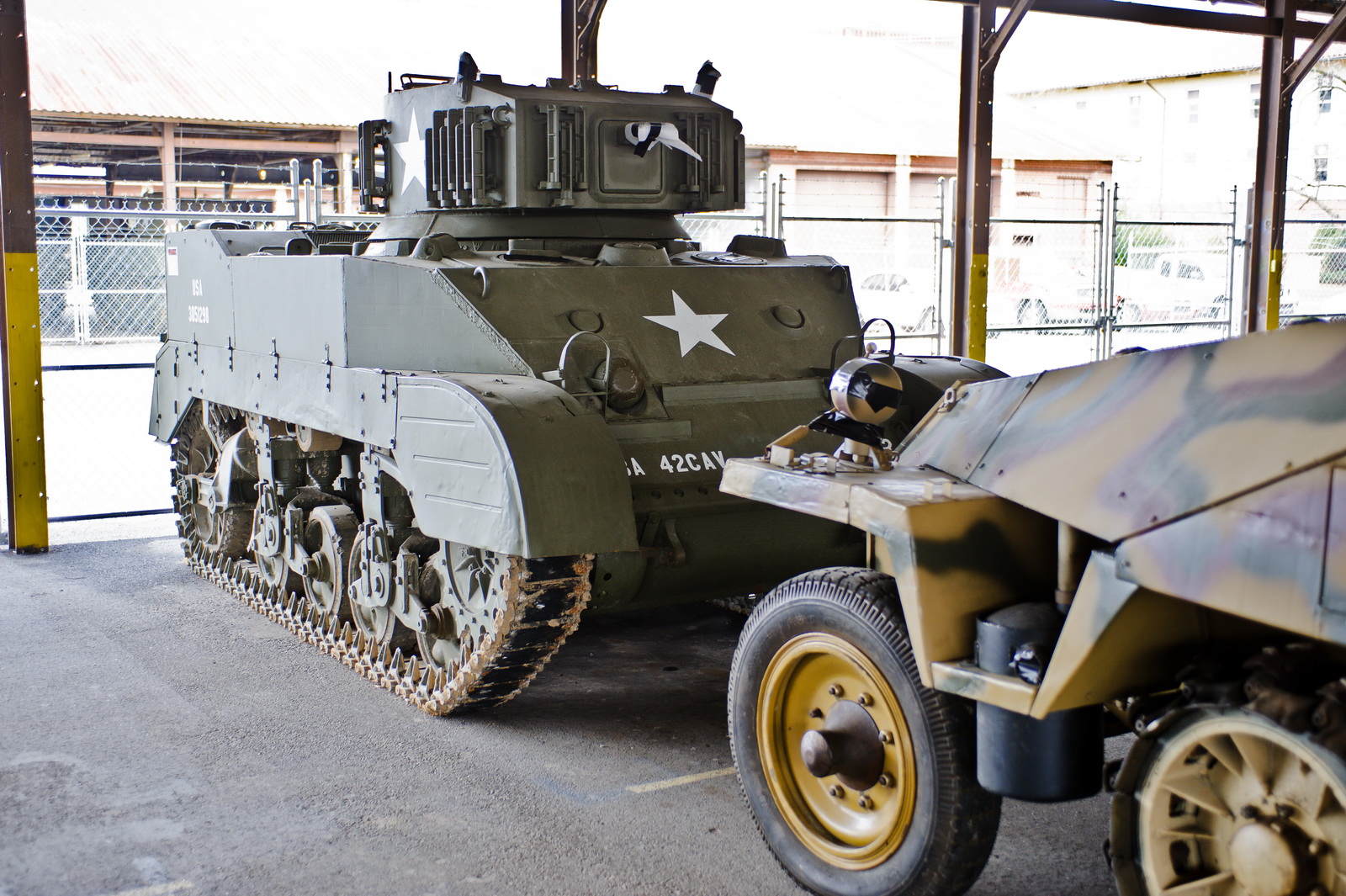
an M5 light
25 FEB 2011 - Armor museum artifacts stored at the outdoor holding lot on Sand Hill, MCoE, Fort Benning, GA.  Photo by John D. Helms - john.d.helms@us.army.mil
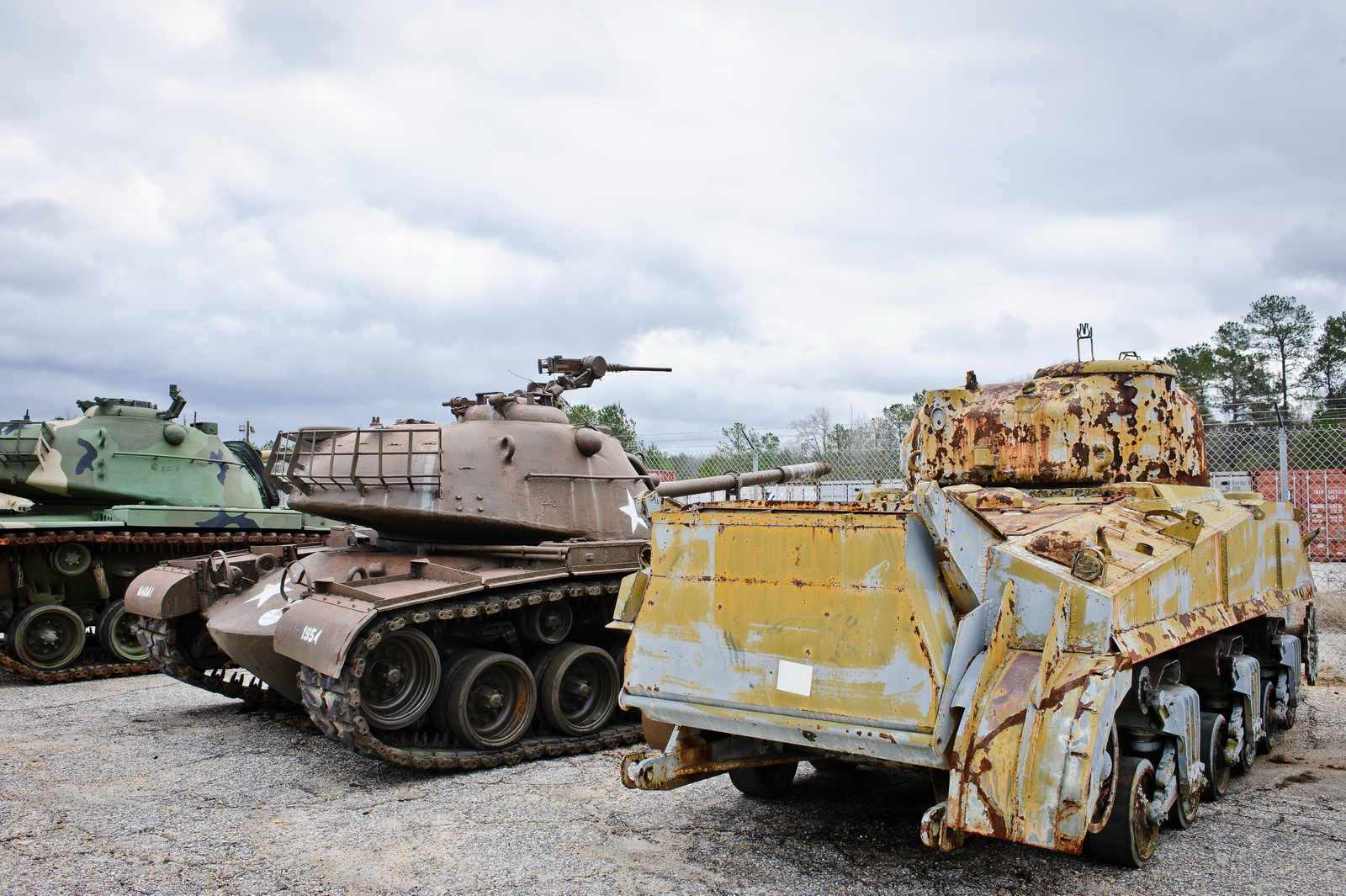
stored in the yard next to a pair of M48s, an oddball M4A4. 
25 FEB 2011 - Armor museum artifacts stored at the outdoor holding lot on Sand Hill, MCoE, Fort Benning, GA.  Photo by John D. Helms - john.d.helms@us.army.mil
M3 Grant
25 FEB 2011 - Armor museum artifacts stored at the outdoor holding lot on Sand Hill, MCoE, Fort Benning, GA.  Photo by John D. Helms - john.d.helms@us.army.mil
M3 light
25 FEB 2011 - Armor museum artifacts stored at the outdoor holding lot on Sand Hill, MCoE, Fort Benning, GA.  Photo by John D. Helms - john.d.helms@us.army.mil
M24 Chaffee light
25 FEB 2011 - Armor museum artifacts stored at the outdoor holding lot on Sand Hill, MCoE, Fort Benning, GA.  Photo by John D. Helms - john.d.helms@us.army.mil
The mighty T29! This thing would have eaten King Tigers for breakfast!


#57 Civilian Sherman Use: Hollywood, Loggers, Farmers and Frat Boys


Another shot of the restored VC, note how far apart the pair bogies are.
A restored VC, note how far apart the pair bogies are, this one with a museum in Europe.

Civilian Sherman Use: Hollywood, Loggers, Farmers, Museums and Frat Boys

Since the Sherman tank was produced in huge numbers, and the Army didn’t need that many, and even after taking the best for themselves, mothballing the best of the ones they didn’t for use as military aid to struggling allies, they still had a bunch of small hatch M4 tank of various types sitting around.  The US Government decided there might be a civilian market for the tanks and put them up for sale as surplus.

The M3 Lee in 1941
The M3 Lee in 1941

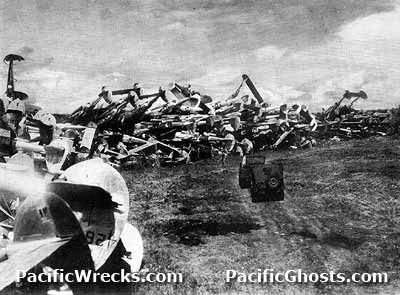
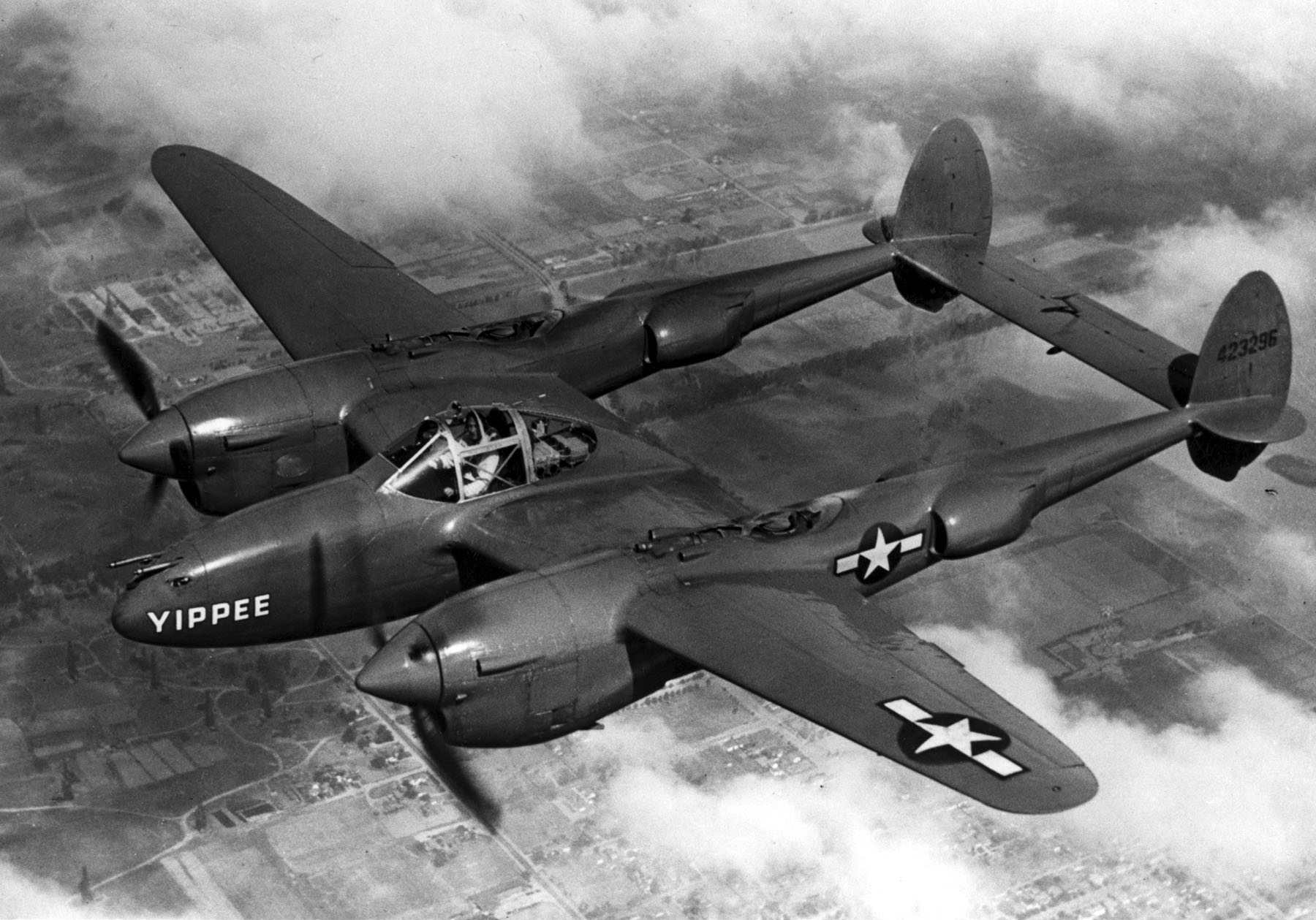
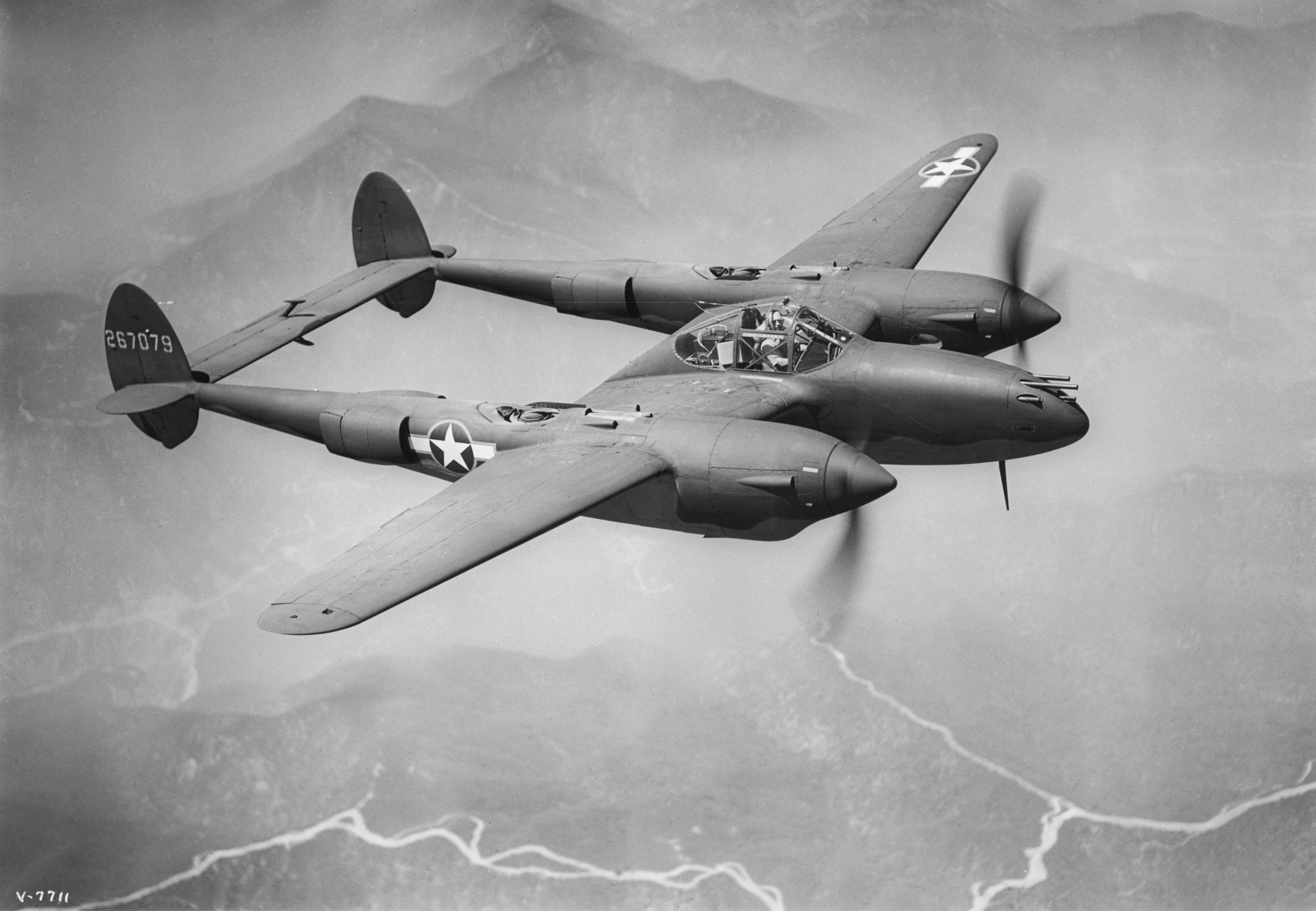
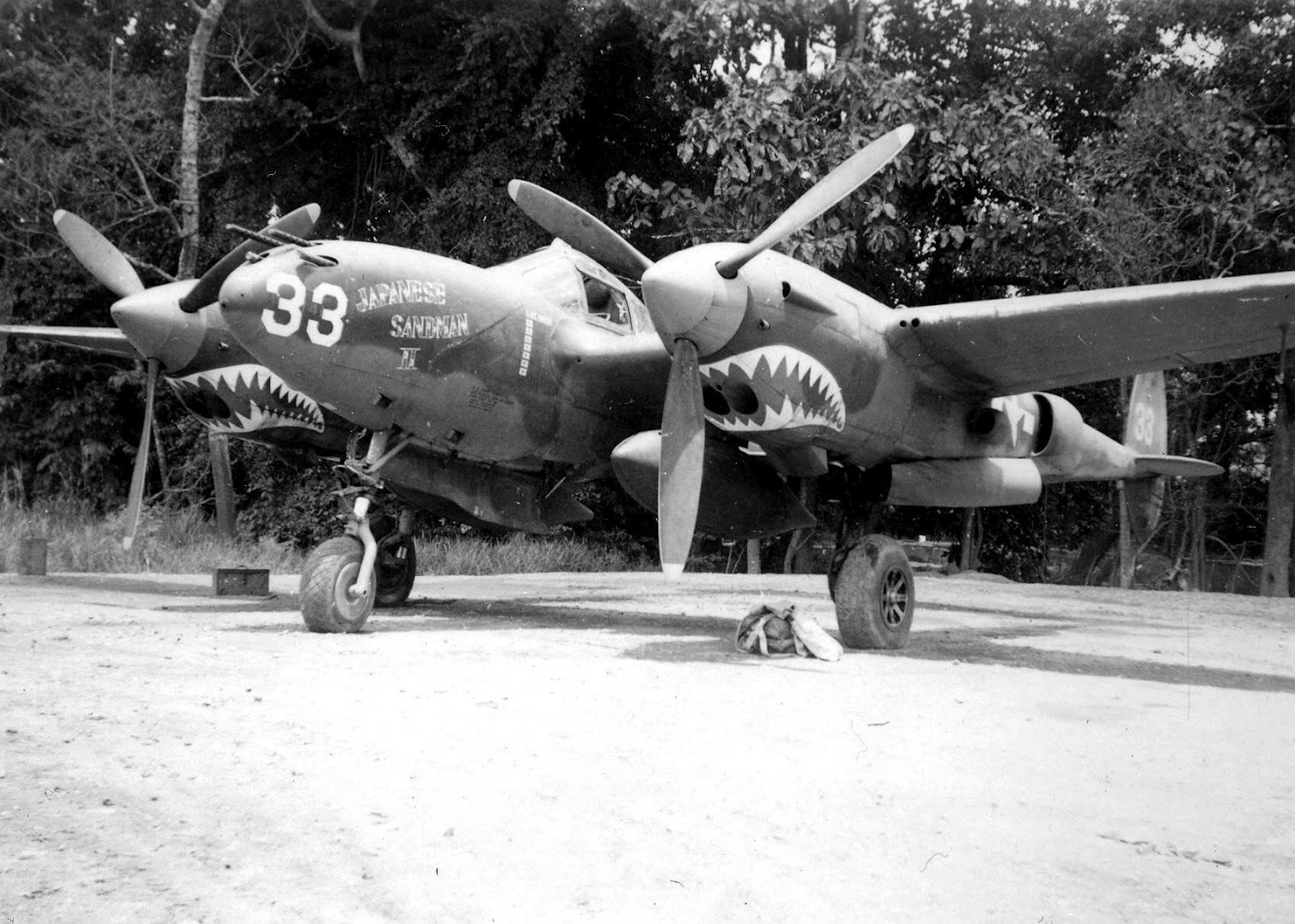
It was not just Sherman tanks that would go on sale after the war, actually before the war ended in the case of aircraft.  When the war ended the US Government was saddled with so much, now essentially useless, war material, in many cases they just left it to rot where it was sitting. They bulldozed the stuff into ditches or off cliffs, or dumped it into the ocean. That was the fate of most of the war material in the pacific theater.  There are heartbreaking photos of P-38 Lighting fighters bulldozed off a cliff in the Philippines.
wwii-p38-dump-area
This was the only photo I could find of the P-38 dump in the Philippines.
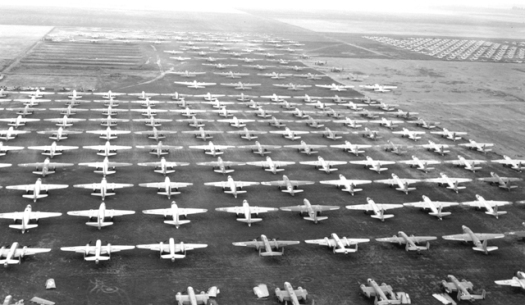
The war material, tanks, planes, trucks, tools, bulldozers, tug boats, etc. back in the United States would mostly be melted down for scrap,  thousands of B-17 and B-24 bombers, P-40s, P-38s, P-47s, you name it, if it flew, it was surplused after the war. Many airlines snapped up the transport planes and cargo planes, but just about all the fighters and bombers got scrapped. For about the price of a nice new car you could have owned any of the fighters, brand new, with full tanks of gas. Many fighters were bought up for use as air racers, or use as surveying aircraft, but at that point in time no one cared enough about them to consider preserving them, with exceptions for particularly historically significant aircraft.
ontario-california-military-boneyard-aerial-1946

You could buy Shermans in running condition, with the gun DE milled, for about the price of a nice used car.  I do not think the Sherman was a hot seller, though a few civilians here and there bought them for the novelty. They did sell to some construction company’s here and there, other companies bought them up in droves, and all the other vehicles that used the Sherman powertrain, and began converting the hulls into specialized equipment used in construction, mining, and forestry. They also one in at least one case sold a Sherman to a college fraternity.

Traxxon-Tank-Drill

133580828_B2oSVjA9_1aMadill171TimBrown4HEF

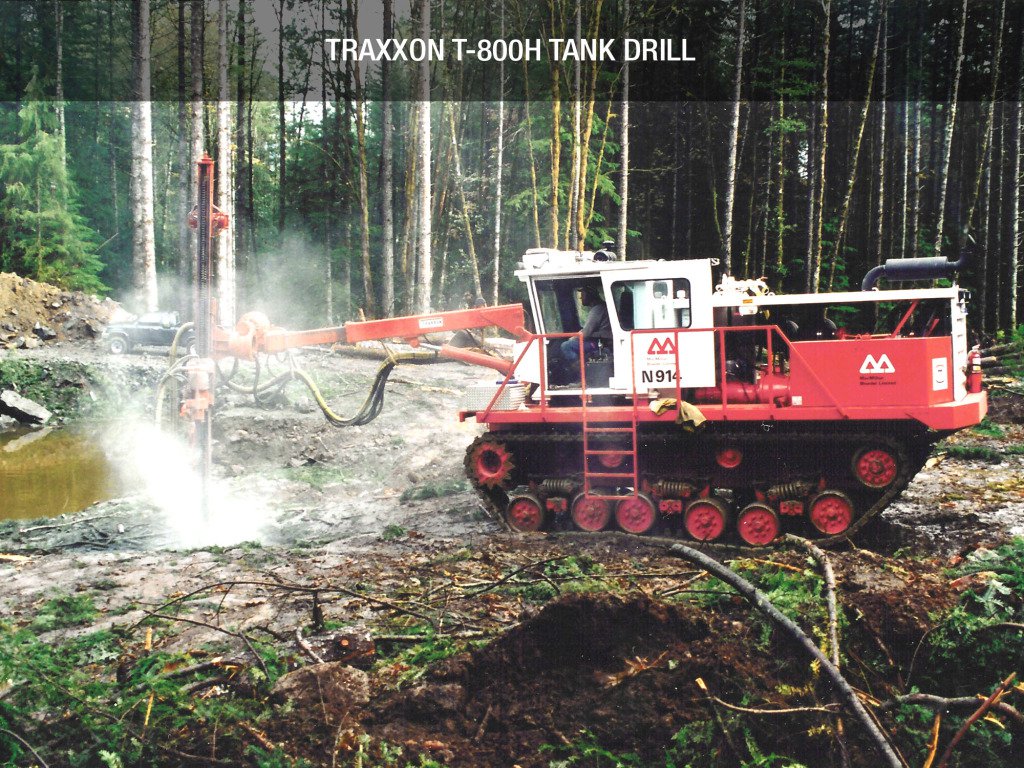
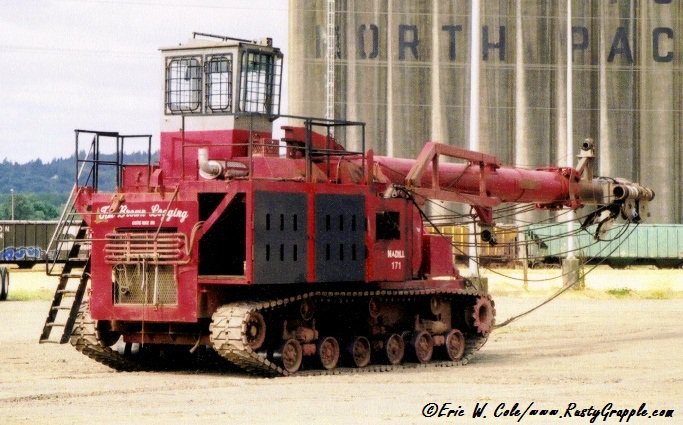
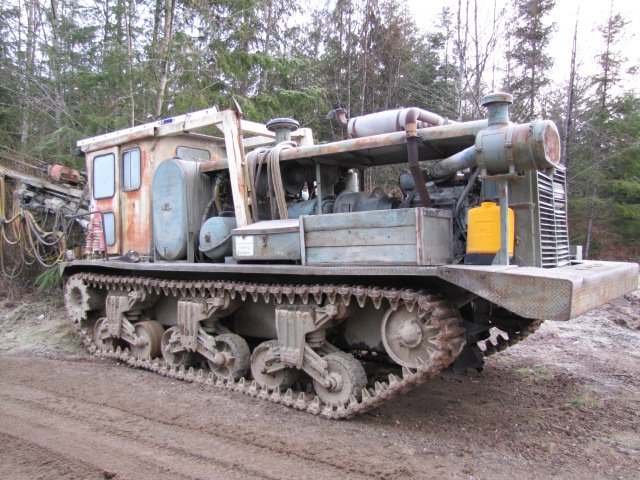
Several companies, Finning, Traxxon, and Morpac made rocking drilling machines based on Sherman hulls, the whole upper hull being replaced by the drill and superstructure. Madill seems to have specialized in converting Sherman hulls into mobile ‘yarders’,  a central tower with winches, used to pull freshly cut trees up to an area to be further processed and loaded on trucks. These companies were mostly Canadian, and Morpac is still making heavy duty off road load carriers based on Sherman suspension components.

Sherman-dozer by vickers

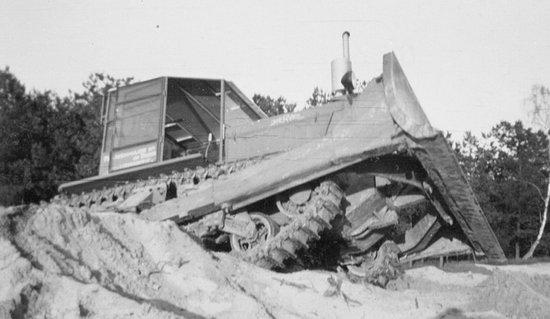
Vickers used Sherman hulls and suspension to make heavy duty tractors for peanut farming in Africa.  These heavy tractors were to be used to clear land for the farms. They only used the suspension, final drives, differentials and tracks, the transmission was different and they used a large inline six for power.

IMG_1105

Some power companies used drilling machines based on the Sherman tank as well, but I am not sure if they are the same as the drills made by Finning and Traxxon.  In at least one other case a company named Abdo S Allen Co. used a Sherman tank they bought surplus in the 60s as a heavy duty building destroyer. They used the M4A3E8 Sherman, with no dozer blade or anything to knock down large swaths of houses in North West Oakland California in the late 60s.  They could be the only destruction company to figure out they could use a tank for demolishing light buildings.

DSZ_7721
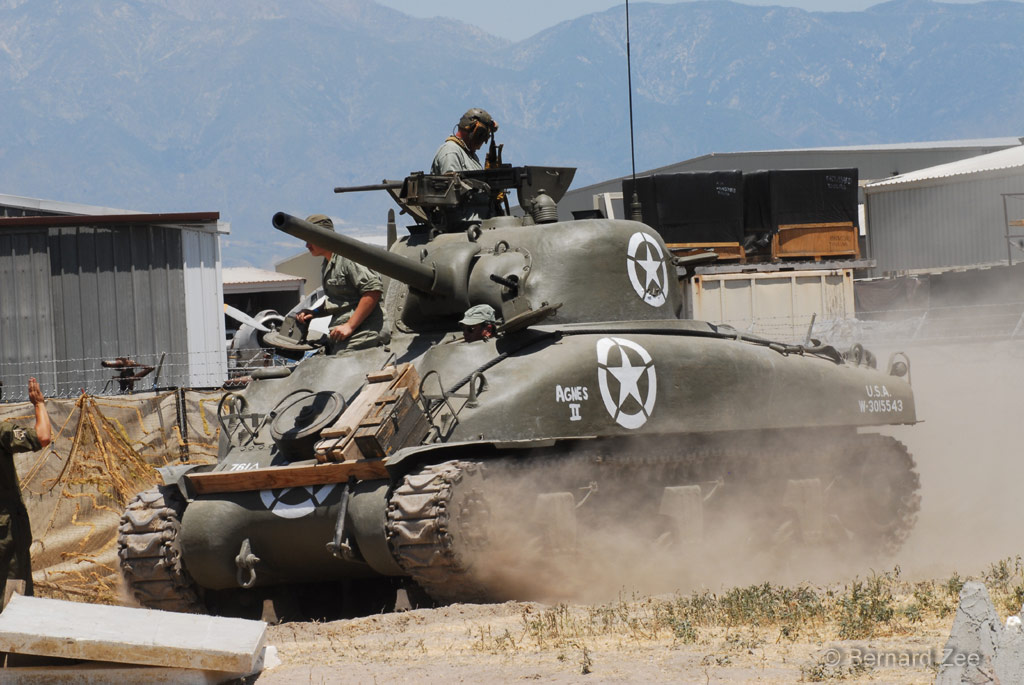
This is Agnes II, the Plane of Fame Museum at Chino California’s working M4A1. This tank looks like it’s in very good condition, and is an early small hatch tank.

In the 70s things began to change. Interest in World War II started to pick up, and that meant interest in the equipment, so museums for WWII equipment started becoming more popular.  The United States has always been interesting in aviation as a people. So WWII aviation was the first thing to really take off. It really started with surplus machines being used as air racers, and then many of the old racers, sitting around rotting, got bought up by men who wanted to own a WWII aircraft.  Some of these men founded things like the Confederate Air Force, or the Planes of Fame Museum in Chino.  These groups and many more keep aviation history alive by keeping the fantastic old flying machines in the air. It’s amazing that today, there is a larger variety of well restored and rare WWII aircraft flying than when I was a kid in the 70s.

49-e-1280
I can’t resist a chance to past Corsair porn. This is the Planes of Fame’s F4U-1A Corsair. They’ve had it for years and you can see the amazing Steve Hinton at the controls. This image is from www.warbirdsdepot.com

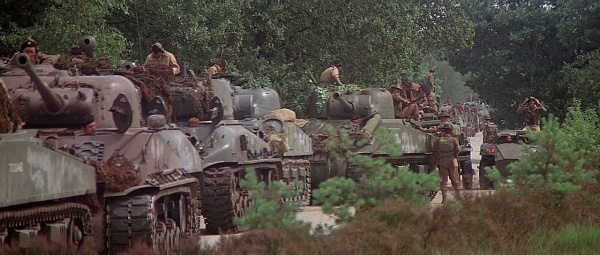
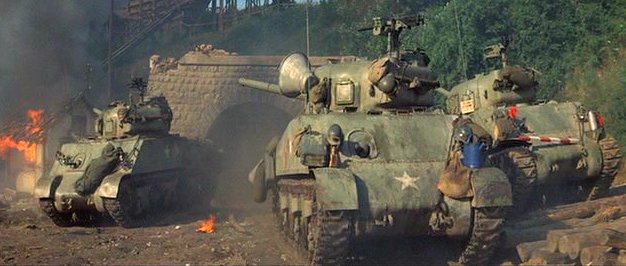
Hollywood made a few movies using somewhat correct airplanes, but most movies until 90s didn’t bother with accuracy in armor, and many of the big screen epics like, The Longest Day, the Battle of the bulge, and Patton, using more modern stand in tanks.  A Bridge To Far, broke the mold, and got a lot of running Shermans together, though many not exactly period correct.  Kelly’s Heroes was another oddball in that it used real Shermans as well, but their tiger was fake.

600px-BridgeTooFar_2015
A bunch of Sherman tanks gathered for the Movie, A Bridge To Far
tank-1984-james-garner
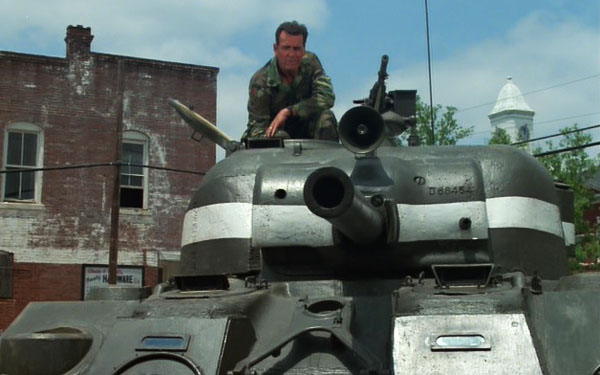
Jame Garner, on top of the M4A3 small hatch tank he is about to use to knock down a building, in the Movie ‘Tank’
action
Train yard raid in Kelly’s Heroes

As interest in WWII continued to grow, all forms of equipment became popular, and there had already been a few tank guys out there that had a tank or two, or whole collections. Tank museums, most in the US anyway, are owned by the government, and the displays are largely gutted, welded closed near hulks, rusting away in an outdoor display area. It’s not uncommon in Europe for a tank museum to have several runners they bring out for events various times a year for crowd pleasing displays.  There are a few museums in the US not owned by the government that are doing this now too.  One, at least in the past, I don’t know if it still runs, was the Planes of Fame museum in Chino California, they had a running Sherman they show off at their airshow. The Flying Heritage Collection in Everett, Washington, has a running M4A1 75 and a T-34-85 and do an event where they drive them around on May 30th! This weekend! Battlefield Vegas a huge shooting range in Las Vegas, has a large verity of Machine guns you can shoot and is resto modding a Sherman that they got off a target range.  The owner is planning on adding some more modern updates to it, for safety, reliability, and habitability in the Vegas heat. Since the tank was just about at the scrapping point, and I’m for A/C in everything, I see no problems with this at all.

ShermanTank05
This is the later production M4A1 75 Sherman the Flying Heritage Collection operates, it’s newer model but still a small hatch tank. Note the extra armor on the turret cheek and over the hull ammo rack

There is also a large group of people, who like to reenact WWII battles, and they collect the vehicles as well, but tanks in this scene are rare. There are small private tank museums that use their tanks in local events like veteran days parades or local airshows. Tanks are a lot easier operate and cheaper to maintain than a WWII airplane, and that may be adding to their popularity and value with collectors as well.  Aircraft require all kinds of inspections and certifications, and you have to store them in hangers, and if you don’t fly them regularly they will rot away. Since they fly, not being on top of all the required maintenance might get you killed.

M4_Sherman
privately owned and beautifully restored M4A1 76w

If your tank restoration project breaks down when your testing out the rebuilt Ford GAA,  you just fix it there, or have it towed back to your work area. It’s not going to fall out of the sky and possible kill you and other people. In both cases, to really work on it, you need some heavy equipment. You’re not pulling a turret, or motor (tank or plane), without a heavy duty hoist of some type, 10,000 pounds plus minimum, and that might not be enough to get a turret off.  Most tank motors the Sherman and other American WWII tanks used are pretty simple as internal combustion engines go, though the R975 radial would be pretty daunting to most car people, even it isn’t that complicated. In both cases they are thoroughly documented, but true experts on the motors who can overhaul them are few and far between, for both tank and aircraft motors.

M4105W
Privately owned M4 105

In the United States, it’s not all that hard, if you’re willing to pay the taxes and go through the government checks, to own a tank with a working canon.   Since the tanks were never sold by the government to civilians with working guns, the guns are often pieced together, with parts that don’t match, and this really takes the danger level of owning a tank to a new level.  Part of the added danger is the rounds can’t just be purchased, you have to find suitable used brass, not an easy task, and then hand load it with surplus or custom made projectiles and surplus powder. As dangerous as this can be, I’m all for allowing people to do what they want with the things they own, and having a working main gun on your Sherman is pretty damn cool.

Sherman M1 from the x littlefield collection2
An Isreali Sherman M1, that belonged to the largest private collection of Armor on the west coast. Until the owner died.

Now, these last few paragraphs have had a touch of tongue and cheek in them, owning a tank is a very expensive thing to do, and the bigger the tank the more money it will suck up each year, just less than an airplane.  A tank can’t fall out of the sky, but it is by no means safe, and doing any kind of work on it, or even climbing on and off of it, can cost you a finger or broken bones.  Putting an arm or hand in the wrong place while a turret is being rotated can get them messily removed. Falling off a tank while it’s moving is a bad way to die, but it happens.  It’s hard for people who have never worked with heavy equipment of any kind to realize just how dangerous 30 tons of steel is just sitting still.  That said, the people out there restoring WWII history, and keeping it running are awesome. Nothing beats seeing a Sherman tank moving around to really give you an idea of what the thing was all about. The Sherman people who go to the trouble to get the A57 in their M4A4 working are my automotive heroes!
the-tank
James Garner hauling ass in a M4A3 Sherman in the movie ‘Tank’

At some point in the 80s some producer or special effects place got their hands on a Sherman and it made appearances in shows like the A-team, Knight Rider and Airwolf. I suspect it was the same M4A3 used in the Movie ‘Tank’ with James Garner, and that is now owned by the Collings Foundation.  In more recent years, privately owned tanks, and some working museum vehicles were used in the making of the miniseries Band of Brothers on HBO. They don’t appear in many of the episodes, but they are in at least two. More recently the movie Fury was filmed using the tanks of the Bovington tank Museum in the UK. They also purchased an M4A4 hulk, and did a quickie ‘resto’ on it and made up a fiberglass turret that could be blown off, for the movies to often used ammo rack explosion.

fury

US_Sherman_(3666208242) (1)
M4A2 used in Fury, before it was kitted out for the movie


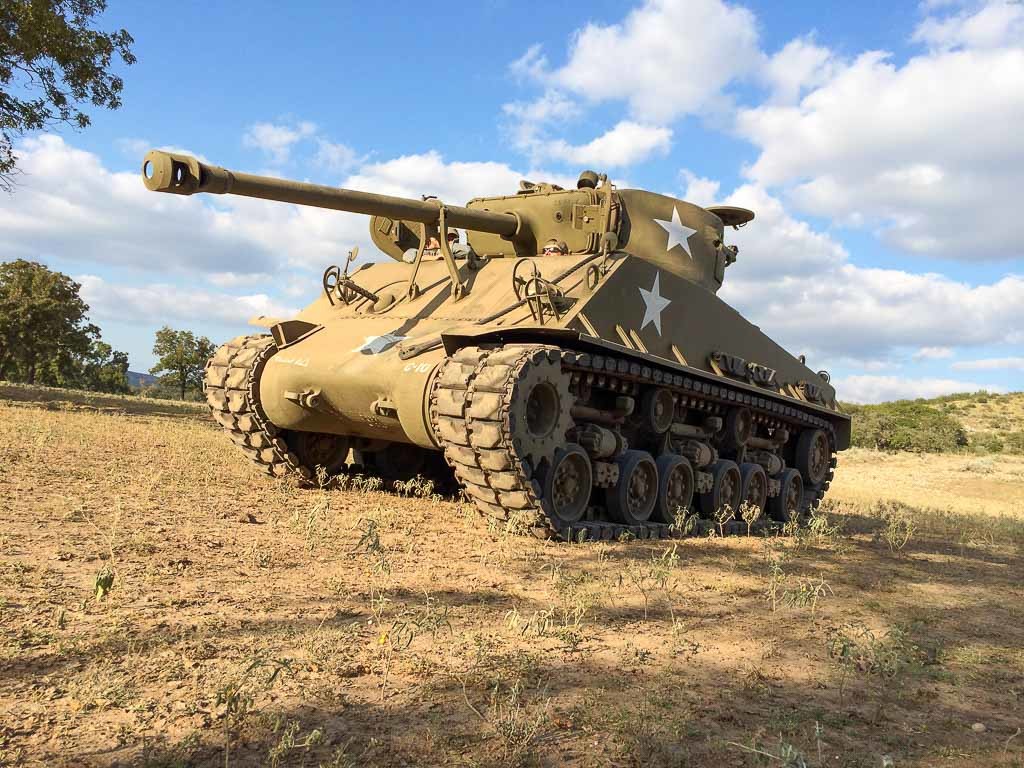
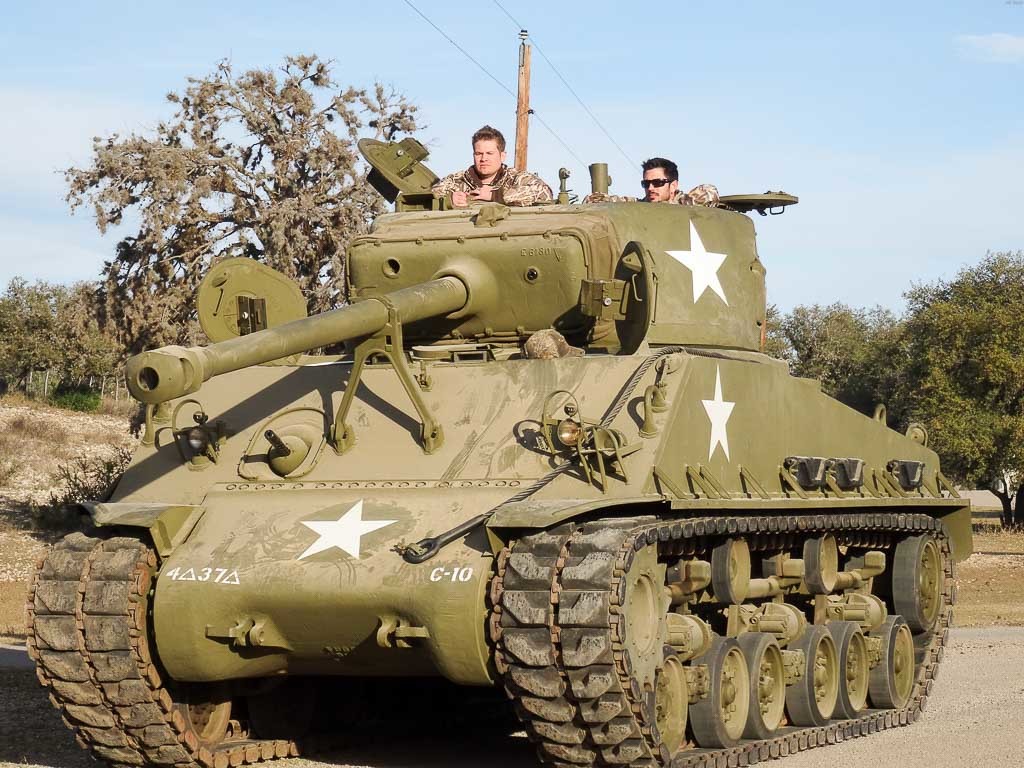
Another thing tanks get used for in civilian life is in ‘Drive a tank’ places like, Ox Ranch in Texas, and driving a tank isn’t the only thing you can do there! Machine guns, Off roading, hunting, tanks, this is like heaven!

sherman-tank-1024x768
OX Ranch’s M4A2 76w HVSS in action
tank-driving-sherman-1024x768
OX Ranch’s M4A2 76w HVSS in action

There are several other places in the US, and around the world like Drive a Tank in Minnesota and Battlefield Vegas, (Sherman in the works). You can pay for a package that often includes driving several kinds of vehicles leading up to the tank of your choice. They often offer add-ons like shooting machine guns or running over a car you supply, for various fees. The places that have a Sherman usually don’t use it in the car crushing displays; it’s usually a bigger tank like a British chieftain.
M4DV
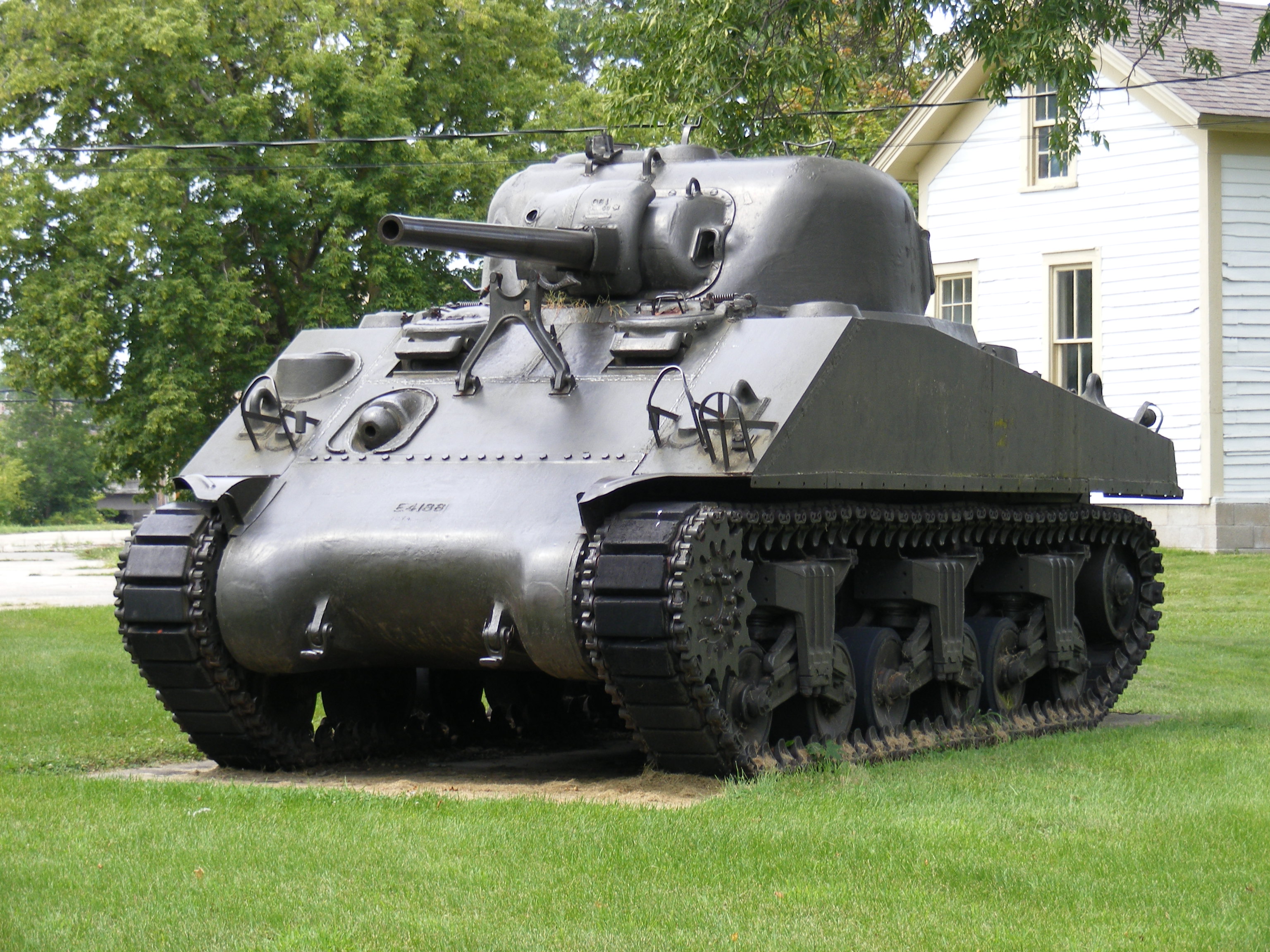
M4 tank in front of a VFW

The final civilian Sherman type I want to mention is the kind you find in front of VFW halls, or town or state parks. The tanks in these cases are not actually civilian tanks. The Army still owns them more or less, so if the place they are in happens to close down or change, the town or VFW can’t sell the tank. The Army will come and get it, and they are supposedly responsible for keeping them up, but in reality, they are usually pretty rusty on the inside, and often have the floors starting to rust through.
 

Sources
  1. Warhistoryonline.com Civilian Shermans: After war they went to work 
  2. The Rusty Grapple: Logging History Online
  3. Yesterdays Tractor Co.
  4. Battlefield Vegas
  5. The Ox Ranch
  6.  Drive a tank

#56 Special Gallery 1: Shermans of the Fort Benning Digital Archive

Special Gallery 1: The Shermans and Lees of the Fort Bennings Digital Archive.

Fort Benning, a very active US Army base in Georgia has put up many very interesting historic Photo Galleries.  You can find the website here  The Gallery these Sherman photos came from is the Historic Photo Gallery.   These are just the Sherman and or Armor related images in the gallery, there are many more from Vietnam and Desert Storm.  

37TB 4AD tank gunner SEP 1944-X3
The tank is from the 37 TB, of the 4th AD. This caption says the man in the photo is the gunner,  September 1944, the tank is either an M4 105, or an M4A3 105, from the location of the M2, I’m going to say, M4.
M4 Medium in Korea
This is an M4A3 76 HVSS tank in Korea, by this point, the water jackets on the hull ammo rack would not be in use. One hint it’s a post WWII Sherman is the first aid kit mounted on the side of the tank. I can’t make out the markings it looks like 7-32-1 on the co drivers side of the differential housing, and a triangle 13 on the other side.
10AD training 1943-X3
10th AD training in 1943, the tank is an M4.
22--Tank Maint in Bel SEP44-X3
A tank crew cleaning the tube, in Belgium 1944, the curved hull corners say M4A1 to me.
10--3d army maneuver maint-X3
An M2 Medium having some heavy duty field repair work done. 
WIA Evacuation w tanks
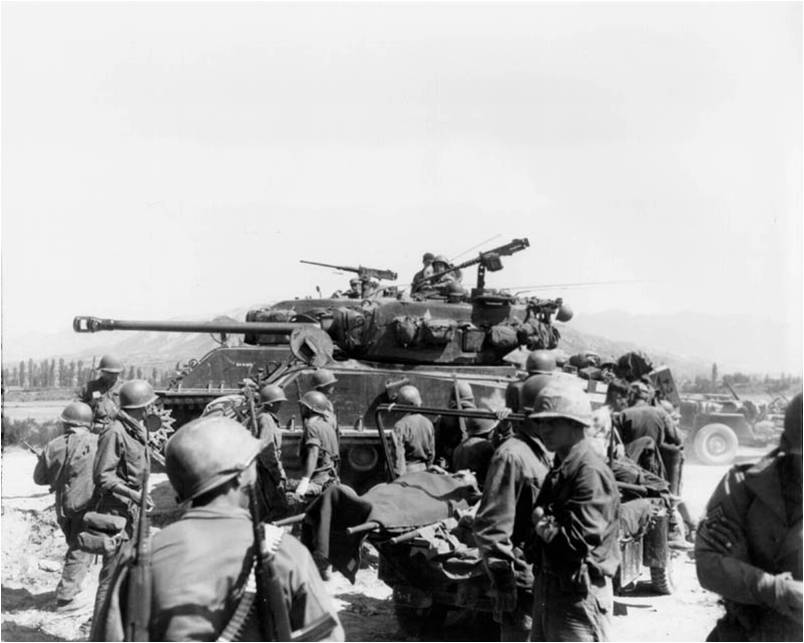
The photo caption says WIAs evacuated via tank, and it looks like Korea. The tanks are M4A3 76 HVSS tanks
19--M3Med-NATO-X3
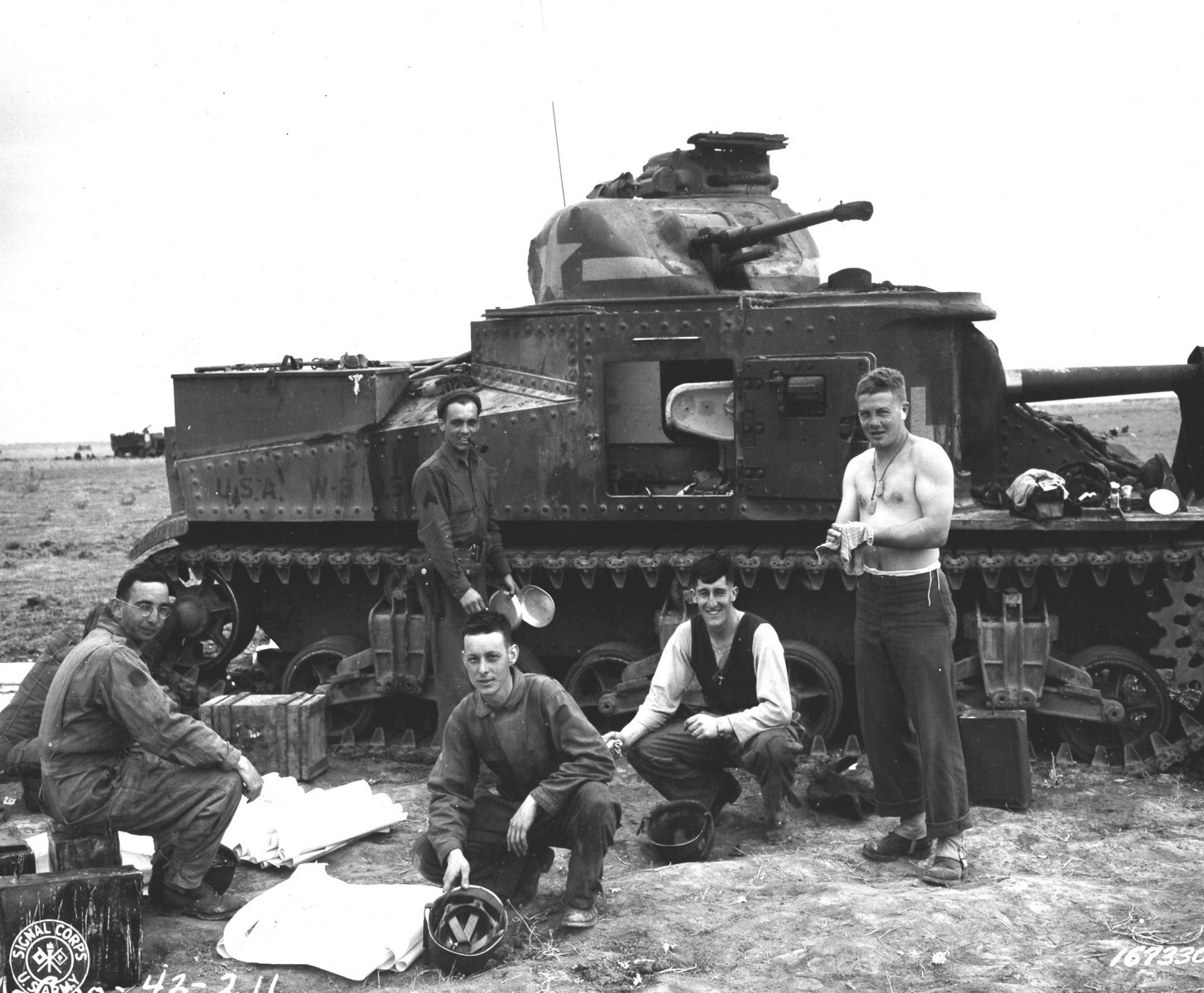
Most of a M3 Lee crew getting ready for some chow in North Africa
20--1AD in Italy-X3
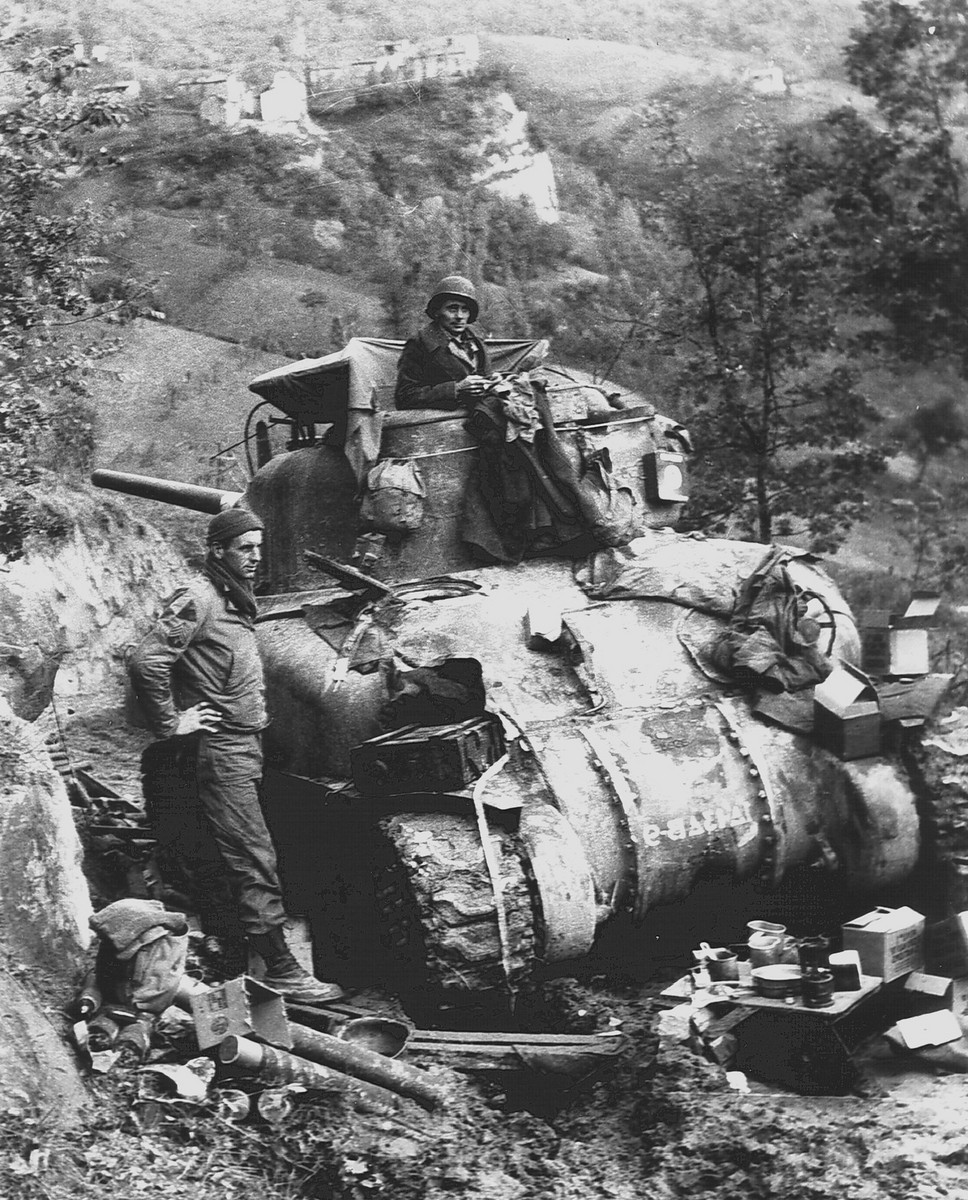
This is a really interesting picture, the tank is an M4A1, it has small hatches, but has the improved, no DV port casting. The tank is with the 1st AD, somewhere in Italy. Note all the mud, the blanket draped over the commanders hatch, it was probably rainy and humid.
24--761ST TB-X3
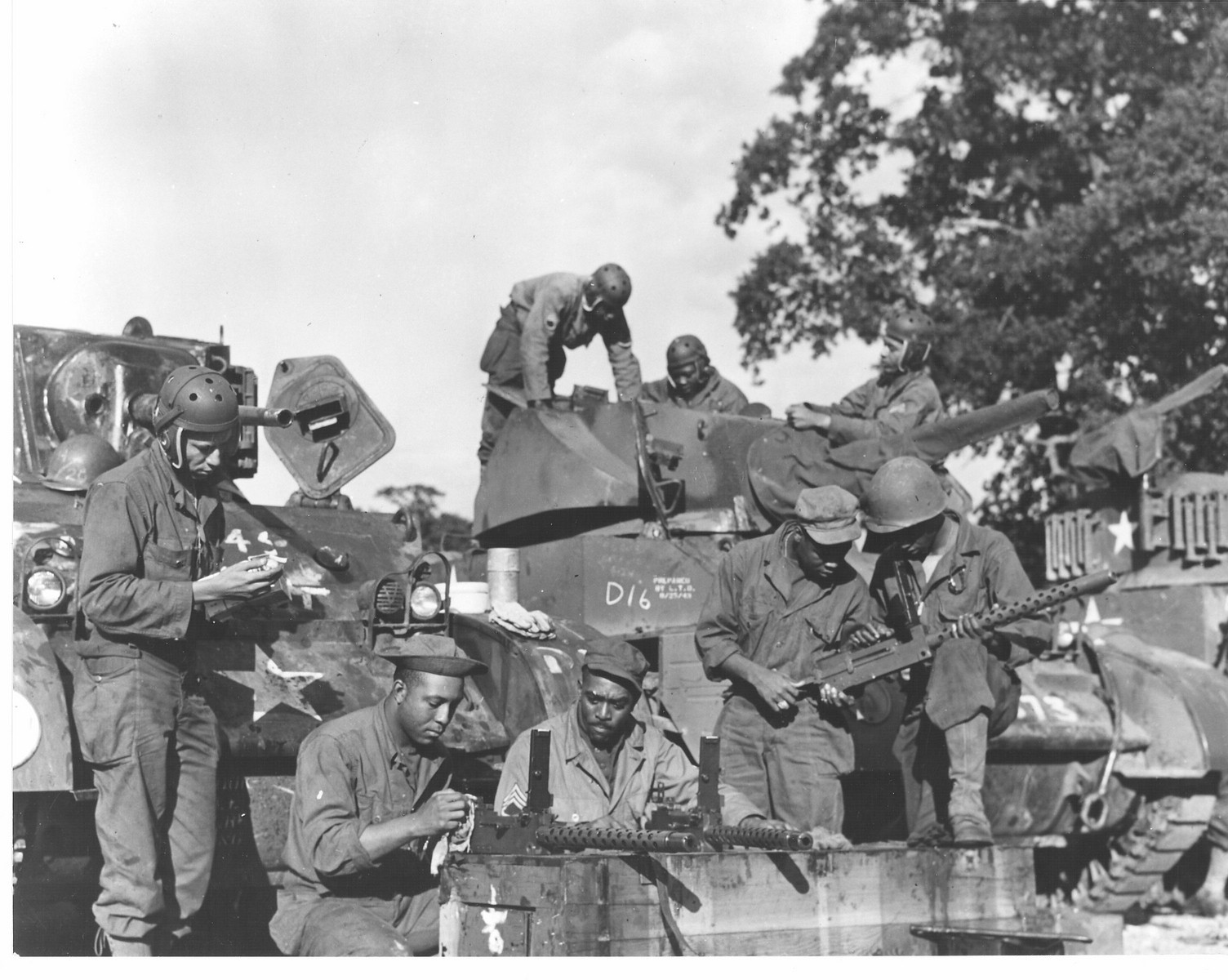
Men of the 761st TB clean their M1919 machine guns in front of their M5 lights.
2AD tank in Bel DEC44-X3
This is an M4 with the 2nd AD in Belgium December of 1944, it looks like it has all the quick fix upgrades.
66AR 2AD crossing obstacle SEP44-X3
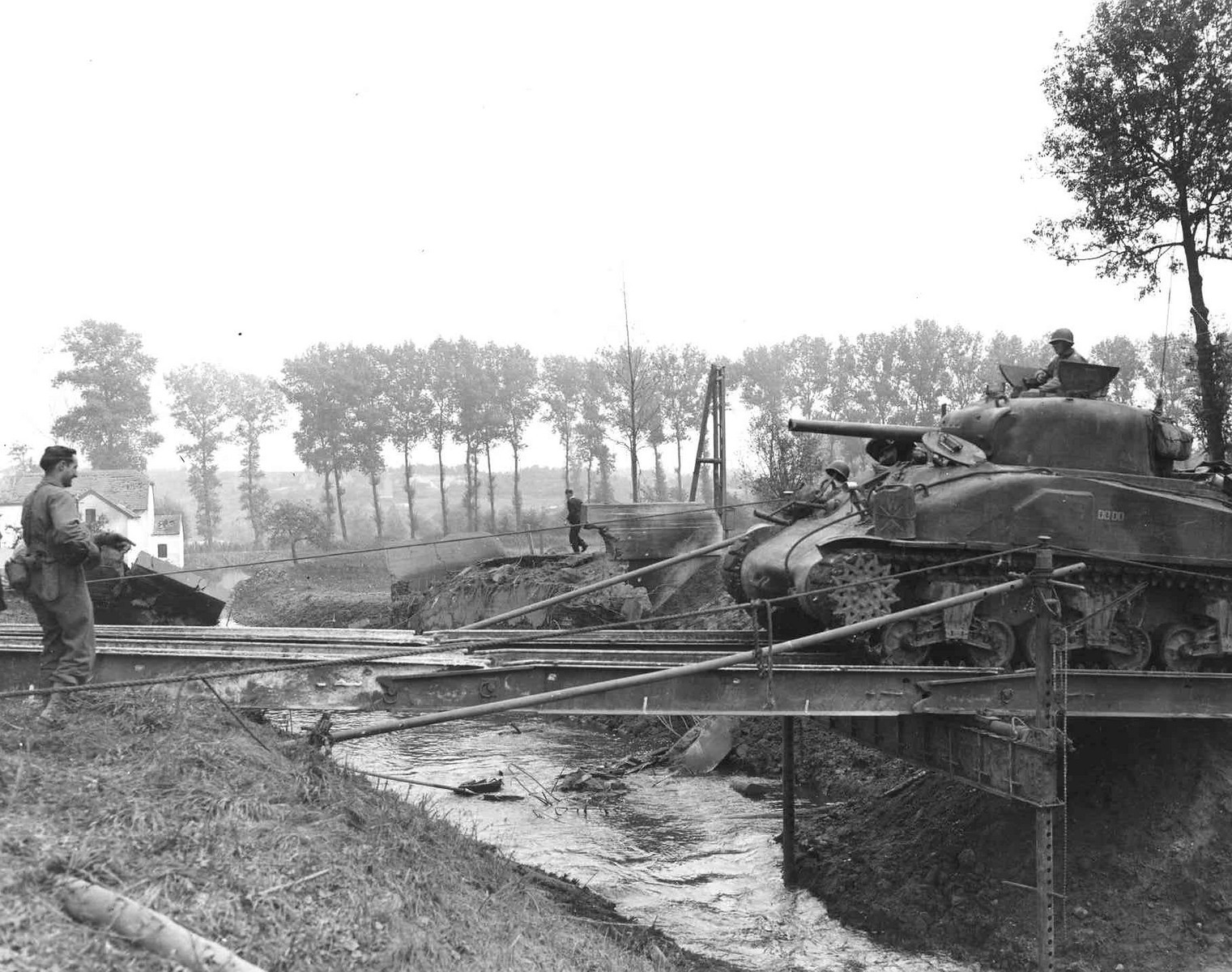
An M4 composite hull, with the 66AR of the 2nd AD, crossing small gully on a very rickety looking bridge in September of 1944
1AD tank crew NATO NOV 42-X3
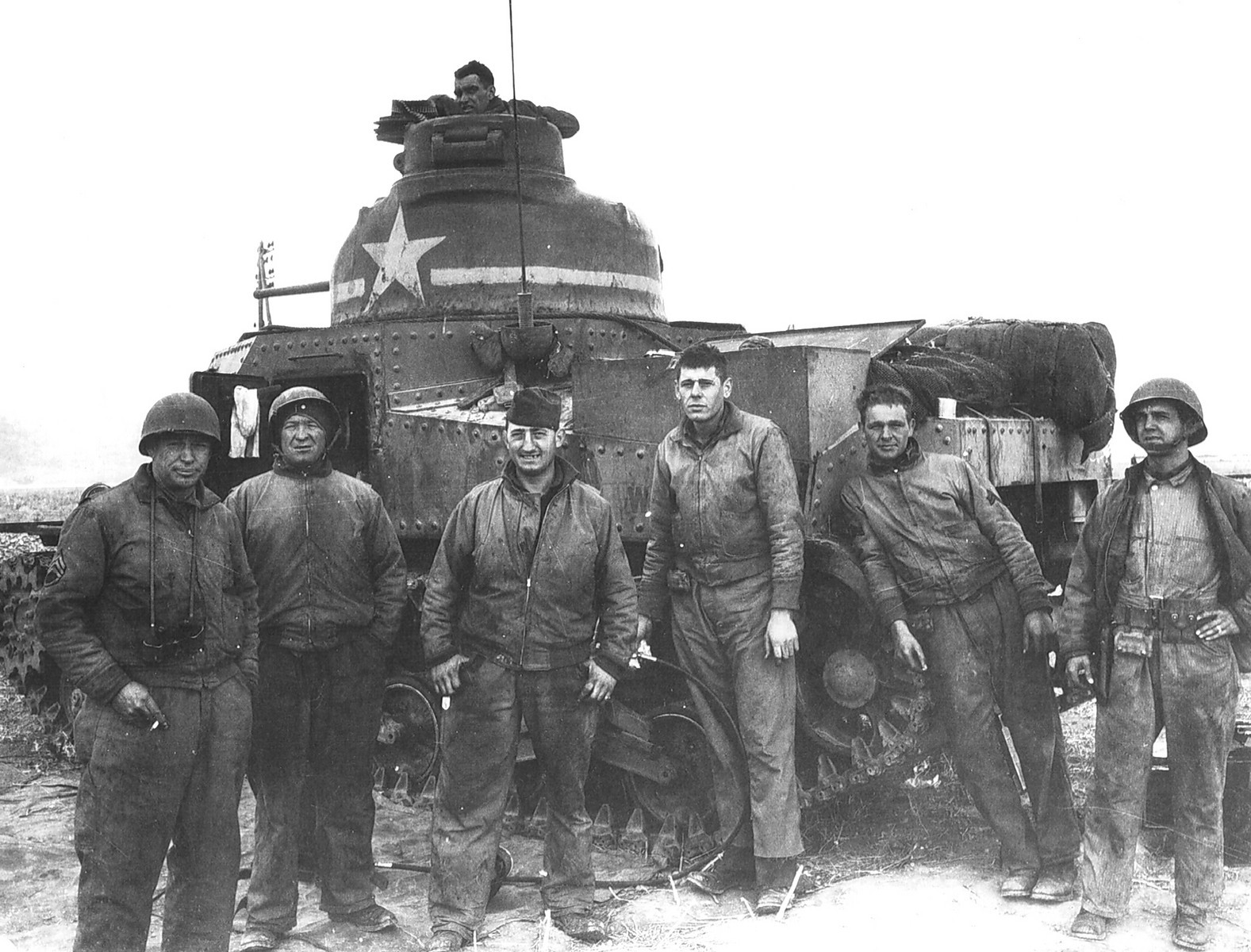
1st AD M3 Lee crew somewhere in North Africa, November of 1942, man, do these guys look dirty or what?
Armor in Brittany AUG44-1834x1007
A US Army M4A3 in Brittany, August of 1944
1AD column in Italy-X3
A platoon of M4 tanks in Italy, with the 1st AD.I wonder if they planned to try and climb that hill… Probably not. 
M5 in ETO
An M5 light somewhere in the ETO
Tank-inf team
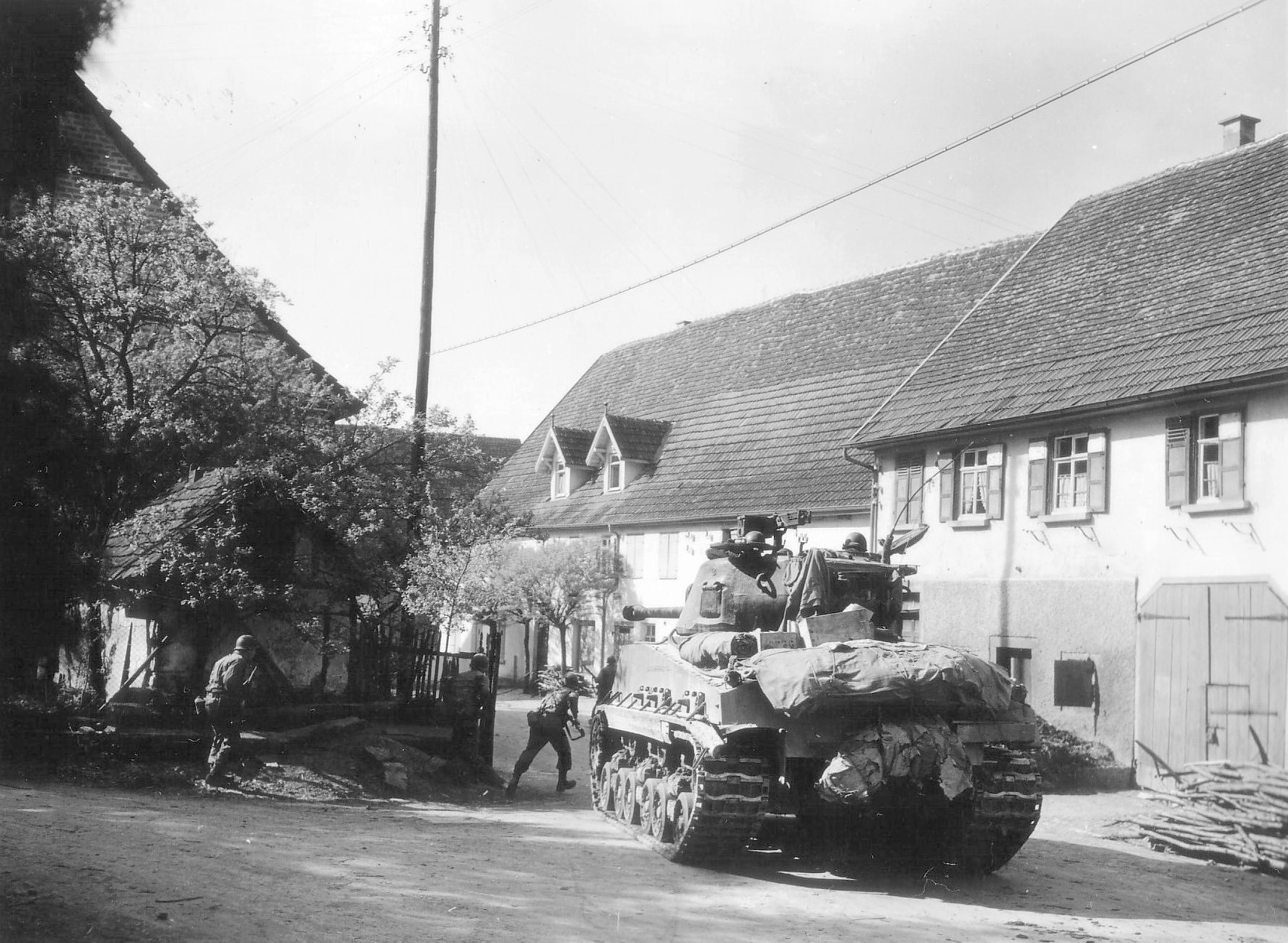
This photo is labeled ‘tank infantry team’, the tank is an M4, and it’s probably somewhere in the ETO.
1AD elements near Anzio-X3
1st AD M4A1 tanks near Anzio, note all the storage on the back deck, a large tarp and a big bundle of camo netting. 
Tank-Inf team in town
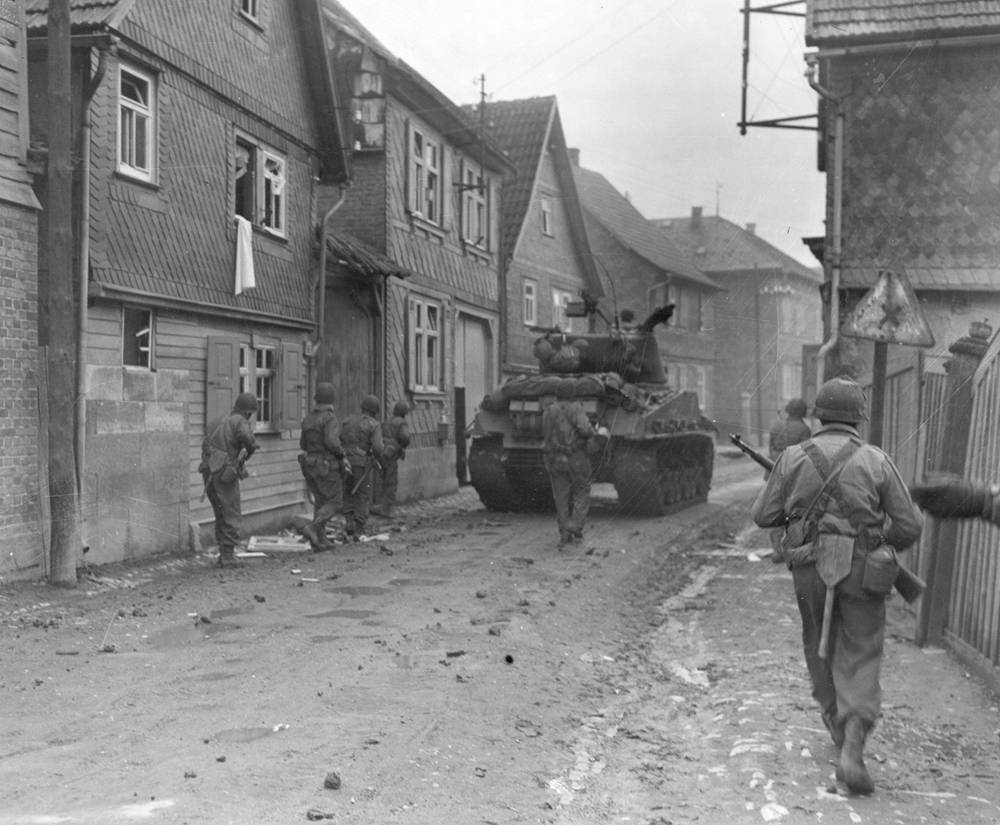
This image is labeled Tank Infantry Team in town, the tank is an M4A3 76w HVSS tank, and it’s somewhere in the ETO, probably Germany, in 45.
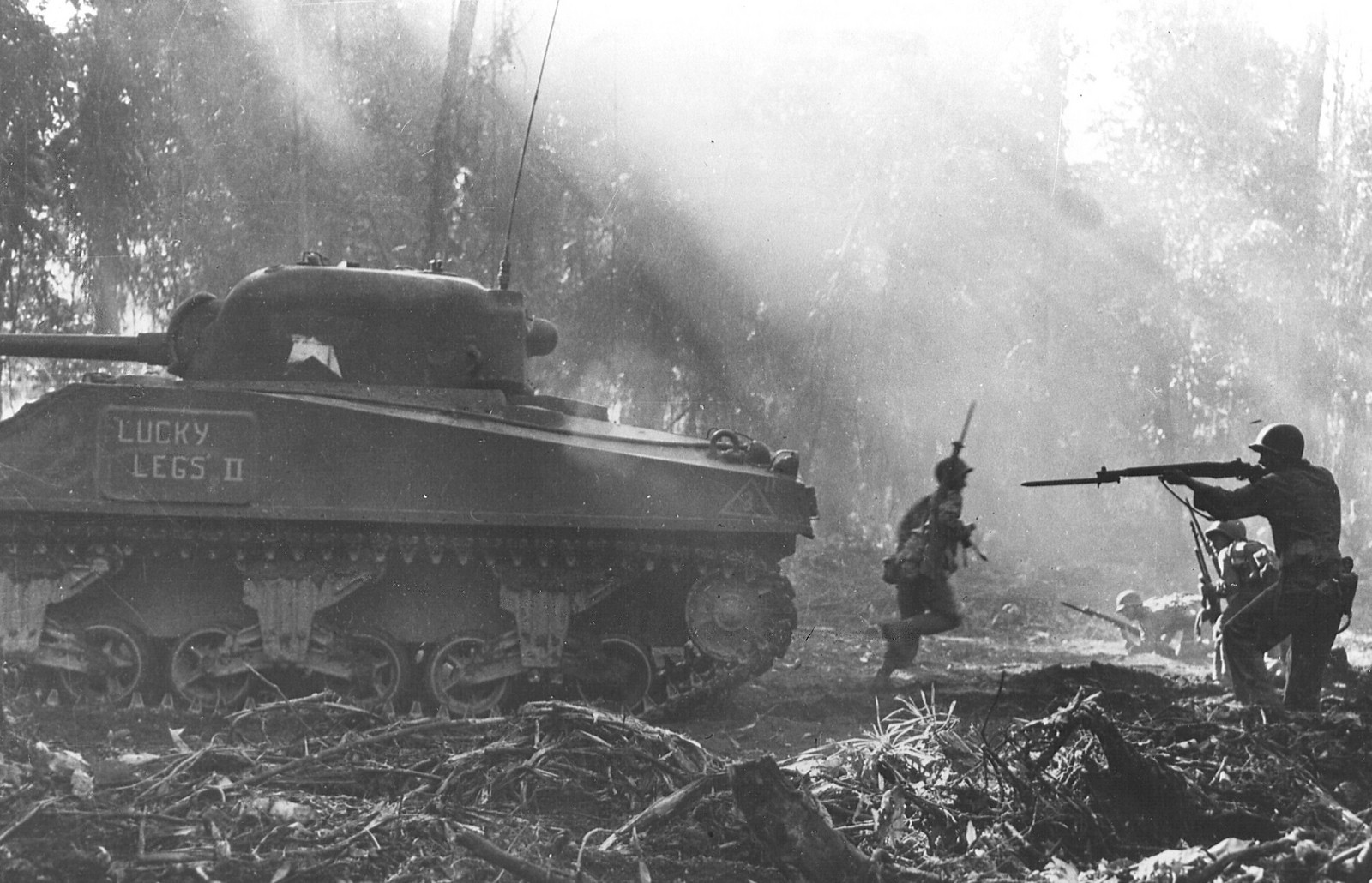
Tank-inf at Bougainville MAR44-X3
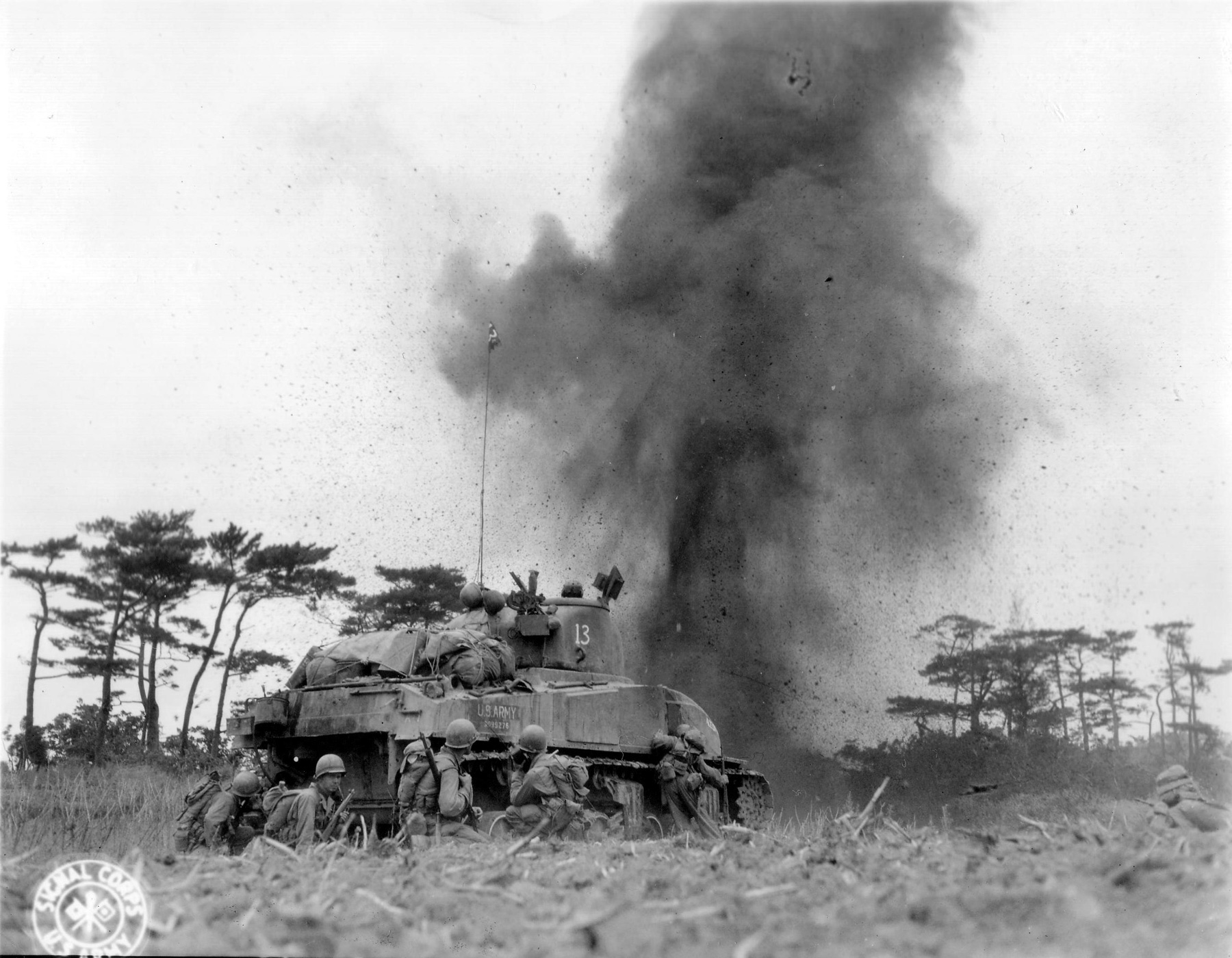
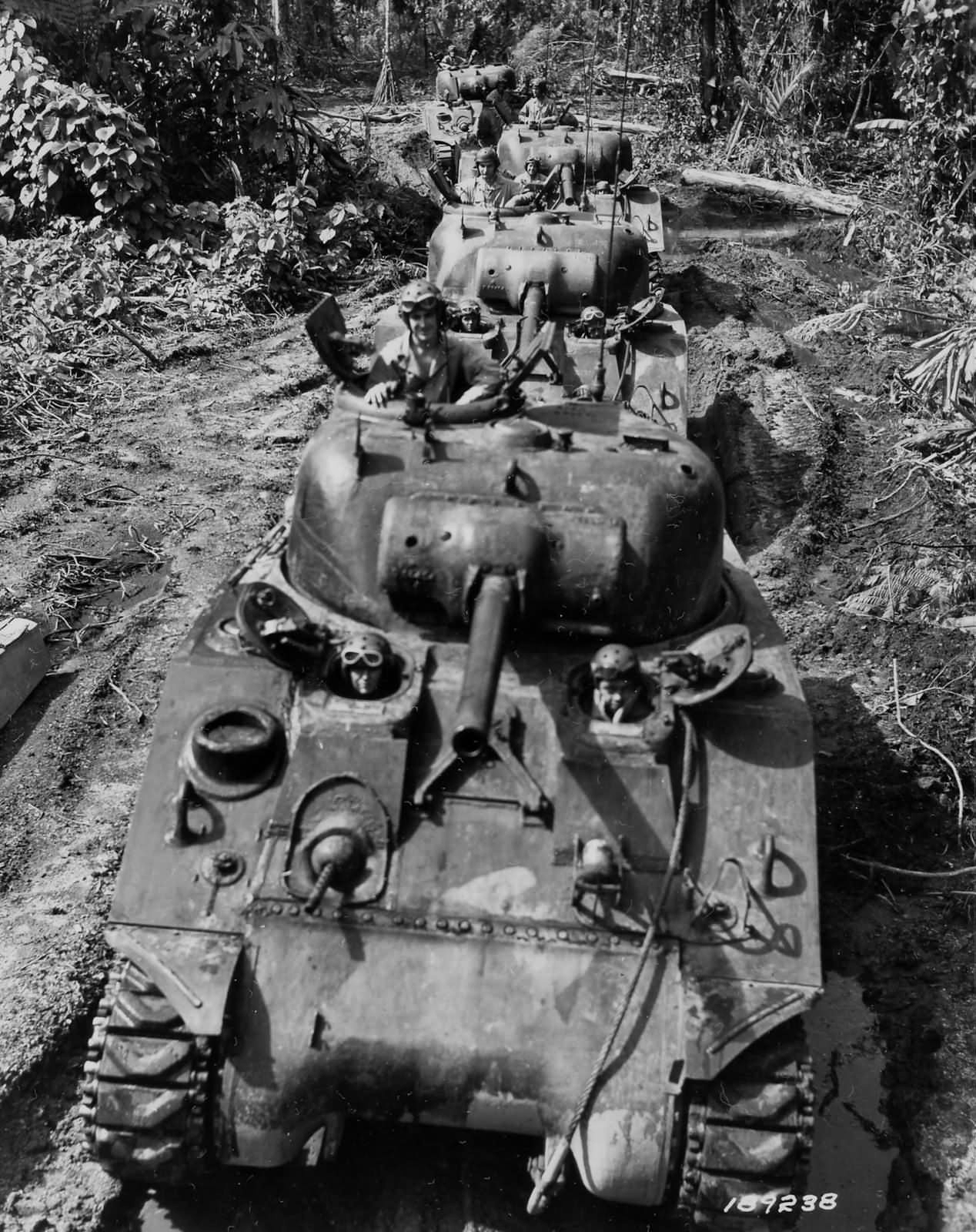
This one is labeled Tank Infantry Team Bougainville 1944, and the tank is the famous Lucky Legs II. I think I have more info about this tank and it’s battalion here somewhere. More info from Belisarius, ‘An M4 Sherman named ‘Lucky Legs II’ of 754th Tank Battalion leads the attack with infantrymen following close behind with fixed bayonets on the perimeter of the 129th Infantry, 37th Division, Bougainville (Papua New Guinea, in the Solomon Sea). 16th of March 1944.
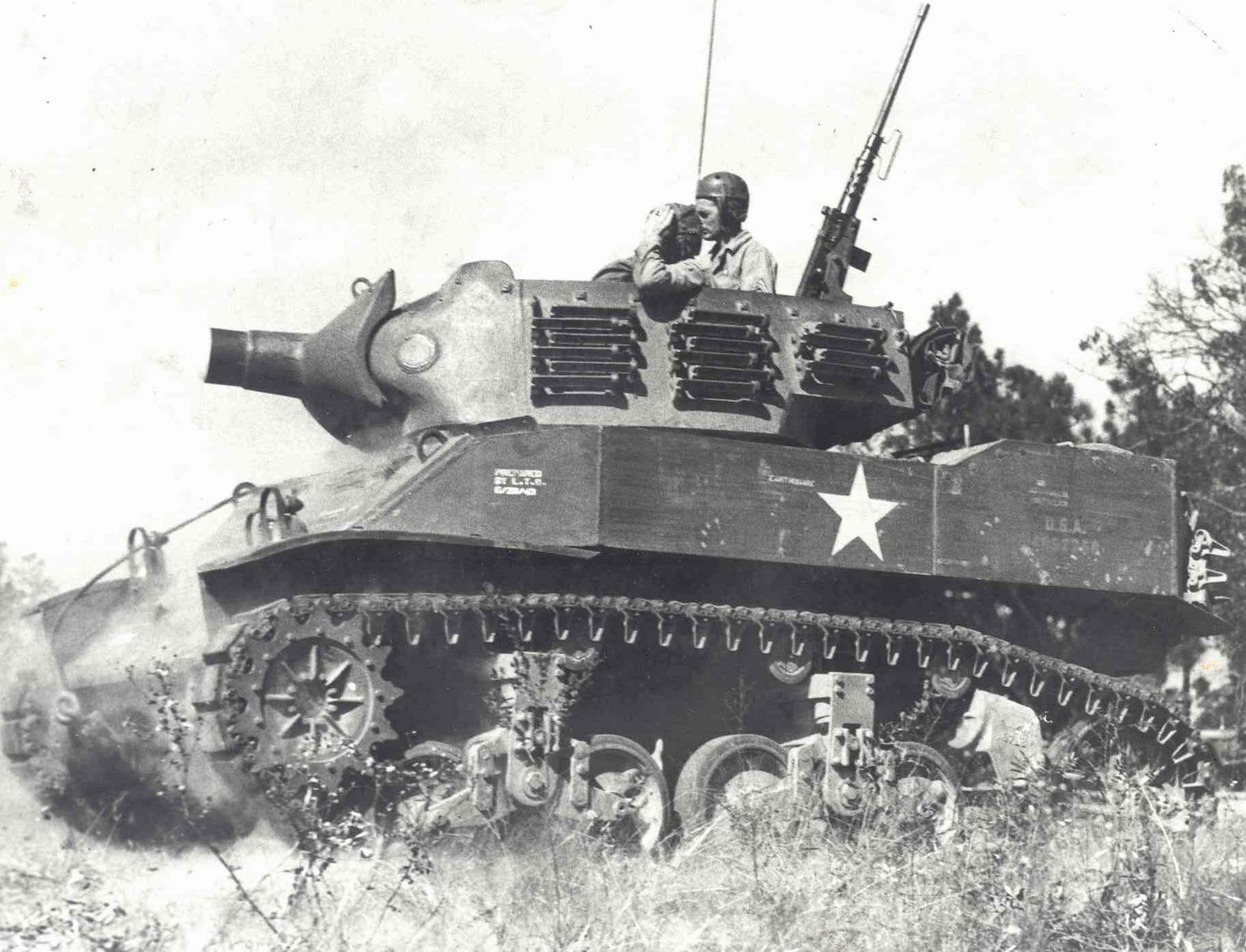
5--M8 HMC training 1943 (Armor)-X3
An M4 HMC, or Howitzer Motor Carriage.

#55 City Tanking: The Tank Infantry Team in Cities and Towns

City Tanking: The Tank Infantry Team in Cities and Towns

Tanks and cities do not like to mix, but when your job is to support the dough on the ground when they go into the city, so do the tanks.  So when your Armored Division is ordered to attack into an urban area or the infantry division you’re supporting as a separate tank battalion goes into a city, so do your Shermans. When you really think about it, it’s a lot safer in a tank in an urban environment than for infantrymen, since they face all the same threats, but the tank has armor…

easy8 france, unknown unit
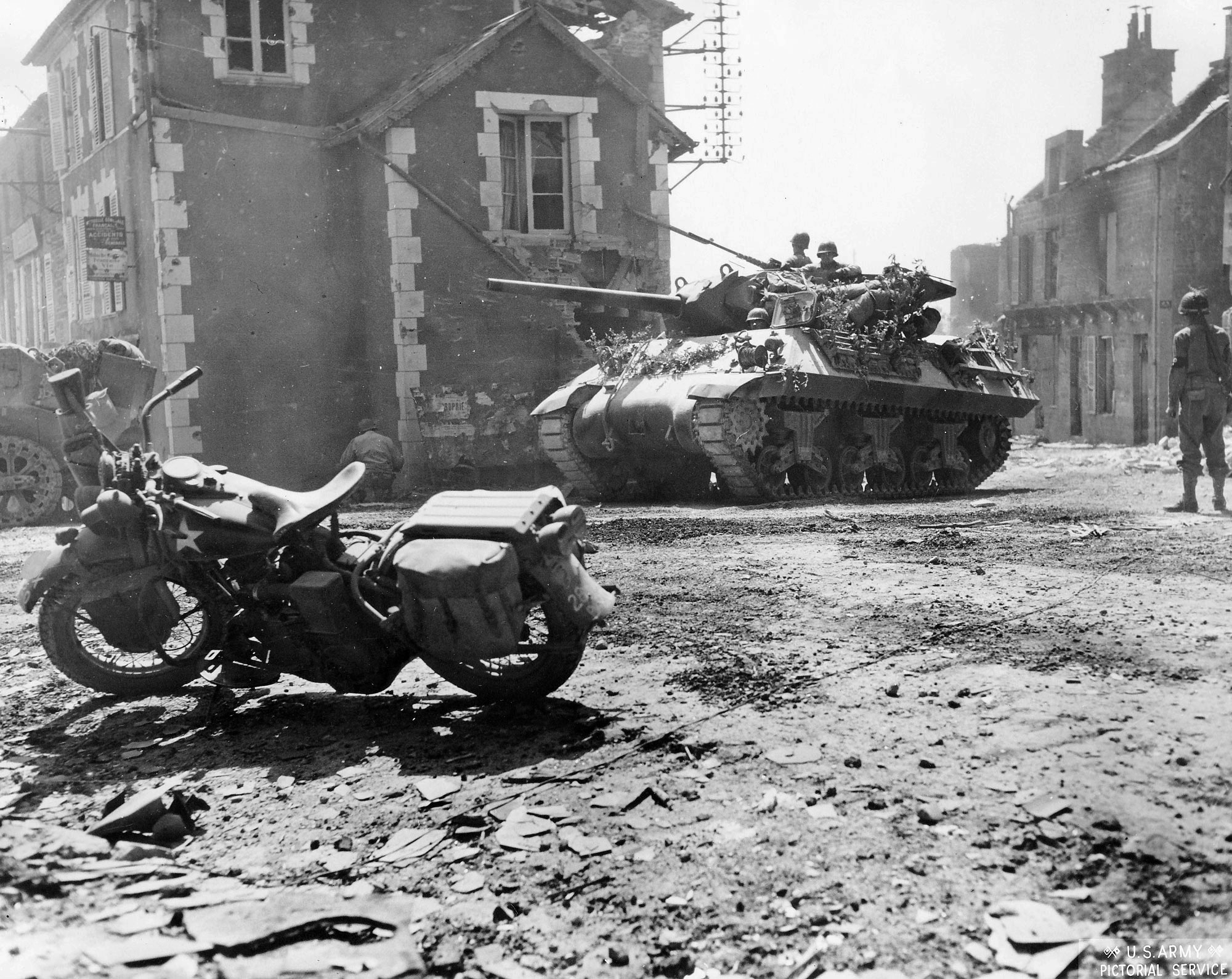
An Easy 8 in France, in a town, in action 

All the hiding places and areas tanks can’t see or reach is what makes a town or city far more dangerous to armor. More than forest or jungle, the city gives the enemy infantry so many good places to hide, the already nearly blind tank is at just about as big a disadvantage as it could be at, and they only have the firepower to use to thwart it, and at times the firepower was restricted. The clever US Army soldiers came up with solutions for this, like every other problem they encountered during the war.

g905056563
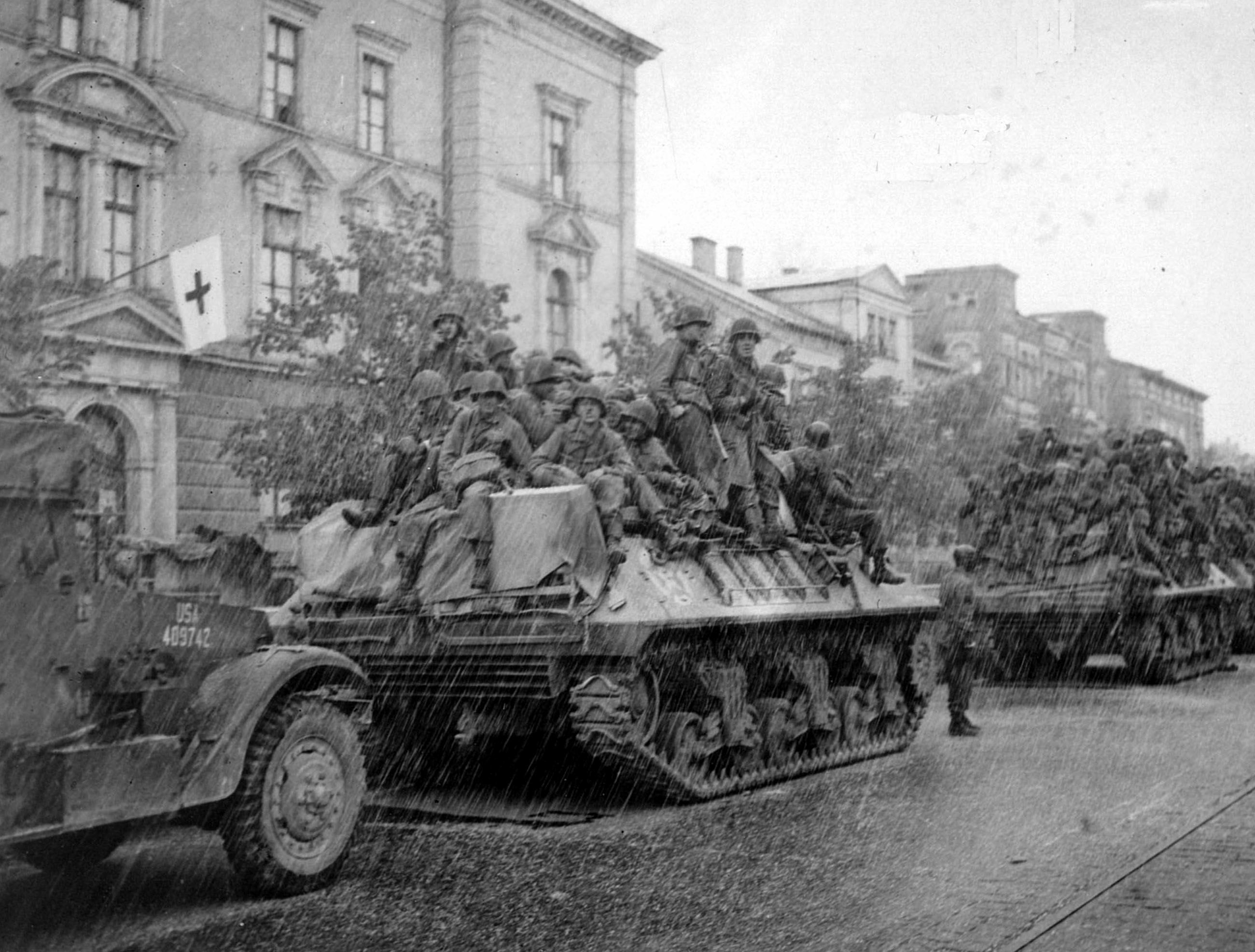
Heavy rain coming down on doughs, on an M10A1 in a city

The main threats to a tank in an urban environment are enemy grunts with TD weapons like the Panzerfaust or Panzerschreck, or even just grenades and improvised explosives.   Anti-tank guns would also still be a serious threat, but they are harder to hide in a city, but if they can be emplaced in the right kind of building, a stone, heavily constructed one, or area in the city that could cover many roads, like a hilly, mid-city park they can make a very tough strong point. In Europe, there are a lot of heavily constructed buildings too, but also large numbers of wood buildings a Sherman could bring down with ease, as long as it didn’t have a basement. If the defenders of the city have time to figure out all the good site lines and emplace things in ideal spots if they know a fight is coming, they can really make a city into a fortress.

stupidtankistupid
I threw this one in to show German tanks had all the same issues in urban areas that the Sherman did.

The defenders of a town or city have a big advantage in setting up their defenses. First off, they know the layout of the city; they would not just have maps or aerial photos to rely on. They can also blow up buildings and create roadblocks to channel attacks.  When they set their city defenses up correctly they can set up roadblocks, covered machine guns, or even AT or infantry guns, which could not be engaged by the attackers behind the roadblock because of buildings and other obstructions.  Another advantage the defenders would be sure to use would be pre ranging in their artillery and having it ready to drop right on key areas. If the town had any castles or other historic, large stone buildings, these would be troublesome hardpoints and in some cases bigger than the Shermans cannon could deal with.

100593
Brit Shermans moving through an urban area

Another big threat to everyone was the sniper. A hell of a lot of tank commanders, infantry sergeants, and officers got offed by German snipers. Its well know, in the ETO, MTO, and North Africa, most American tank commanders fought un-buttoned, making them prime targets.  It takes a ballsy sniper to take on a tank because if they miss and the commander spots them, he’s going to respond in one of three ways.  By shooting at him with the tanks co-ax, by shooting him with the .50, or most likely of all, the 75mm with an HE round or WP round. Or all of the above and it takes even more guts to try and shoot a panzerfaust or Panzerschreck, and they get all of the above for sure.

771st_Tank_Battalion_M4_Shermans_Supports_17th_Airborne_Division_Muenster_II
771st Tank Battalion M4A3 76w tanks move through a town

All these things that make city fighting deadly for tanks make it absolute murder for the foot soldier.  In a tank you have armor, and if done right, a lot of men outside your tank there with the sole duty of defending it.  Including a dough sergeant riding on your back deck talking to your commander and when the shit hits the fan, the commander buttons up and the sergeant gets on the phone at the rear of the tank and tells the commander what stuff to shoot. The key here though is they are outside, and the only cover they’ll have is the buildings around the tank or the tank.  Far more doughs died in every engagement than tankers, and even more, would die without the tanks around.

0_155aa2_2f5da4ec_orig (1)
An M10 in a town

The proper way to use armor in the attack on a town, or city, was to start by offering to let them surrender. If they didn’t, depending on the politics around keeping the village intact, they may or may not shell the hell out of it before attacking. In many cases, the Nazi scum was occupying buildings in towns of countries they conquered and couldn’t care less if the places were wrecked and the town’s people killed when they were forced out. The Allies cared to some degree, but only so much, and if the Germans put up a really stiff fight, some big divisional artillery would probably be called in.

5tharmy
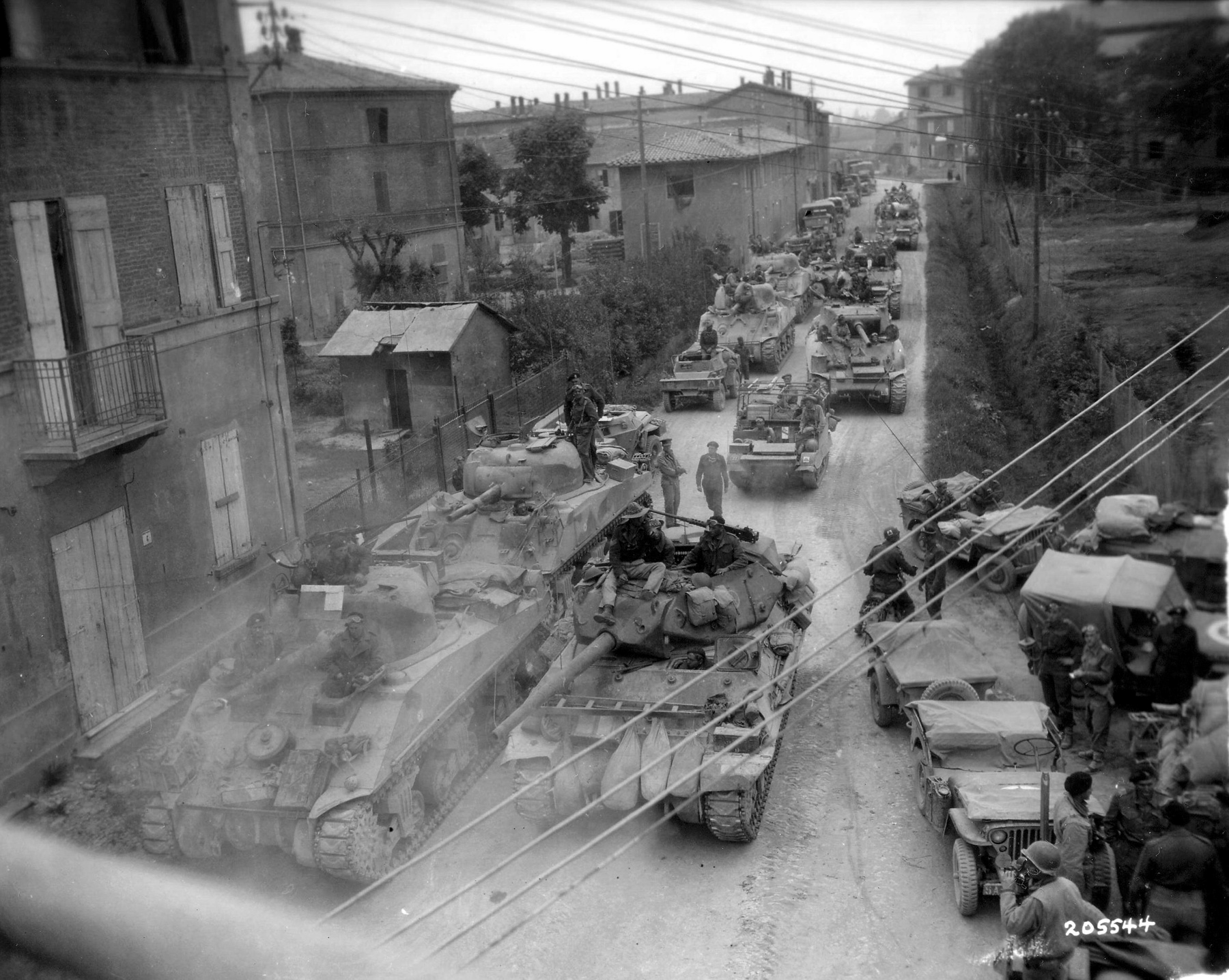
A bunch of 5th Army tanks in a town

The next step, in any case, would be for the infantry doughs to move out. They move into the town ahead of the tanks and will take the buildings on either side of the roads the tanks will be forced to work on before the tanks move up. If there is resistance in the first buildings, the tanks will be in view of them and help support the infantry with direct fire. Once the buildings were secure, the tanks would move up, and the doughs would begin to attack the next set of buildings, that the Shermans would now be close enough to fire into.  If the first buildings are tough, the tanks may move up a little to support the infantry pulling back.

M4_Sherman_6AD_Belgium_1945
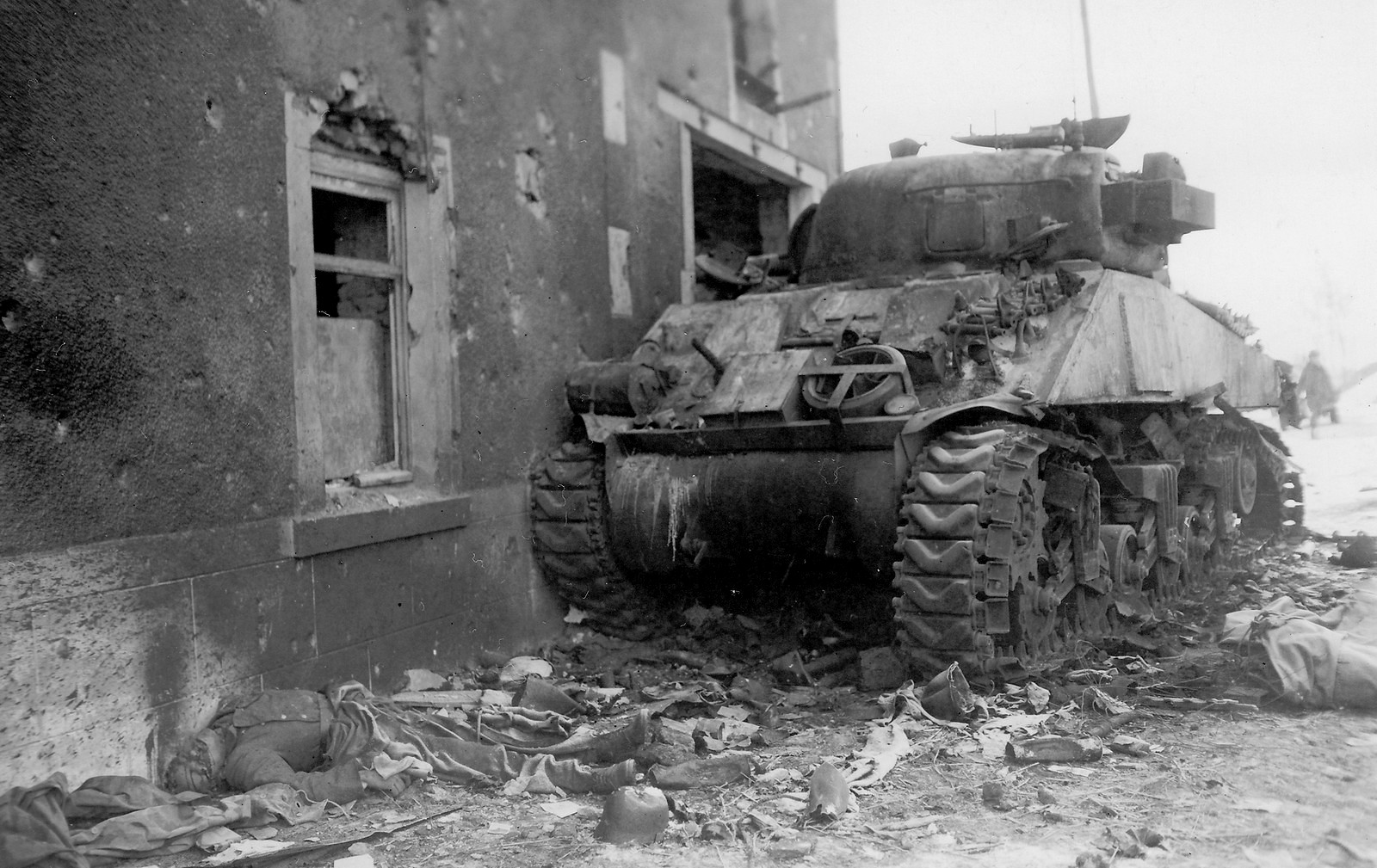
6th AD M4 knocked out in a Belgian town

Once the attacking force had penetrated into the town or city, they have to be ever watchful of the German counter-attack, that the Nazi forces, who knew the places they were just forced out of well, would attack, and try and cut off the tanks, sometimes using clever routes the allied forces might not know about. If they succeeded the tanks were in trouble, because the infantry could attack them from several directions at once, and while the turret was facing one way, walk right up and place a charge a weak spot and blow the tank up. The key here would be if the US line was getting weak for the tanks to pull back with the doughs, shooting the hell out of the buildings as they backed out.

M4A3E8_Sherman_HVSS_with_76mm_gun_10th_Armored_Division_Rosswalden_Germany_1945
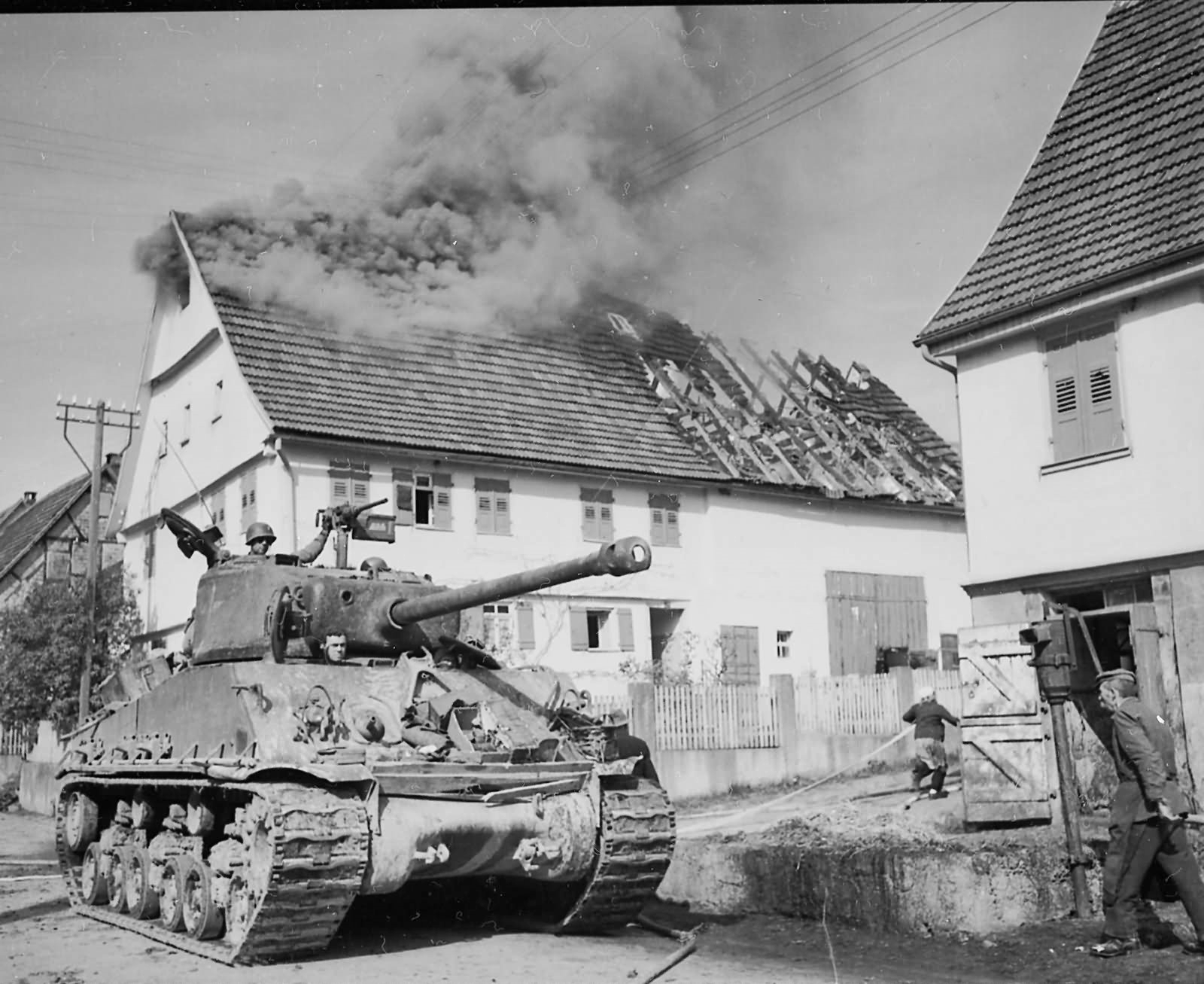
A 10th AD Easy 8 in Rosswalden. Fenders are beaten up, the wood on the front is cracking, and the co-driver needs to put on his helmet.  Also, note the poor lady in the background trying to fight the fire.

Most of the time pulling back wouldn’t be needed, the Sherman tank when supported properly, could make short work of all but the most massive buildings. The 75mm guns 1.5 pound TNT HE round would make short would of wood buildings, and WP smoke would fill it with smoke and set it on fire. For harder buildings, constructed of things like brick or stone, they may have to punch a few holes with AP before sending HE rounds in through the same holes. Plus the Sherman has two medium machine guns, and the turret .50 manned by a dough adding to the firepower.  For anything really stubborn, they could bring in the 105 Sherman with its 6 pound HE charge.  We also know Shermans, even when working with independent tank battalions tried to at least operate in pairs.

14AD_M4A3_Sherman_05_1945
14AD M4A3 76W in an urban setting, doing what Tank crews and GI’s, in general, did a lot, sitting around bored to out of their minds. 

Even using the best tactics, tanks were lost, and many doughs went down, and while in allied countries, retaking ravished and conquered lands, restraint was encouraged and often shown. This was not the case in Germany and other pro-Nazi countries. Once in the lands of the enemy, and after seeing concentration and death camps most allied troops were unwilling to show restraint when the Nazis decided to make things hard and use a town as a strong point. Burning a whole town flat wasn’t out of the question if the Nazis fought hard, or the population helped much.

Arnoldsweiler-Germany-45_104th_ID
A pair of up-armored M4A3 tanks in Arnoldsweiler Germany, both knocked out. 

In some crowds, it is popular to decry the treatment the German people got by the Allies when the tied had turned and it was clear Nazi Germany was done for.  I’m not going to knock the good guys for being harsh to the Germans, soldier, criminal SS, or civilian, I didn’t have to fight against the evilest regime in modern human history, and see the evil shit they did first hand, and am more than willing to accept they felt some Nazis, no matter their age, sex or type, deserved no mercy.  The Nazi regime showed no mercy for the 6 million Jews, and 6 million other undesirables, after robbing them of everything including their hair, before murdering them in the death camps.  They killed tens of millions of Russian civilians, and raped so much, they planted that seed in the Russians. The Nazi German regime raped, murdered, and robbed its way across Europe, they are lucky mankind had come far enough to not imprison every living adult German or worse. This site will never support Nazi propaganda, myths lies, or popularize war criminals like many other websites on the internet.

3AD_Schevenhutte_44
A pair of 3rd AD M4A1 tanks in Schevenhutte

. . .

0_7d76_940e7f60_orig
Several M4 and M4A1 parked in a town

There was also something called the tank raid, but it fell out of favor pretty early on and depended on the enemy having no idea you were coming.  This was basically a commando raid with tanks; they breakthrough in lightly defended area, and romp and stomp and then move on, before much resistance can build.

0_155a98_b2cf0c0c_orig
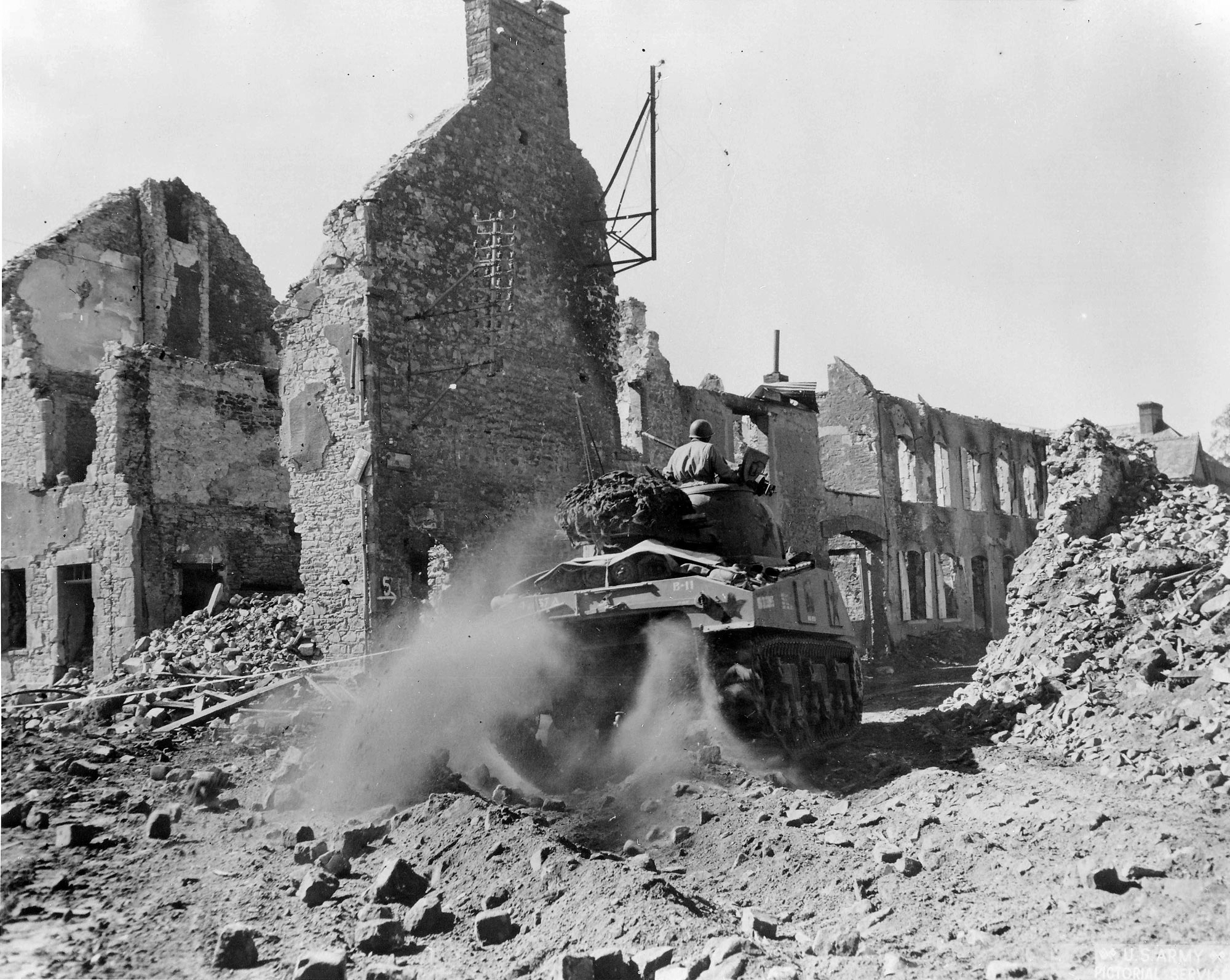
A large photo of an M4 moving into a heavily damaged urban area.

Using these tactics, the tanks, and any infantry riding them, could do a lot of damage to a unit that was capable of knocking them out, and running away before they got the chance, AA units, any kind of artillery really. If you can think of a unit that would be behind the lines, but somewhat close, your tank raid could come and ruin their night or early morning, or late evening.  On a big scale, this is what the Armored Divisions were envisioned doing but rarely got the chance to do.

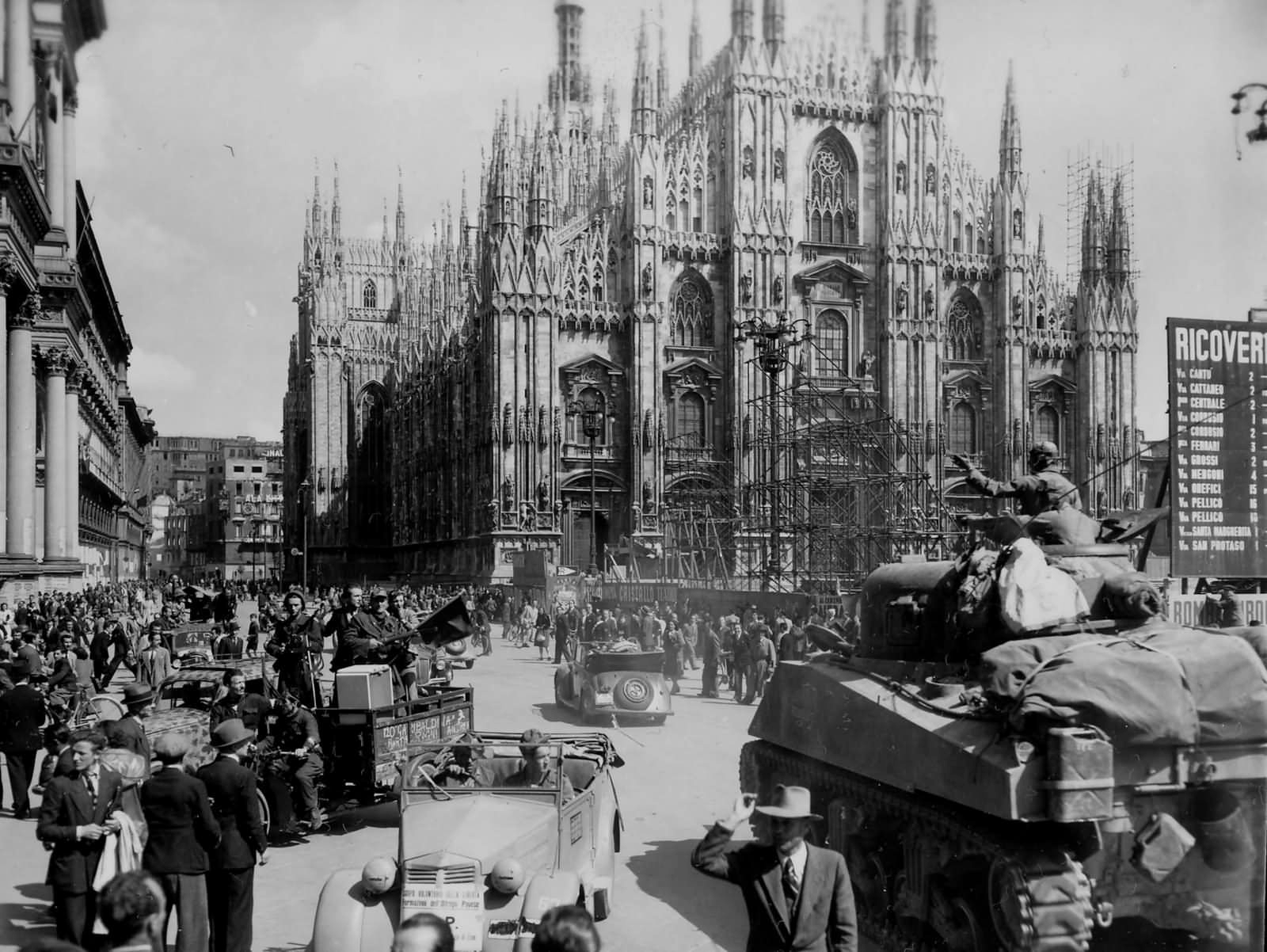
1st_armored_division_M4_sherman_in_piazza_del_duoma_Milan_Italy_1945
Milan Italy

The big danger is in staying in one place long enough for a strong response to being formed,  moving out into a unit that knew you were coming and has armor or anti-tank guns, or getting cut off and hunted down. Other problems are tanks breaking down, and getting lost, and not having enough space for everyone on the working vehicles. So for these to work they had to have limited objectives, a way in and out, and enough good intelligence on the area to know the areas to avoid that could kill your tanks.  That’s a serious list of problems to overcome to make this work, and when tried, even in the Pacific, it usually resulted in a lot of lost tanks and dead or captured tankers and doughs.

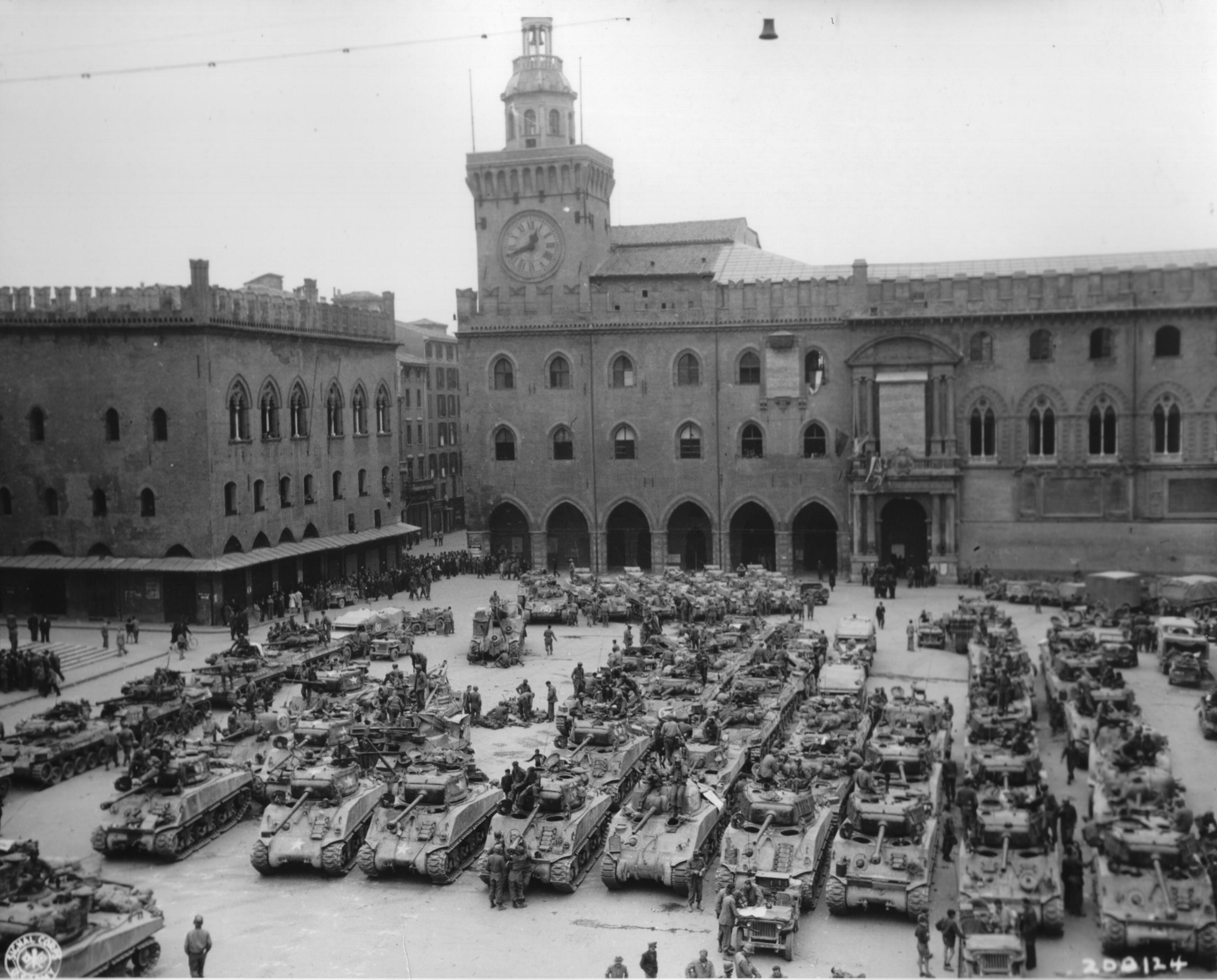
A whole tank company or more parked in a square.
A whole tank company or more parked in a square. Huge very detailed photo

The train yard scene in the movie Kelly’s Heroes is a decent example of this, as far as movies go. This could also happen on accident when things were unsettled during a large attack, parts of units trying to get back to friendly lines could run into supply units trying to find the attackers, and fights could take place.  There were cases where tanks were sent into urban areas by infantry officers who had no idea how to properly use tanks, but this went badly most of the time.  On occasion, TDs were asked to fill in for tanks in the infantry support role, but this was a harder job for them since they had open-top turrets, less armor, and fewer machine guns.

The_British_Army_in_the_Normandy_Campaign_1944_B9477
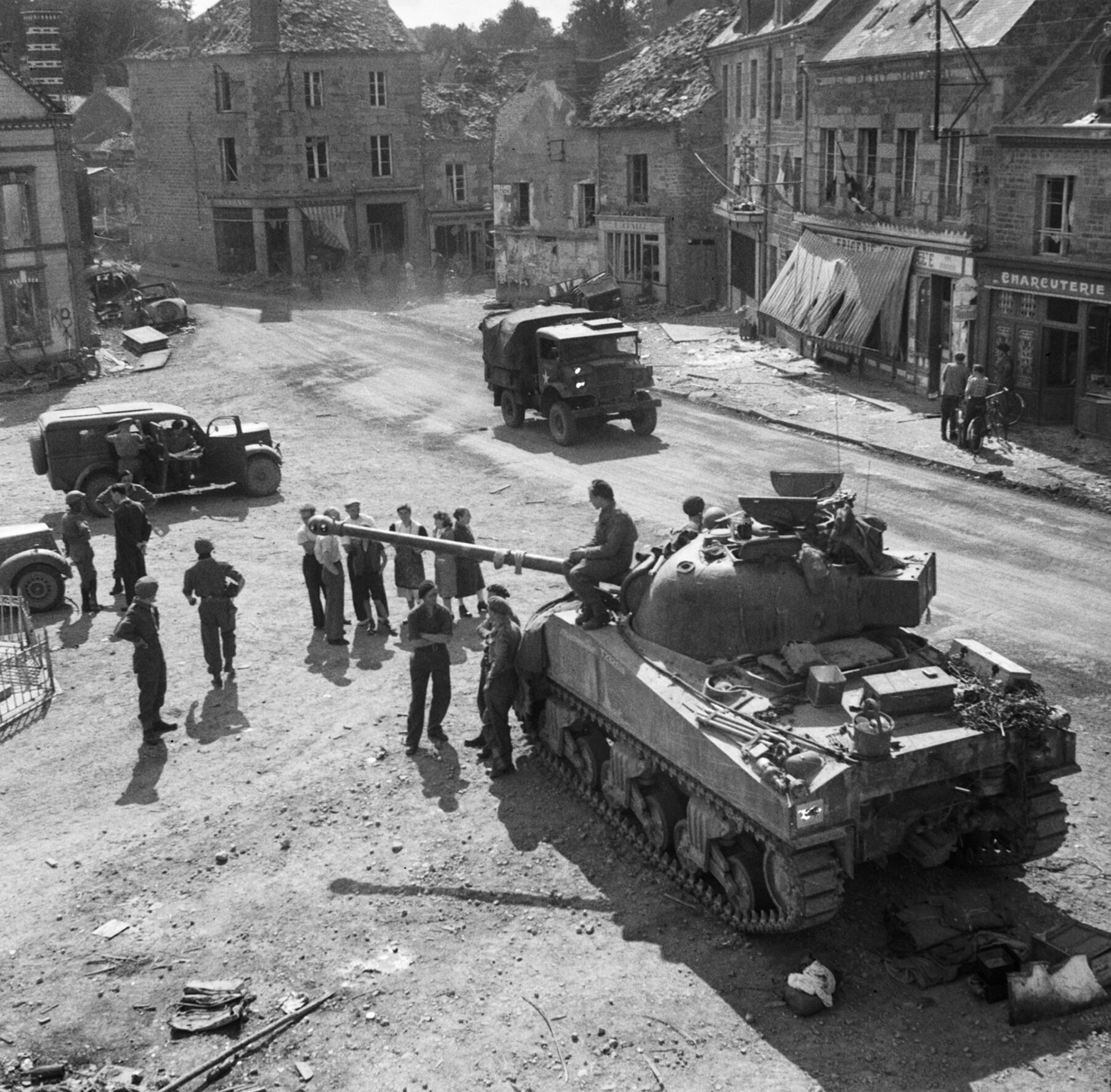
IC Firefly in a town in Normandy

Sources: Combat Lessons, The Rank and file, what they do and how they are doing it 1-7, and 9. Oscar Gilbert’s, Marine Tank Battles in the Pacific, Harry Yeide’s, two Tank Battalion books, and his TD book. Zaloga’s Armored Thunderbolt, and Armored Attack.

#54 The Escape Hatch, Interior Lighting, Exterior lighting and Auxiliary Generator: They had to go somewhere.

The Escape Hatch, Interior Lighting, Exterior lighting and Auxiliary Generator: Why? Because People Want to Know About Sherman Interior Lighting

The Escape Hatch: If You Can’t Get Out the Top Get Out the Bottom

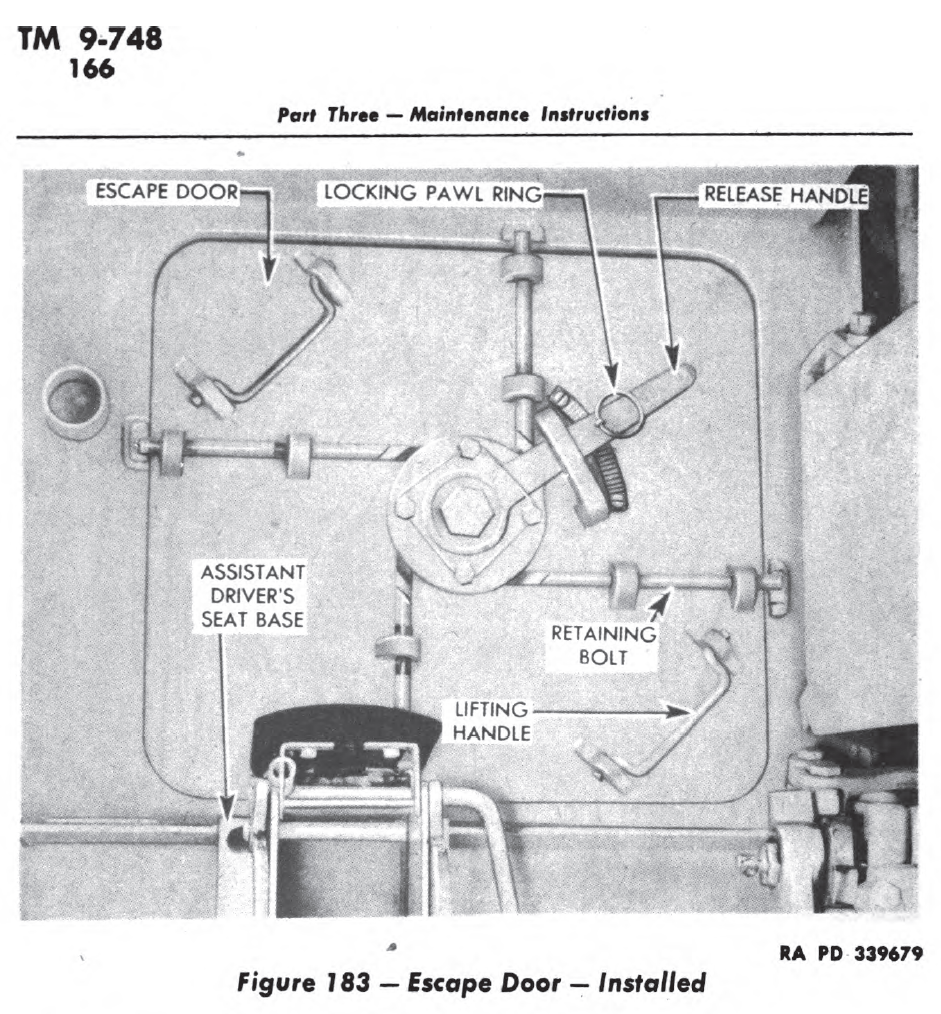
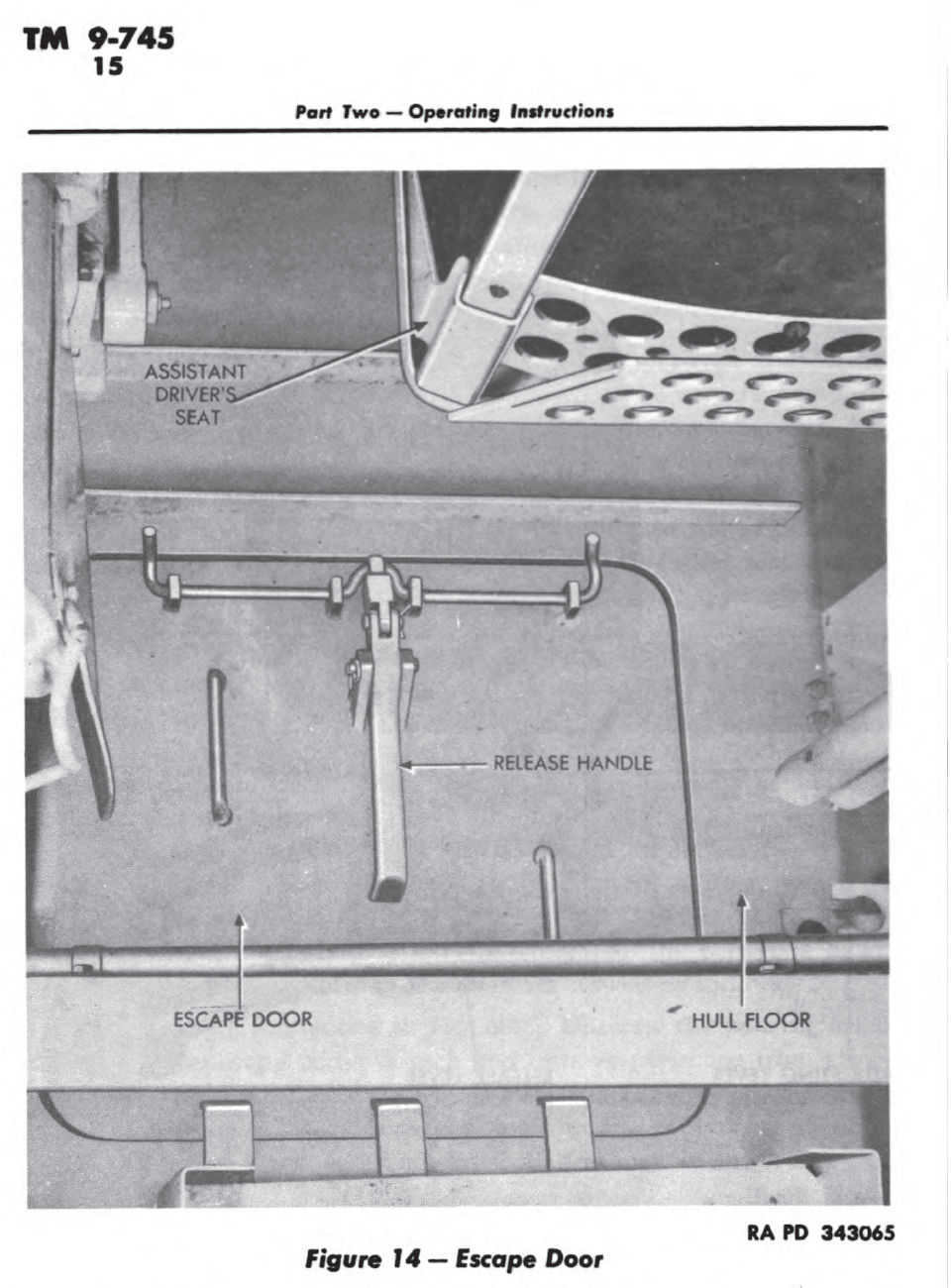
escape hatch
Sherman hatch this does not seem to have changed much from the start of Sherman production to the end

All Sherman tank production models and most of the TDs and ARVs based on the Sherman had an escape hatch right behind the co driver’s position. The location and size of the hatch stayed the same, but the ones installed on TDs seem to be different than the ones installed on tanks. None seem to have been hinged though, a common field modification was adding steel tabs to one side of the hatch so it doesn’t fall all the way out this was a common modification on both tanks and TD. This field mod was made a factory installation on at least the M36 B2.

M10-36 escape hatch
M36/M10 escape hatch

The escape hatch on early Shermans with a full turret basket was only really usable by the driver and co-driver. The driver would have to climb over the transmission to get to it, but the area was pretty large to get through. The reason the turret crew couldn’t use it, or it would be hard for them to use it, was the turret basket on early Sherman models it was fully screened in.  There were openings, so the loader could reach the hull sponson ammo, but to use these, the turret had to be in the right place and not facing forward. These openings, when turned towards the co-driver or driver would allow them access to the turret, or the turret crew to the hull.


When they decided the initial ammo storage layout was too dangerous, they removed the screening, and the ready rounds, making access to the hull for the turret crew much easier, but there was still the turret basket floor, and the braces attaching the floor to the turret to get in the way.  As the Sherman matured, the basket on the second generation Shermans was cut back to a half basket, and then eventually removed. Once this was done, using the floor escape hatch was much more convenient for the turret crew.

The Shermans escape hatch was located just behind the 1-inch thick armor under the driver and BOG, where it was only half an inch thick. Far enough back there was not much of a chance of the crew being seen as they exit.  The hatch was not used for just escape, I’ve read many accounts of the hatch being used to rescue wounded and or just pinned down men under heavy machine gun fire.  The men would be told to lay still, and the tank would be directed onto them by the infantry in the area, in some cases one of them riding in the tank and when close the man on the ground would make sure the tank was going to straddle him and then waited to be run over. Once the tank was over the man, the escape hatch was dropped, the man pulled in and the tank would back out. This could be repeated as needed in the Pacific since in many cases the Japanese had nothing that could take on the Sherman locally.

One final thought on the escape hatch, the reason it was fairly large and far back under the hull was that there were no torsion bars to worry about getting in the way. Later US tanks did have hull escape hatches, but they were usually further forward due to torsion bar use, and different driver’s location. You can see this on the M26 Pershing, where the escape hatches, there was one each for the driver and co-driver, were right under driver and co-drivers station. In some cases large mines could blow this escape hatches up into the crew compartment, injuring the driver or co-driver. This could take place on a Sherman, but no crew member was right over the hatch.

Interior Lighting: Because the Interior of a Tank is Dark, and People want to know About the Lights.

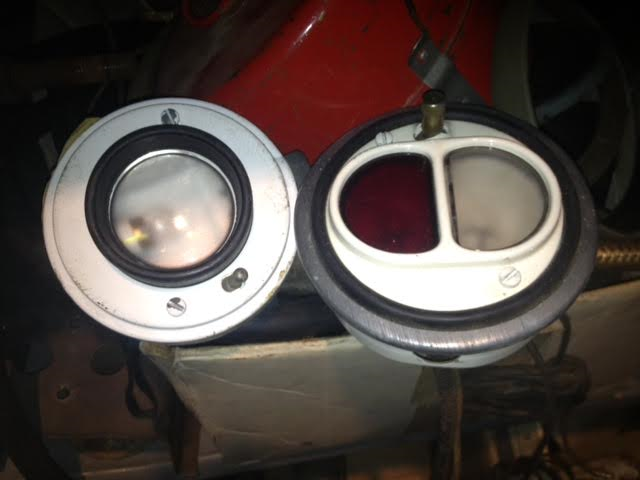
Sherman lights both main types
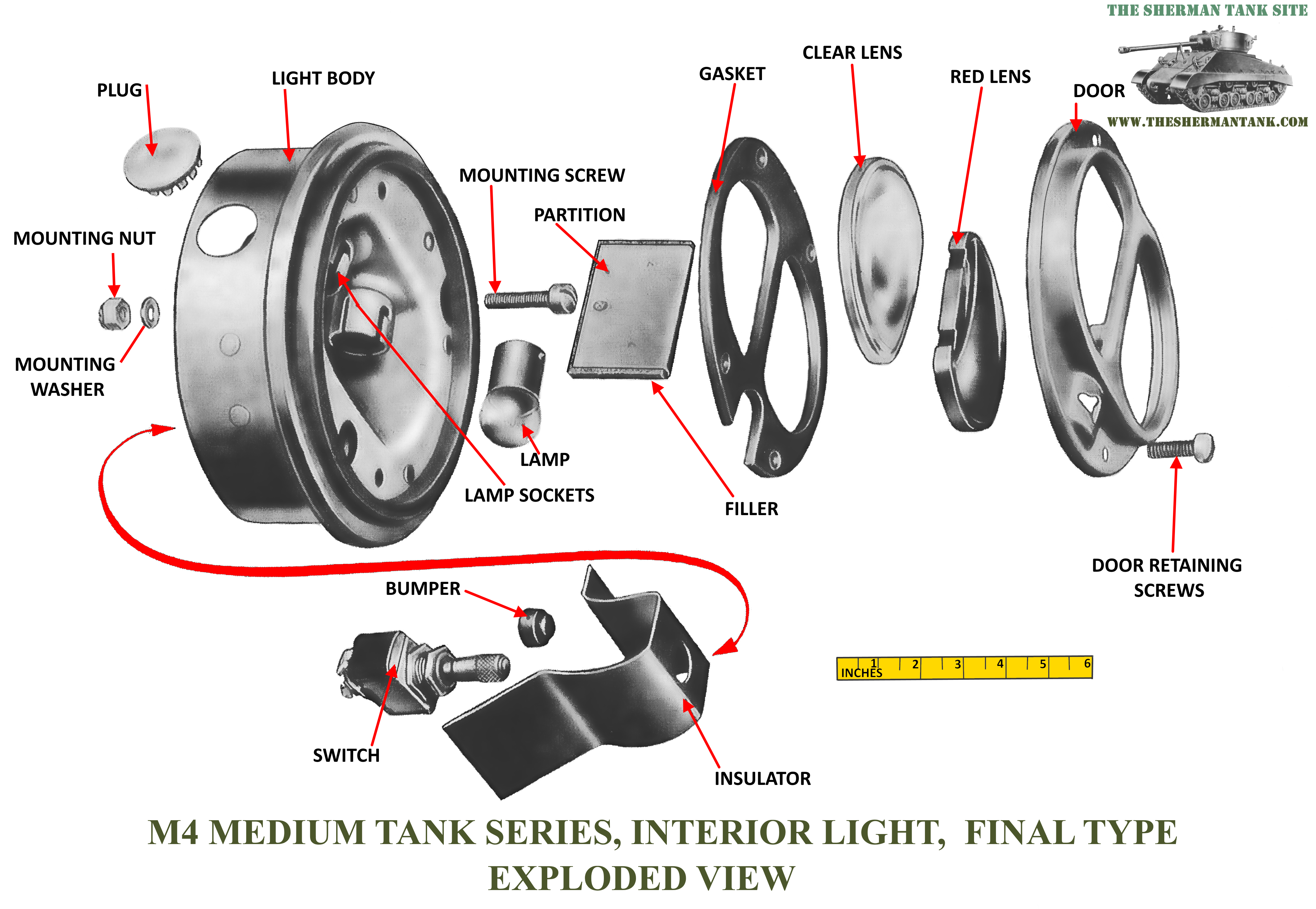
The early and late style Sherman interior lights. Thanks to Marc S over on the G104 mailing list!

The interior of a Sherman tank is a pretty dark place, even during the middle of the day, particularly on the early models, when buttoned up.  The only light would be what could come in through the various periscopes if they were open, or the DV ports on DV Shermans.  On late model Shermans with the all-around vision cupola would be a little better but still not great. Opening the hatches and the pistol port, of course, helps a lot, but you can’t run that way when they are shooting at your Sherman.

m4a3 hull lighting wiring diagram
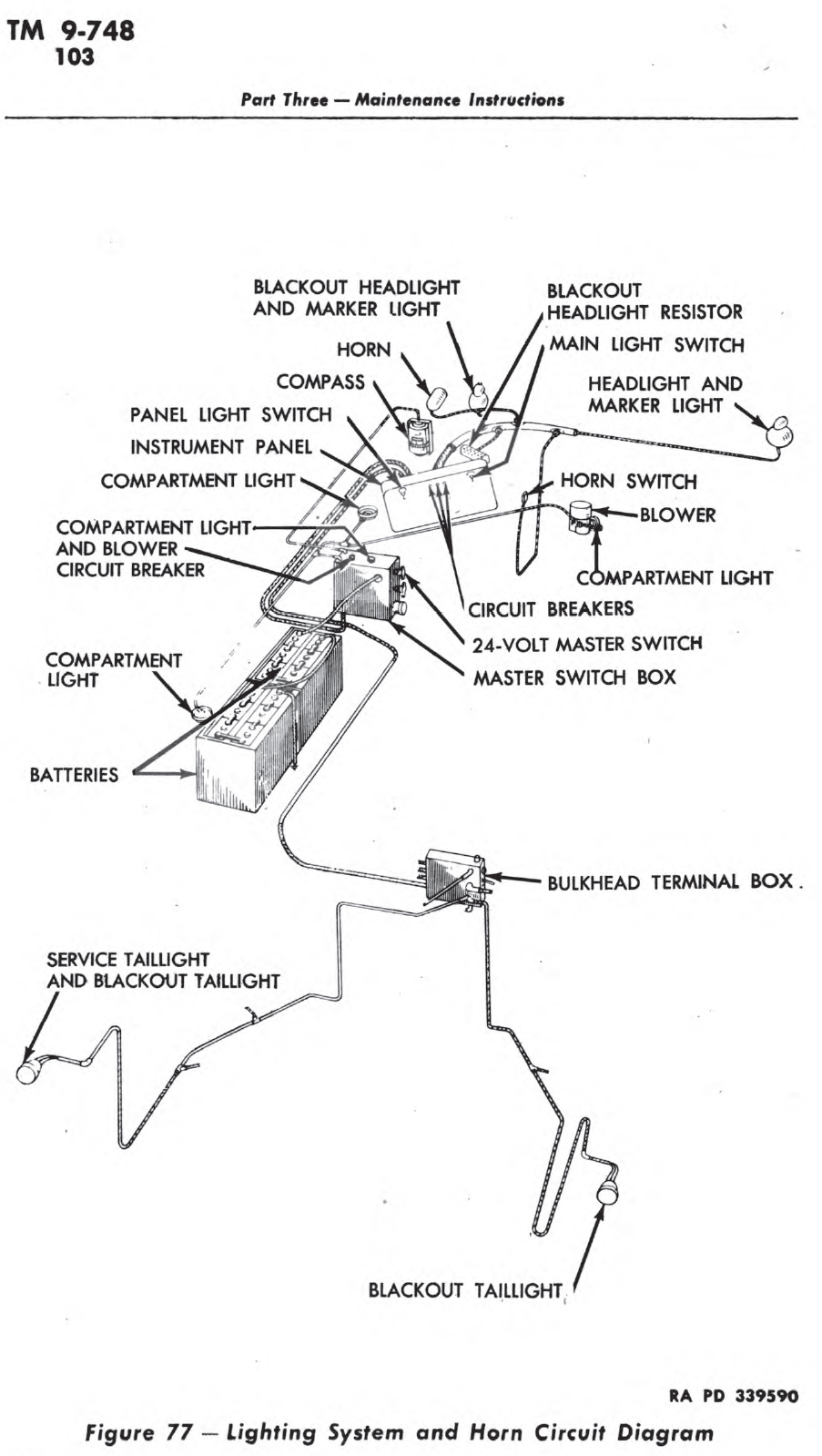
M4A3 hull wiring diagram showing crew lights

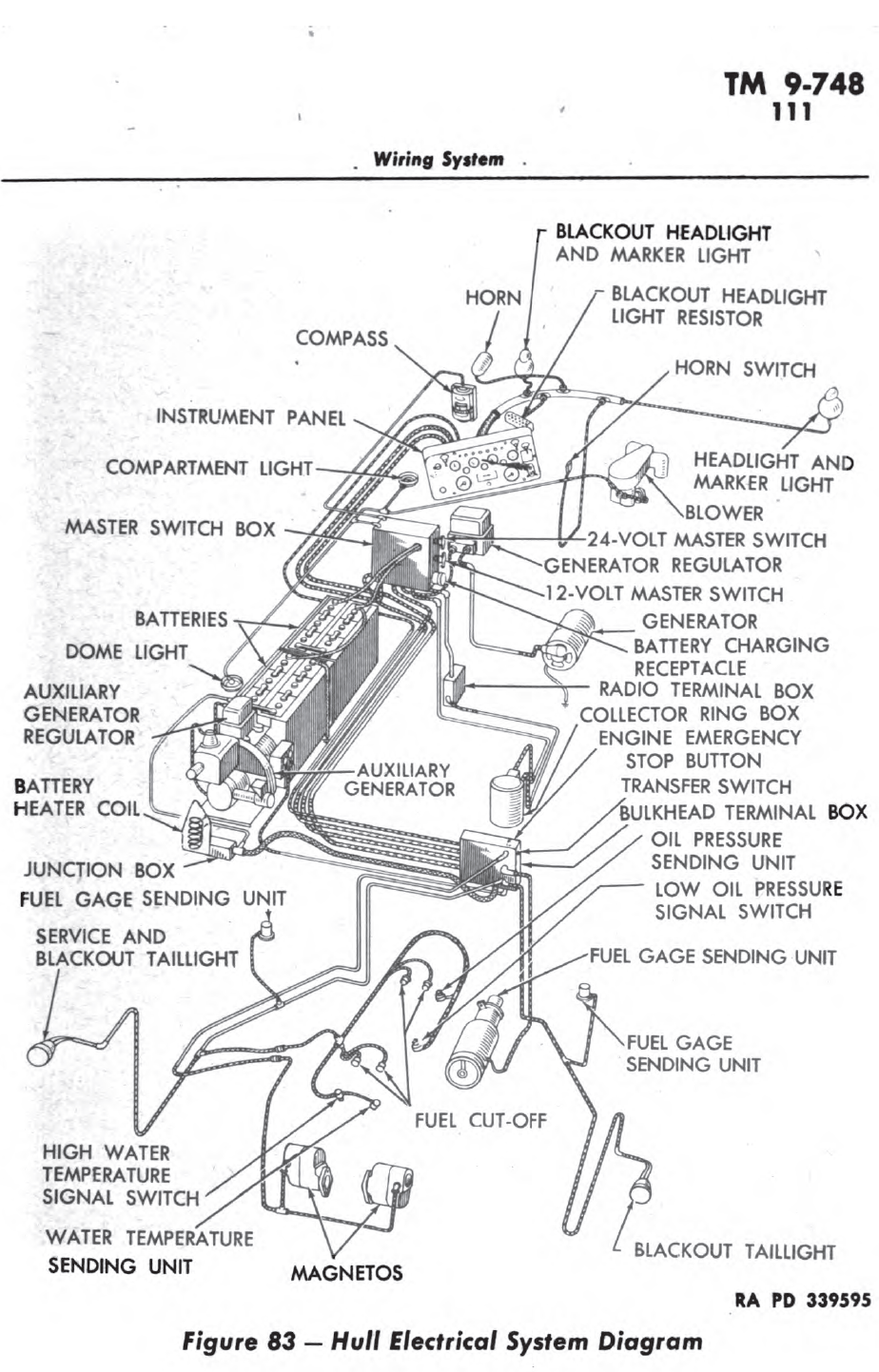
Now those clever engineers who designed the tank thought about this one, and they provided the early Sherman crew with three interior dome lights in the hull and four or five on later Shermans, and the instrument panel and compass were illuminated.  The turret had an additional one to two interior lights on early tanks, and three on later Shermans. These lights were all three candlepower.


M4A3 drivers side
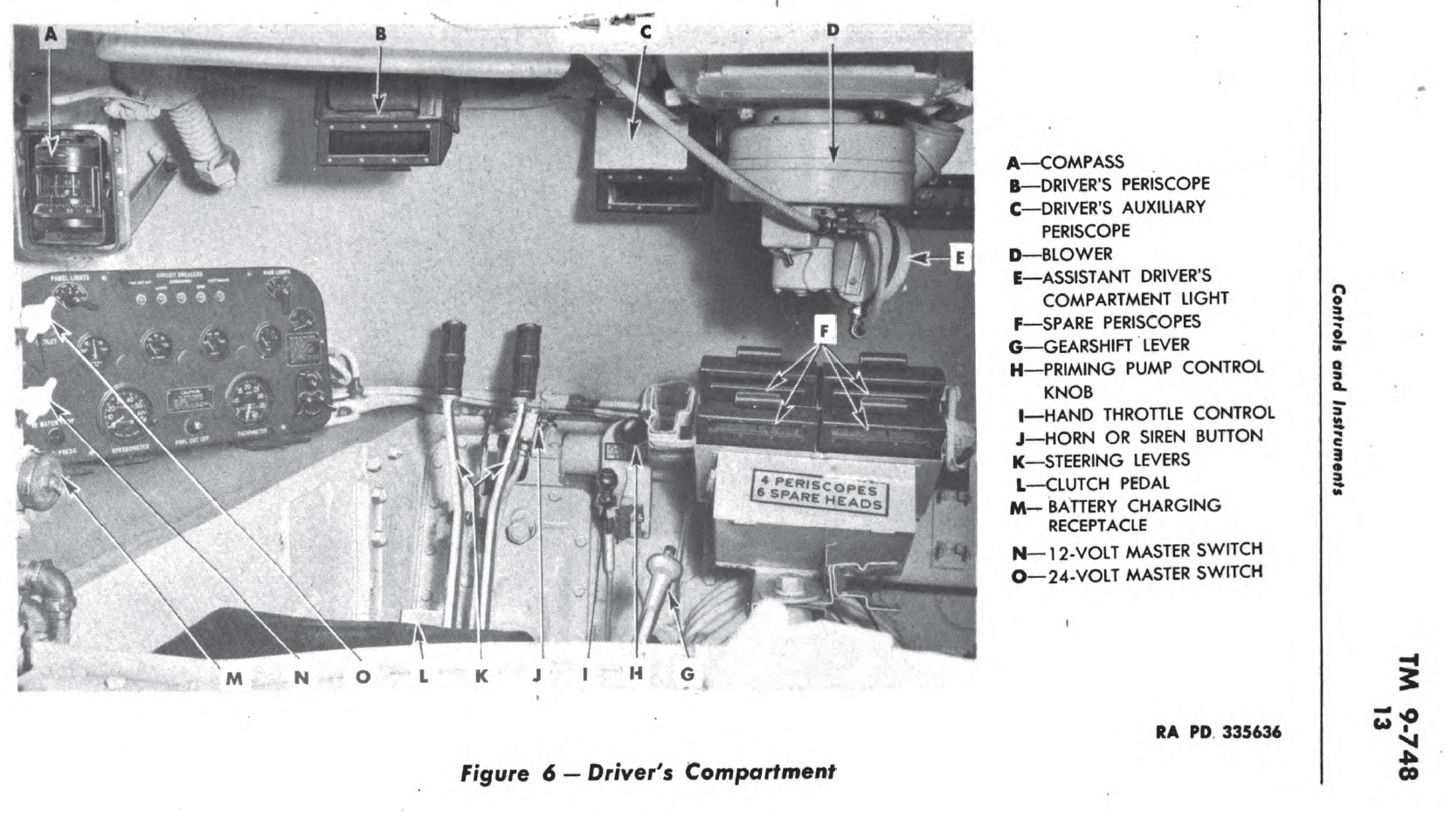
You can see the co-drivers light mounted on the blower in this diagram
blower for the crew
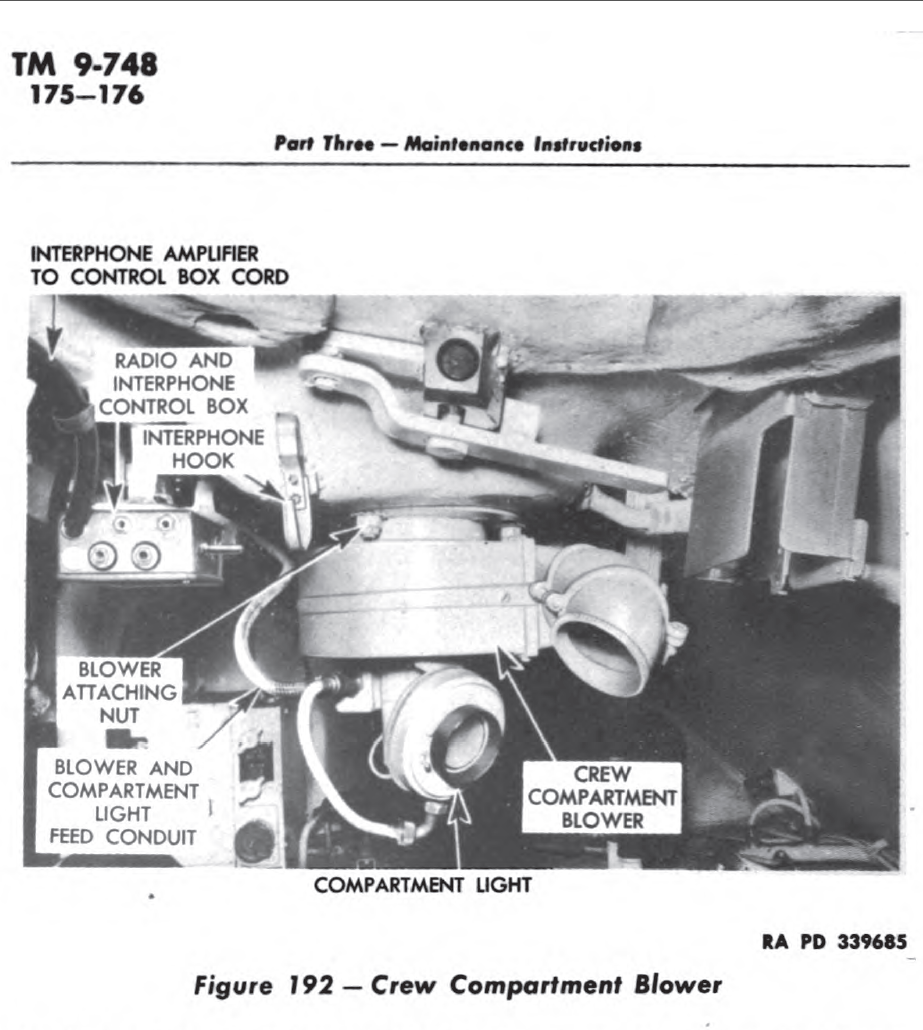
A better view of the light market E in the above diagram

Early Sherman interior lights were white light only, but later ones had a red light as well to help with night vision. The lights are all in series with the master battery switch, so it must be on for them to work. Think 70s car dome light for brightness levels. There was also a third interior light type, used only on 105 Shermans, that didn’t look the same, but I do not have a picture of it at this time.

Exterior Lights: The Sherman Tank Had Those Too!

M4A3 drivers side headlight

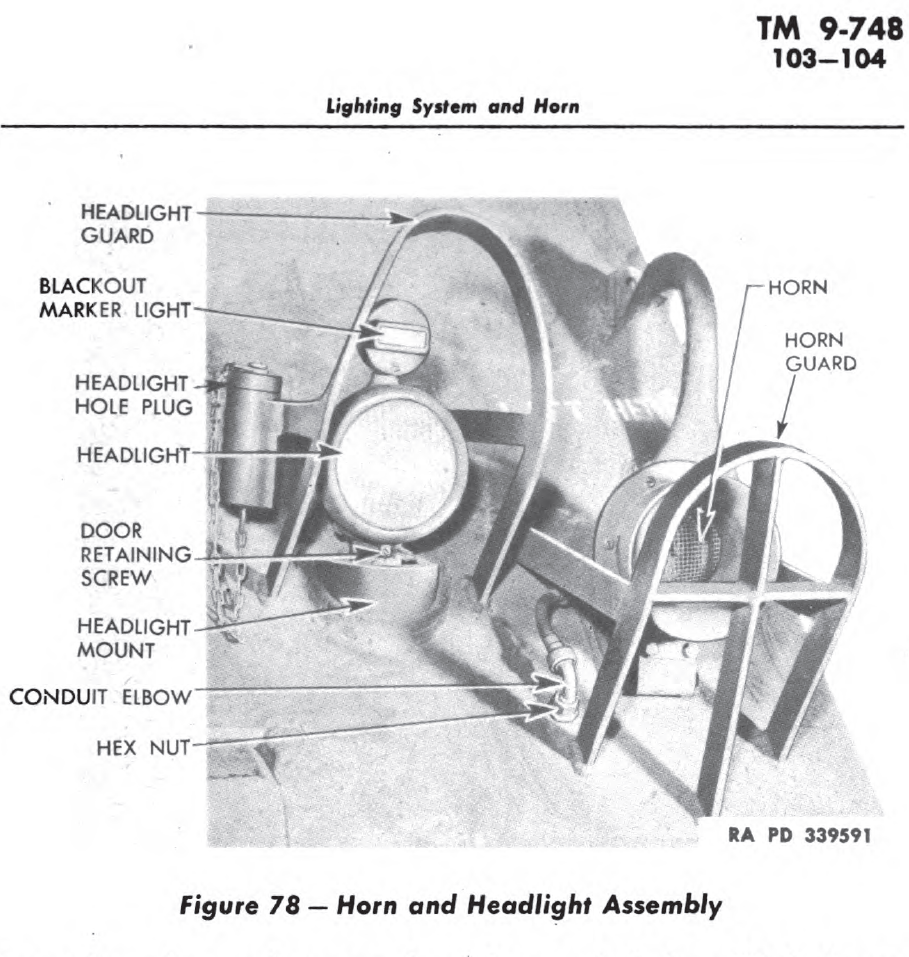
The Sherman Tank had to drive on roads, sometimes in traffic, and at night. To facilitate this, the tank had removable headlights and taillights.  The later model Shermans also had provisions for an amiable, removable spotlight mounted on the top of the turret.

M4A3 blackout light drivers side

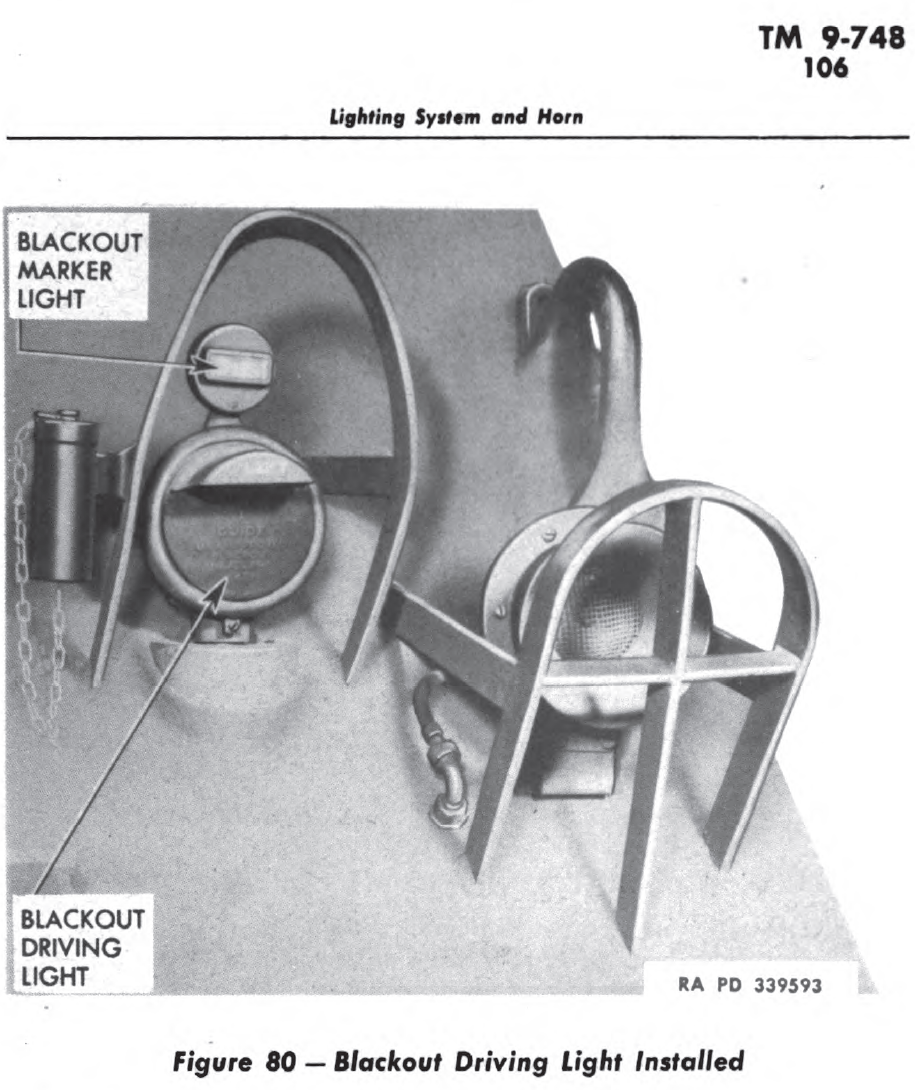
The Headlights came in two varieties, a regular headlight, and a blackout headlight, both had blackout markers.  They would use the normal headlights anytime being observed at night was not important. If there was any chance of enemy observation, then just the blackout lights would be used. In extreme cases, just the black-out markers could be used.

m4a3 taillight

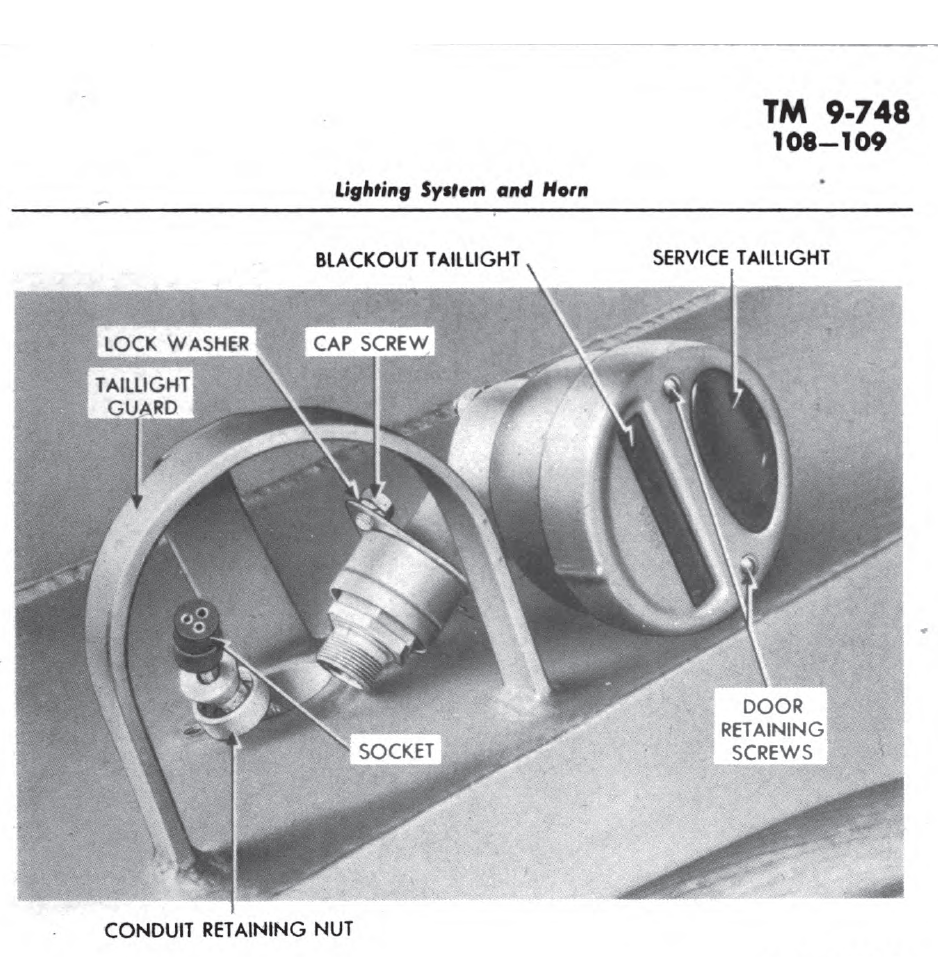
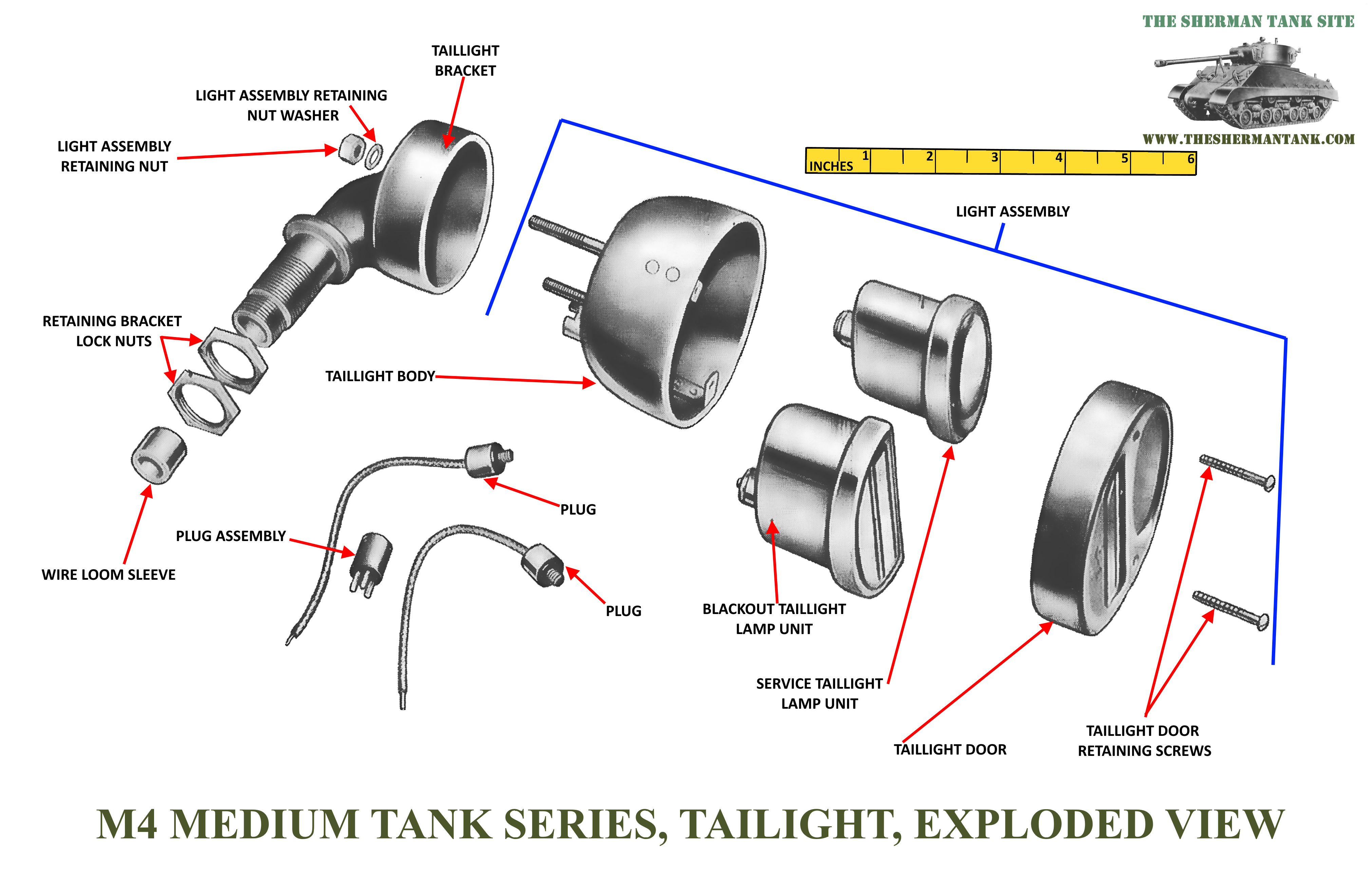
The tail lights were smaller than the headlights, and there was only one service taillight, and a pair of blackout taillights mounted in a pair of housings on the rear hull.

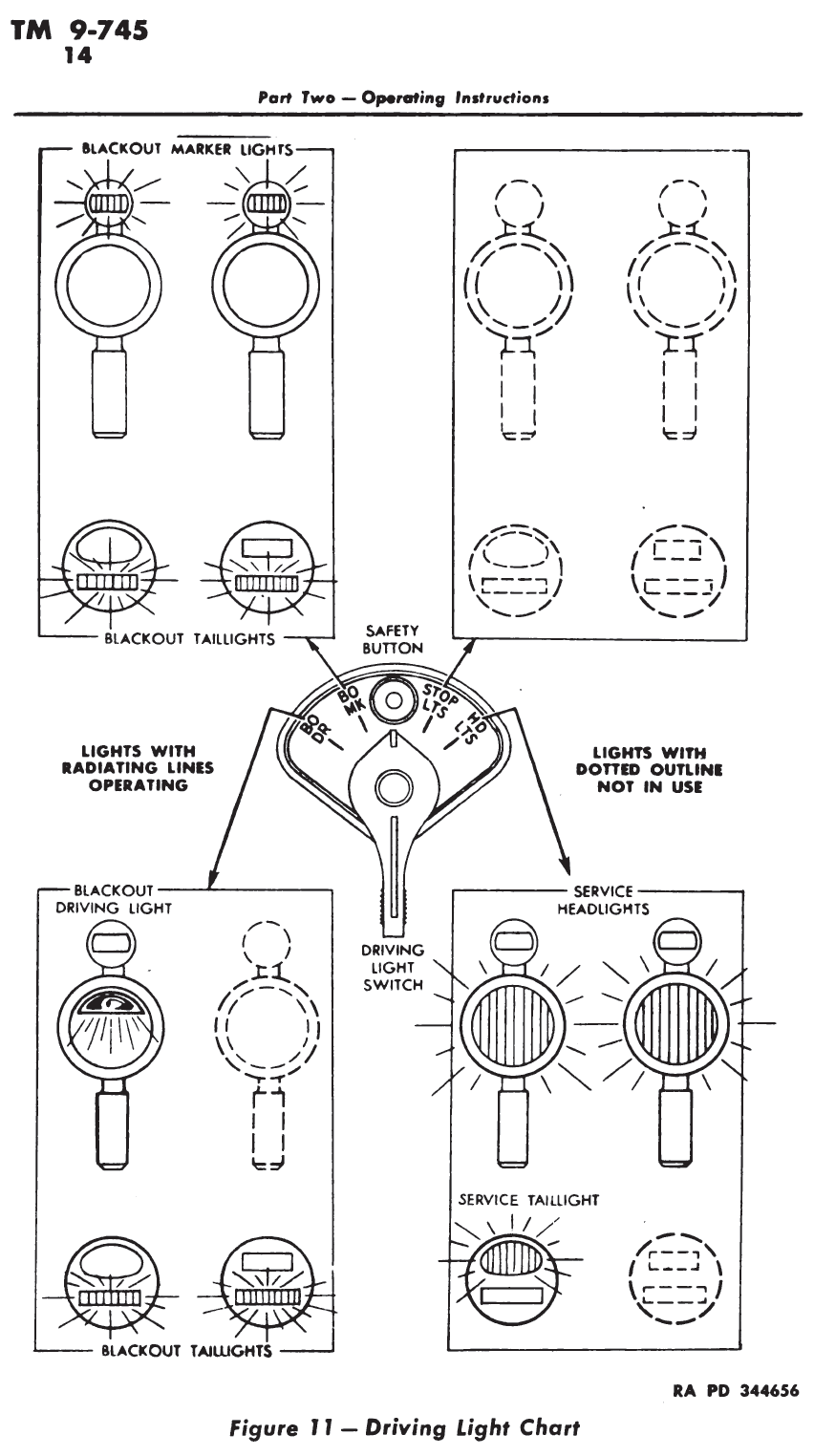
light switch settings

Mid to latish production turrets and most 76mm turrets had a removable,  paintable from the inside, spotlight added to the top of the turret. Many early Shermans that didn’t have the turret roof spotlight mount had it added during overhauls.

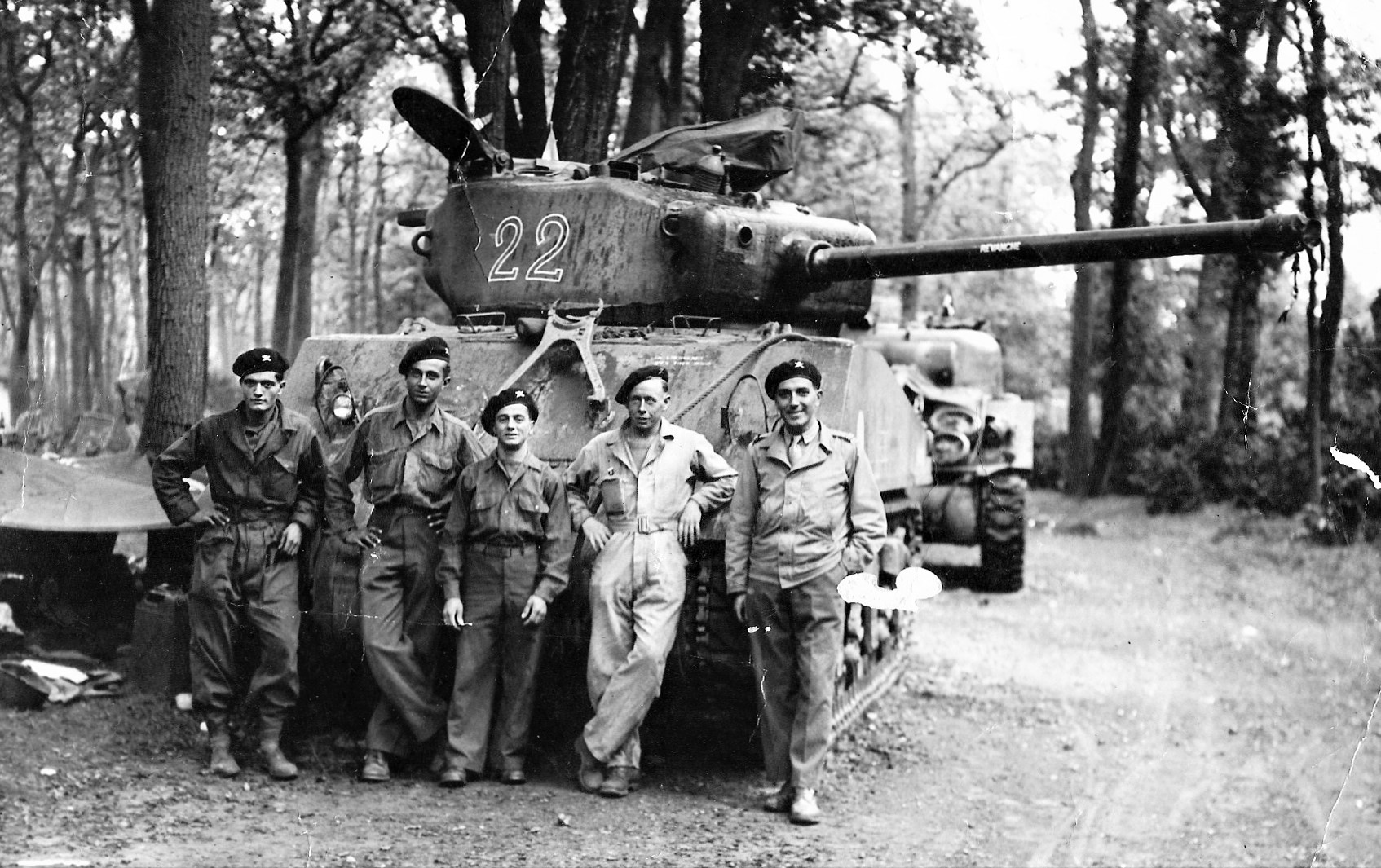
French crew on the background of the tank Sherman M4A2 (76) W of the 2nd company of the 501st Tank Regiment (2 Compagnie de Chars, 501 RCC)
You can just make out the turret spotlight in this photo

The headlights and taillights were controlled from the driver’s panel by a four position switch. All the lights were removable, so they wouldn’t be damaged when the tanks went into combat.


The Auxiliary Generator: All Shermans Had One, Even the TDs and ARVs, but they were not always the same unit


auxgen early 

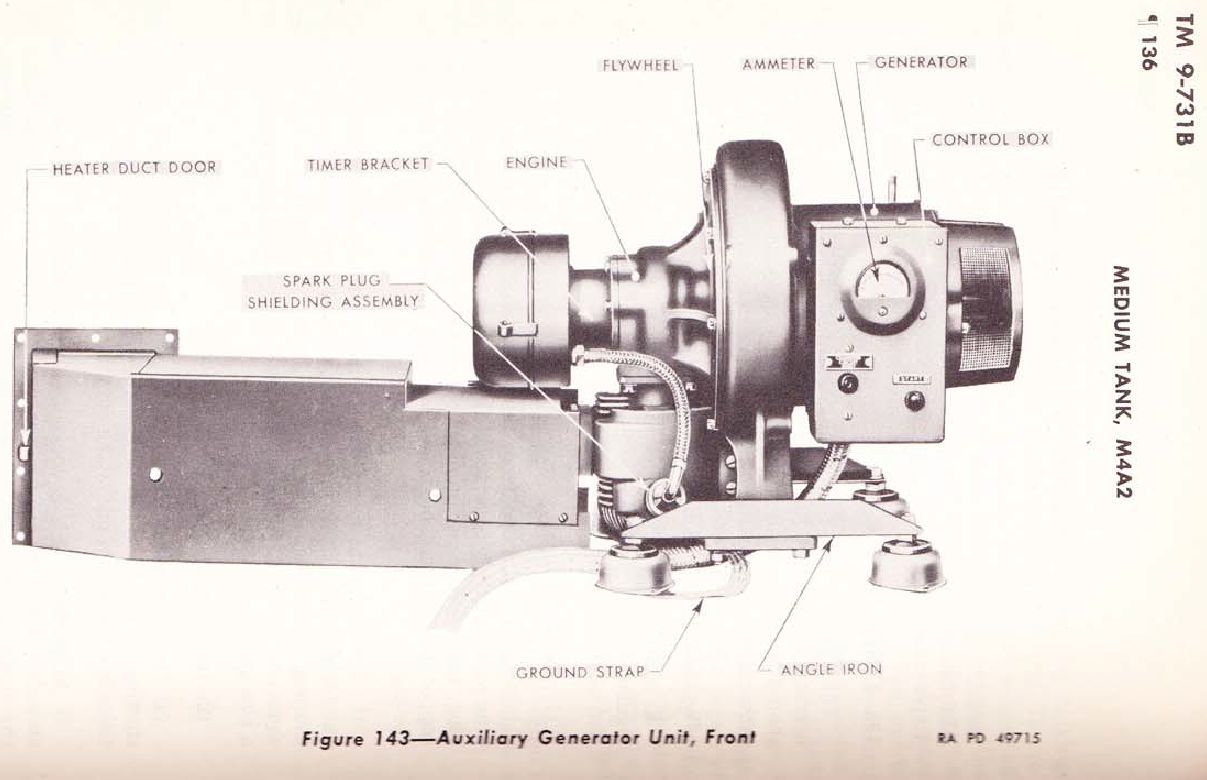
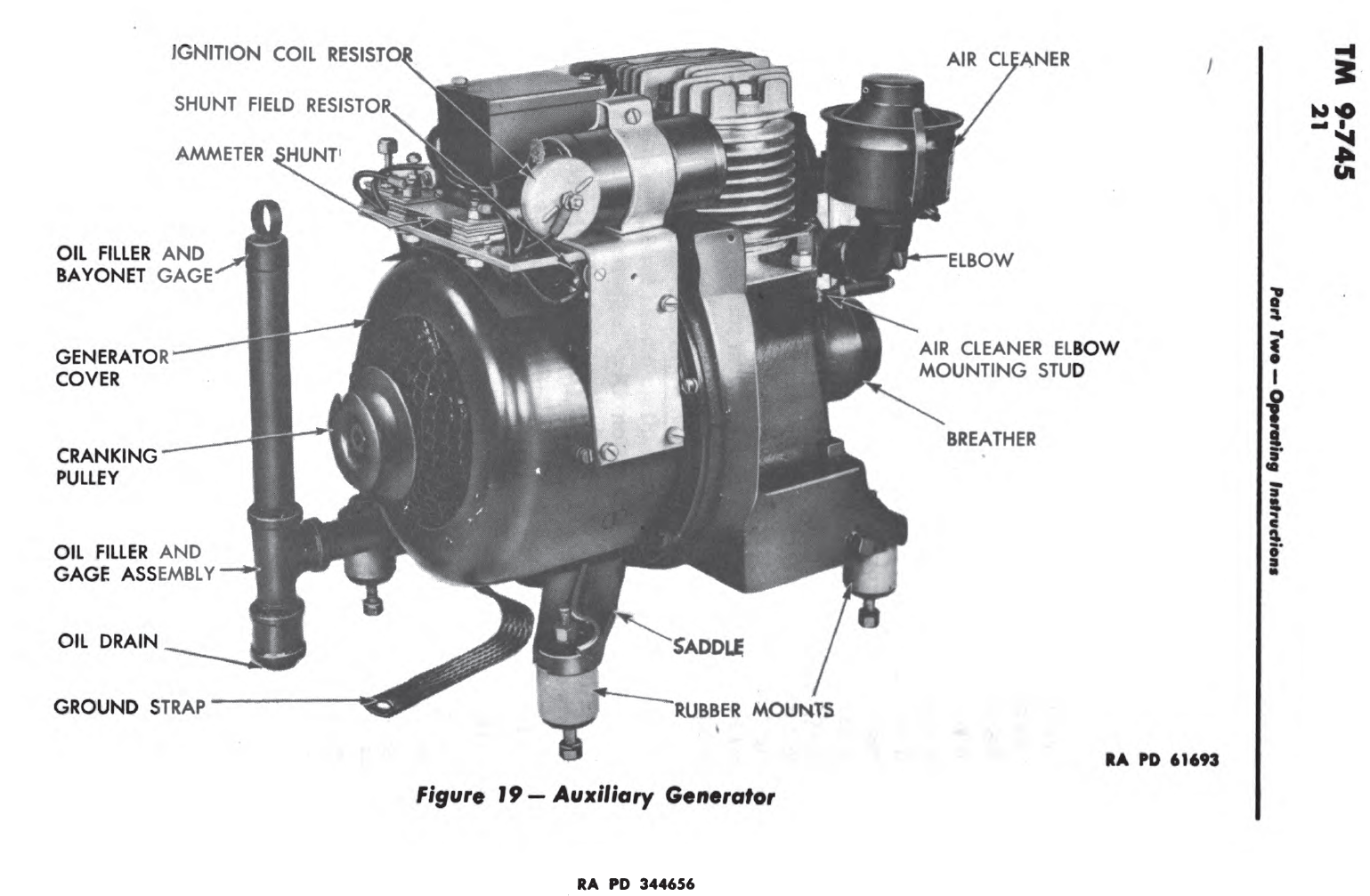
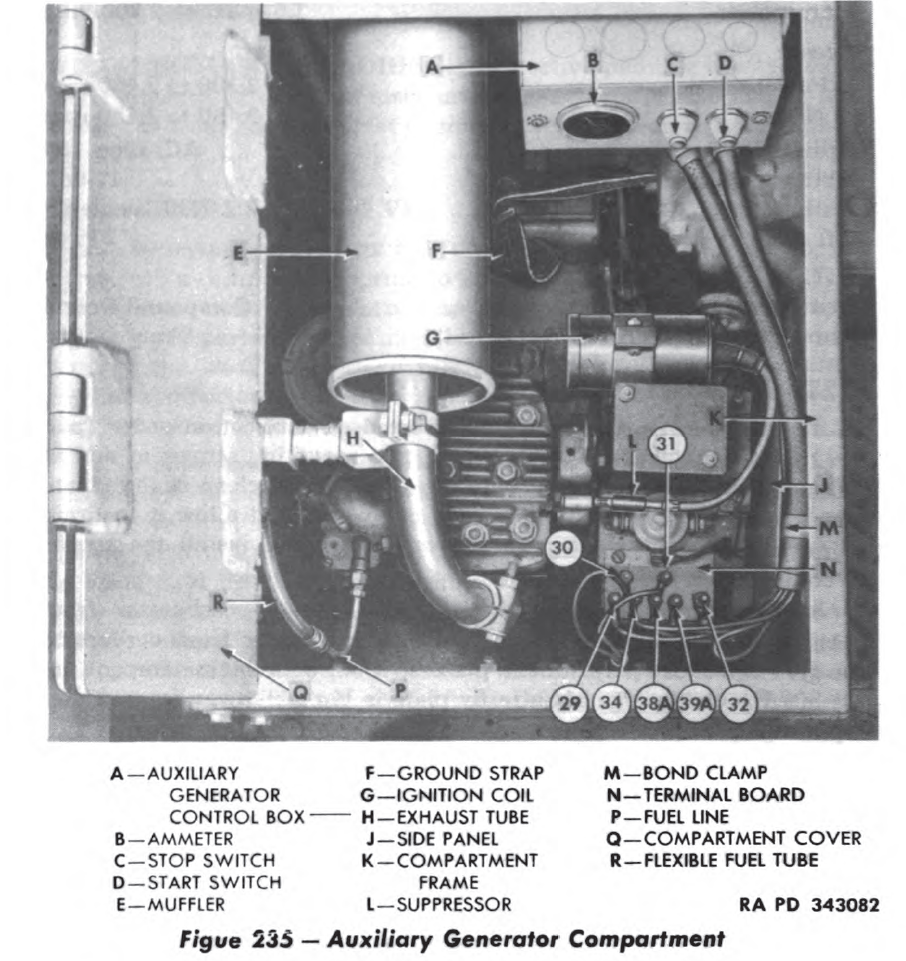
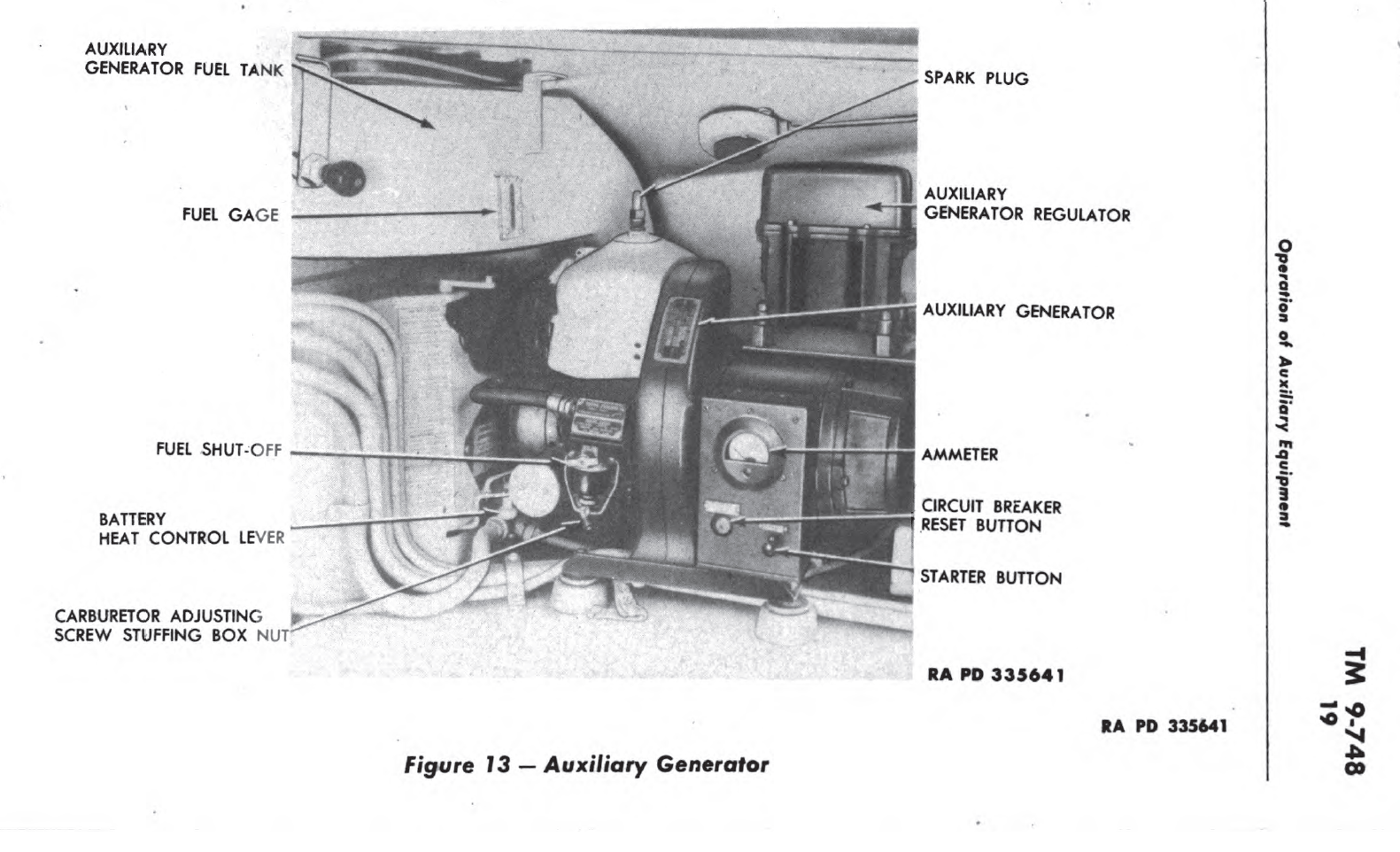
The Homelite Model HRUH-28: Was the exact model used in most Sherman based Tanks and TDs; the Army used this Aux Gen well into the 50s. Homelite also made other models for aircraft use, and they may have sold them commercially.  There were a few differences in the installation, on early production Shermans, it was installed with a simple muffler that had an outlet at the rear of the vehicle, and the heat generated by the use of the generator was called an added feature, and was the tanks ‘heater’. Later versions had a ducting system that vented the heat into the engine compartment to help pre-warm the engine in cold weather or vented into the crew compartment to heat it. The ducting added about 15 pounds to the unit, for a total of 140 pounds.

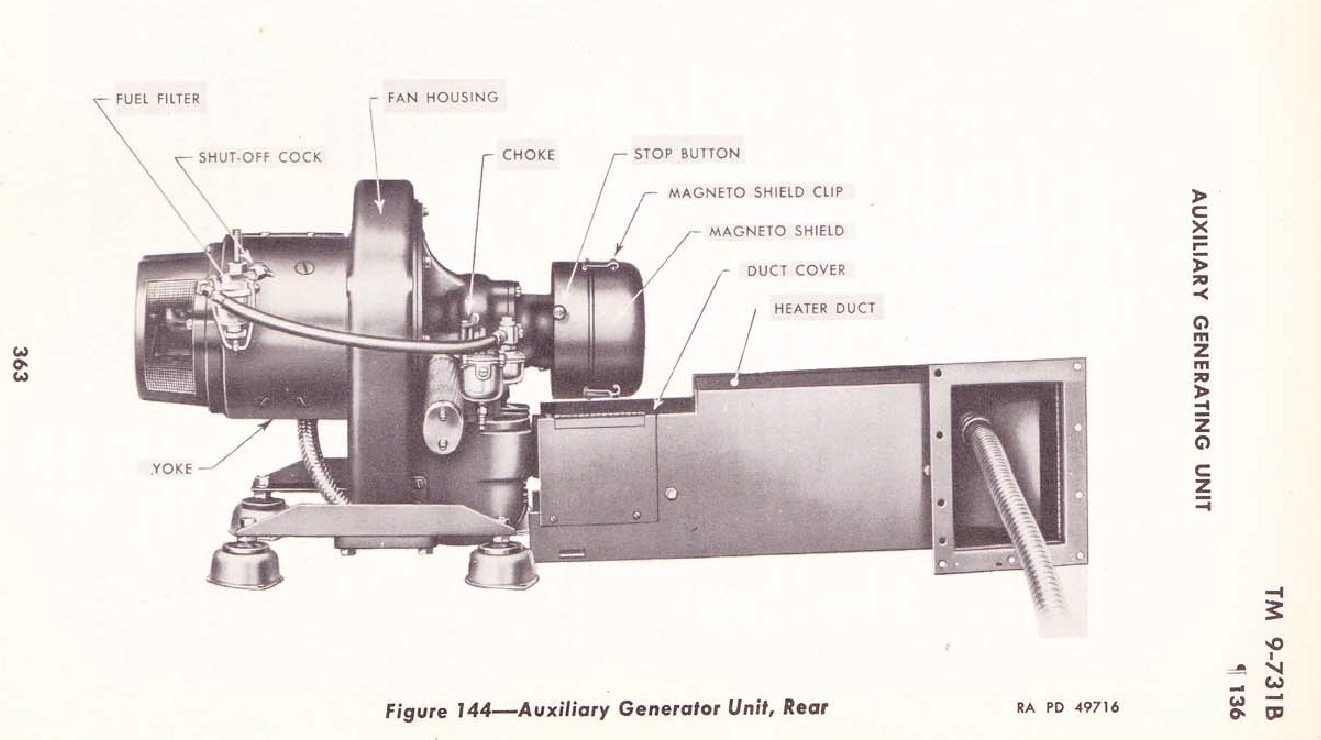
early aux back

The motor that powered it was gas powered, even on the diesel tanks, and was a single cylinder, air-cooled, 2-cycle with a 2 3/8 inch bore and 2 1/8 inch stroke. It operated at 3400 to 3700 rpm and burned half a gallon of gas, mixed with oil for lubrication, an hour.  It could be run on gas 80 to 100 in octane, used a magneto ignition and a forged rod, crank, and piston.  The Generator could be started in two ways, if the tanks batteries had enough juice, it could be started by motorizing the Generator with the battery, or manually, with a supplied rope with a handle, on the starting plate.

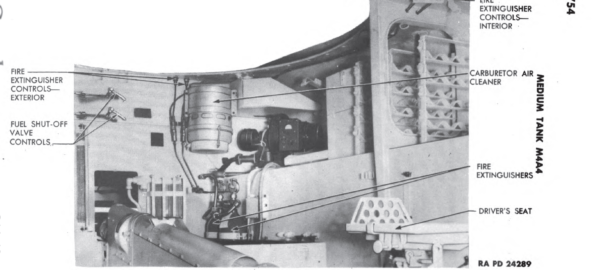
m4a4 interior, manual, m4a4
In this interior shot of an M4A4 from TM9-754, you can see the Homelite auxiliary Generator tucked into the corner

The Generator portion of the unit generated 1500 watts, DC, 30 volts. It was shunt-wound for battery charging. The Armature had a high-quality steel core and was laminated, impregnated and backed to give high resistance to oil, moisture, and dust. The field coils were made the same way as the Armature The whole unit, motor, and generator, used ball bearings throughout.

early sherman hull wiring diagram m4a2
M4A2 hull wiring diagram showing Homelite install
early sherman hull wiring diagram m4a2key
Key for the above image.

There was a short 10 item list of things the tank crew could do to maintain the auxiliary generator, and the final one removed it and put the new one/refurbished one in. looking over the technical manual for the generator (TM9-1731K), and reviewing its construction, it was both heavy duty in construction and designed to give long trouble free service.  The unit took the up rear part of the sponson on the driver’s side and had a dome light right near it on most Shermans.


 . . .

the mystery aux gen
The four-stroke mystery auxiliary generator

The Mystery Auxiliary Generator:  When I was going through all the Sherman Technical manuals looking for info on the lights and Aux Gen, I found a few references to a model not made by Homelite. What’s interesting about this is, the Homelite tech manual is listed as a reference in most of the Sherman TMs that use it, but the mystery Aux Gen is not. I found most of the specifications for it but not everything and I found a few good pictures in the manuals, though one manual was useless in that area because it’s a horrible scan.

mystery generator installed
As you can see this is a more compact installation

The Motor was a single cylinder like the Homelite, but it was a 4-cycle motor, the Homelite was a 2-cycle. The bore was 2 5/16 inches and the stroke was 2 1/4 inches. It ran between 2300 and 2550 rpm and made 1.6 HP at 2300 rpm.

m4a3 hull wiring system
M4A4 hull wiring diagram showing the location of the more compact unit

The Generator was 6 pole, and compound wound for starting, and shunt wound for generating. I assume it put out about the same amount of power as the Homelite unit, but the technical manuals I have do not state what it produced.

The whole unit appeared to take up less space and maybe the aux generator they used in some wet ammo rack hulls. If anyone has more info on this Auxiliary Generator, please contact me!

different style aux gen

Both units had small fuel tanks in the engine compartment with their own filler caps. In some installs, the gas tank may have been partially mounted inside the crew compartment.  I’m not sure if this version had an oil tank or was like the Homelite, that needed oil mixed into the fuel for oiling. I’m not sure why they used two different unit, the size probably had something to do with it, but it also could have been a supply issue, maybe like with the turret traverse systems, one maker couldn’t keep up?


. . .


A little note on the Technical Manuals, you would think they would be standardized, and in some ways they are. The early manuals, like the ones on the Lee tank, and early Shermans seem to be much shorter than the later versions, and none seem to cover the tank in the same way. They all seem to have an inventory of what the tank should come with, and it’s really huge, and a section on how to drive and maintain the tank. They all seem to have an electrical section, but what it actually covers varies.  The M4A4 tech manual has a huge section on the motor, but nearly nothing on how to use the main gun.  They do seem to get better as the Sherman aged, but the only late model manuals I have are for the M36B1 (TM9-748, TM9-745) and B2, and a horrible scan of the M4A3 manual(TM9-759). I have much better manuals for the M4A4 and M4A2 though. I really need a high-quality 9-759!


#53 Bibliography and sources: Yeah I Know Sources on Each Post Would be Nice, I’m Working on it

Bibliography and sources: So here are all my sources

So yes, I know the site would be better with a list of sources, and this is going to be that post for now. I will also, as I review and rewrite all the articles over time, add them to each post.

Data
Data

A bit about the site, and myself, I’m just a guy who really likes WWII history, and more specifically, WWII tank history. I am not an expert on the Sherman, but I do know a hell of a lot about it, and I have a lot of opinions about it as well, and much of this site is me sharing that opinion. The hard data is not my opinion, the specifications, and other details are not my opinion and come from many different sources.  Most of these are listed in the book review and links section. There is even a data post with a whole lot of useful information in picture format of various documents.

First and foremost, most of the minutia details come from reading the Sherman Minutia Website a lot and looking through the Son of a Sherman book. Between these two sources, you can answer almost any question about a production detail on a Sherman you may have, and the nice thing about the SMW is it’s always being updated. I only cover these details in a very general way, I could never do it as well as the book or site.

My next big source of information is period literature and manuals. If you haven’t noticed, I have a very large selection of technical manuals and field manuals on my website, all available for download, for free. I’ve collected a huge number of the things over the years, most in PDF format, but a few in real paper, and I’ve read a hell of a lot of them.  I am missing a few key Technical Manuals, like one on the M4/M4A1, I have the M4A2, A3 and A4 covered though, and several TDs and the Lee. I’m pretty confident I could start up and drive around and M4A2 or A3 or even A4 and adjust the clutch linkage and do a host of other maintenance tasks from reading through the manuals on how to do them. These old tanks are so similar to old cars is funny, and if you know a good bit about old cars the manuals should be very easy to follow, the big difference is the size of the tools and weights involved.

Along with the TM and FMs, I’ve hosted a lot of other documents I’ve found on the internet, from battalion and division histories, the very interesting Combat Lessons booklets the DOD put out during WWII, and I’ve taken information from all these sources.

Now for the books, so many books, most of these I own, and love, but a few I only have in PDF. I already mentioned Son of a Sherman Volume one. If you have any interest in the Sherman tank, you should by the book while it’s in print and reasonable in price, it’s fantastic. It also had some of the better info I used in the factories post. It’s to late to get this book at regular price now, and new and used copies are going for 300 to 700 bucks!

Sherman: A History of the American Medium Tank, by RP Hunnicutt is the holy grail of Sherman books. It is filled with so much information about the production history, use, design, modifications, and hard specifications, that much of the data on this site comes from this book. The gun chart data came from here, all the data sheets, and a lot of the future things that almost made it came from here as well. This book is currently in print again, for 60 buck paperback, 70 hardbacks. Buy it now, before it goes back into the hundreds after going out of print. Though slightly dated in is the short history of battle sections, it is still an amazing book, and really the only hard technical history of the Sherman that is really great. Also always keep your eye out for an original printing, the photos are much better.

Armored Thunderbolt: The US Army Sherman in WWII, by Steven Zaloga this book, when combined with Son of a Sherman and RP Hunnicutt’s Sherman book will give you a very good knowledge base on both the technical and historical histories of the tank, and if you throw in Son of a Sherman you have all the minute details covered. With these three books, you can really get a good idea how wrong the pop culture opinion of the Sherman and German armor in general really is.  So a little more about this book, Zaloga covers both the design history, though not in minute detail, (You will not find detailed specification sheets or a breakdown of the exact details of the differences in all Sherman models) but he does cover much more of the politics and decision making that led to some of the key problems that popped up with the Sherman, US Tank design, and armor tactics.  In this book and several Interesting interviews, he really covers why Belton Cooper of Deathtraps fame was so wrong. He also has a lot of the numbers in his book backing up the Sherman performing in battle better than the Panther. Zaloga is a prolific writer and has put a lot down on paper about the Sherman, and I’ve read almost all of it, aside from a few older Osprey New Vanguard books. This man, almost as much as R.P. Hunnicutt is responsible for bringing out the truth about the Sherman tank.

20151026_170308

The Tank Killers, Steel Victory, and the Infantry’s Armor, by Harry Yeide, These books are another big source they are really great books covering the use of Tank Destroyers and the Separate Tank Battalions.  Yeide is both knowledgeable and easy to read, and I will continue to buy every book he puts out.

20151026_170409

Marine Tank battles of the Pacific by Oscar Gilbert, in comparison, to Sherman use elsewhere, until recently info on the Shermans use in the Pacific was pretty light. This book is specific to the Marines and covers more than just Shermans use, but it does a pretty good job of covering each battle, and most of the info, along with some histories from the Marine Corps was used for the old Tarawa post. His book on Marine tank use in Korea also has some Sherman use covered and is a good read as well.

Tanks in Hell by Oscar Gilbert and Romain Cansiere is a very recent and very detailed study of the use of Marine Shermans on Tarawa.  It is the most detailed history available on the Shermans use in that battle and clears up some mysteries and misconceptions. It was a great read and I just finished it up.

There are so many books on the Sherman out there, I’ve tried to read any I could, but the ones listed are the best and most important. I do not read books just on the Sherman tank, and at one time was what one could consider a wehraboo, and I know the guy who invented the word too, so I have that going for me. Anyway, while a wehraboo, I collected some of the premium good source books on German tanks.  Reading through Panther Tank by Thomas L Jentz started me down the path to salvation, the combat readiness reports found in that book; even on the late model G Panther are truly pathetic, though it is really a beautiful book, Jentz was only against listing source material. I also have Panther and its Variants by Walter Speilberger, another beautiful book, filled with beautiful illustrations on a tank so unreliable to be almost useless. I have Jentz’s two books on the Tiger, D.W to Tiger I and Tiger I&II Combat tactics. Also very nice books but based on old outdated historical information when it comes to the unit histories, but boy are the pictures great. I have Speilburger’s books on the Panzer III and IV, both great books, and the subject matter is more interesting since these were the real stars of the German tank design, in that at least they worked and offered real value to the German Army.  I’ve read Tigers in the mud and even enjoyed it.  There are of course more, but that covers the really big stuff/good stuff.

Other important sources are sites like Archive Awareness, who author takes Russian Soviet-era archive documents and translates them and offers opinions on them. He has some very interesting information on the Sherman tank on his site, and far more on Russian tanks and German lies.  Some say he is biased, but if he is, it’s against the Nazi propaganda that still lives on to stink up the world, and I’m fine with that. Other good sites include Tank and AFV news, and the Lone Sentry.

The Chieftains Hatch of  Wargaming fame, like him or not has produced some very interesting new information about various tanks, and his publication of the French post-war report on Panther use is a real eye-opener and was groundbreaking info. I have links to many of his very interesting posts in the links section. Like World of Tanks or not, they have dropped a lot of real cash on restoring real tanks, and paying real researchers to unearth interesting tank information, they deserve some real credit for furthering the modern understanding of Armor. Wargaming also got a lot of armor experts in one place as a panel for their Operation Think Tank series and let the crowd ask questions, it is on YouTube and filled with very interesting info.

If I have it listed on my links, information from their website has probably contributed to a post on this site.

Now a final bit about sources and this site, all the information in the various posts is true to the best of my knowledge and sources. Some information, mostly image captions are very generic and often wrong, and many helpful people have posted corrections, and I’m always grateful for it this help.  If you think I’m wrong on something, and you can back it up with sourced info, by all means, contact me through the site email, or posting a comment so I can correct any mistakes. I try and keep the site from being about my ego in any way, and will listen to reasonable people with reasonable arguments and most importantly, data and source info to back it up. Don’t bother if your ‘source info’ originated with a German wartime SS source, their wartime numbers are not at all accurate, and even the German army discounted them.

On a final note, am I a fanboy of the Sherman, in a sense, I suppose, but a true fanboy does not understand the flaws of their subject of obsession, and in my case, that’s not true. I know the Sherman had flaws, it like all things created by man, was an engineering tradeoff, and the ones they chose, were the right ones for the US Army in WWII, and even Shermans armed with only the 75mm could have carried the day in Europe. Or that’s my opinion anyway, but don’t let my opinions scare you away from all the hard data on the site.

After just over two years in operation,  this site has grown past 350,000 words, with a huge number of Sherman photos and drawings, many of the drawings pretty rare.  I have more information on the motors and powertrain of the Sherman series than any site on the net. This site has more technical manuals, and field manuals on the Sherman and US Armor use than any site I know of.

This site is largely a one-man operation, and with that much content there will be typos and grammar mistakes, and I apologize and fixe them when I find them. This site has been funded out of my own pocket, and if you count book purchases, the cost has gotten significant, but the content will always remain free, and ad-free.

NARA_-_532562

#52 Soviet Shermans: The Soviet Union Used and Liked the Sherman

71IIXN+-6bL._SX355_

Soviet Shermans: The USSR Was a Big Sherman User, and They Liked it

soviet-sherman
Soviet crew posing in front of their large hatch hull, M4A2 75 dry, tank.

The Soviet Union received three American Medium tank types in large numbers. They received the Lee, and M4A2 75 and 76 tanks. Only the UK would use more M4A2 tanks, though they received only five armed with the 76mm gun, they got far more of the 75mm armed M4A2s.  The Soviets also received a pair of M4A4 tanks for evaluation but rejected them because of the motor.  My impression from the things I’ve read says, they liked the all of them, well not the A4, but liked the Shermans more than the Lee.

SC2056351
M4A2 76w, late production, with an M1A2 gun.

Now let’s cover each tank model.

M3 Lee: The Basic Lee

Podbitie_Sovet-tanki-M3-General-Lee_1942
Knocked out Soviet M3 Lee tanks

The Lee was not considered a very good design by the Soviet Union, you can read their evaluation here, on Archive Awareness, but it was not all negative. They liked the transmission, differential and final drives, and in particular the steering and brake mechanism.  They felt the R975 air-cooled motor was not a great fit for tanks, for all the reasons they are not fit for tanks, mainly the size limitations they put on the tank, and as gasoline AC engines, they don’t have good low-end torque, make driving harder.  They disliked the position of the 75mm gun, and lack of sites on the machine guns.

39919
Soviet M3 Lee, If you look closely you can see grousers installed on the tracks

One thing I found very interesting, is in the summer, they could pack up to 10 SMG infantry into the Lee, along with the regular 7 man crew, making it into a makeshift APC. The thing would be packed full of people though.  The report says all weapons could be fired on the tank while those 10 men were stuffed in, so I guess the US Army or Brits didn’t try this because they liked comfort or something.

general-lee
A column of Soviet M3 Lee tanks.

The Lee did not fare well against the upgraded Panzer IV with long 75, and they lost a lot of them, but they never stopped using them, they just did what the British did and sent them off to secondary theaters, where tanks were still useful, and no enemy tanks were around.  Against poorly equipped, in AT weapon, Infantry, the M3 Lee was a monster of a tank. The 75mm had a great HE round, it was packed with machine guns, and had a 37mm that could sling canister.  The Soviets received 1386 M3 Lee tanks.

M4A2 75 dry: Early Small Hatch 75mm Shermans with Drivers Hoods

PGJKg7U
Early M4A4 with DV ports in Russian Museum. One of two sent to the USSR for testing.

The Soviets received 1990 M3 75mm gun armed M4A2 Shermans. I don’t have a list of who made the early M4A2 tanks they got. They were competing with the Marine Corps and the French and Brits on priority for these tanks, and most went to the Brits.  I’ve looked through a lot of pictures of Soviet M4 tanks, or “Emcha” as they seemed to call them, the small hatch 75 tanks seem rarer than the large hatch 75 and 76 tanks.

This Post on Archive Awareness indicates, they received several hundred very early M4A2 tanks. One of the big indicators of this is the section where they talk about the suspension having the Lee style top mounted return roller, which could be jammed with mud, but then they received later models, where this return roller was moved to bracket mounted to the side of the suspension unit.

Another interesting part of that document is the problems they had with injectors and lubrication problems with the pistons.  The Army reported similar problems with early model M4A2s, with the Air cleaners, cooling system, and clutches, but nothing about the injectors.  This post on AA also indicates injector issues but was overall positive on the M4A2.  Maybe the Soviets used low-quality diesel and the injectors didn’t like it. At any rate, these issues would have been worked out by the time they started getting improved models.

M4A2 large hatch Dry: Late Model 75mm, 47-degree Large Hatch Hulls, but with Dry Ammo Racks

soviet-Shermans
M4A2 75 dry large hatch tanks in action

By late 1943 a new version of the M4A2 was going into production, and it had the improved 47-degree, single piece front armor plate, with large driver and co-drivers hatches. These would be the first tanks to get this improvement.  By the time this model went into production, priority for diesel-powered Shermans was going to the Soviets, since that was the only model they wanted, and the Brits would take the M4A4.

2-37
An final production M4A2 75 dry tank

These improved large hatch hulls still used the dry ammunition rack setup of the early small hatch hulls, but they had the applique armor applied at the factory, and the 75mm turrets had an improved casting thickening the area that had required welded on additional armor on the older turrets. The Turrets had a oval loaders hatch and a pistol port as well, though the commander still got the older split hatch cupola with the 50 caliber mount built into it.

These tanks seemed to have been photographed much more than the small hatch 75 tanks, but I do not have a lot of photos of either. By the time these tanks were being produced, all the major reliability issues would have been worked out.

M4A2 76W: The Soviets were the Second Biggest User of 76mm Shermans

01235874547785
Soviet M4A2 76w with a split loaders hatch somewhere in Germany or Austria

Production of the 75mm armed Sherman was reduced, as Sherman production was streamlined down from the 10 factories that were producing it, to the three that would  finish it off, Fisher, Chrysler, and Pressed Steel Car.  The Soviet Union received 2073 M4A2 tanks with the 76mm M1A1 gun.  This was just about Fishers whole production run on the 76mm armed M4A2.

0_7d81_ee354a41_orig (1)
Shot of a factory fresh M4A2 76w tank at the General Motors Proving Ground

These tanks would have started out with wet racks, all around vision cupolas, a split loaders hatch and an M1A1 76mm gun without a barrel threaded for a muzzle brake.  A few may have even had T23 turrets without the ventilator on the rear. These would quickly be replaced with M1A1C guns with threaded barrels with a protective cap over the threads, and the split loaders hatch would be replaced with the smaller oval hatch.  These tanks would eventually be produced in the “Ultimate” configuration, with the M1A2 gun, and HVSS suspension.

Soviet_sherman1
M4A2 76w with Russian Infantry loaded aboard.

These thanks saw extensive combat use with the Soviet Union, use with Guards units. My understanding is the Russians liked the M4A2 76w tanks just fine, and used them in elite units, but this has no reflection on their feelings about the tank compared to their own T-34-85 tanks.  T-34s were used in Guards units as well, and some units had both, as we can see from this AA post.  By that point in the war the Sherman and T-34 were pretty close in abilities.

M4A4: They Received Two, and that was Enough to Convince them, They Wanted No More

m4a4side

The Soviets sent a group of officials and engineers to check out the Chrysler Defense Arsenal,  to review the world famous tank factories abilities, and the tank they were currently making, the M4A4. This visit took place between December of 42 to February of 43, for more details, see this post on AA.

After being given a chance to drive the M4A4 on the proving grounds and being given lectures and demonstrations of its A57 gas motor, the Soviets decided that the M4A4 was better than the M3 Lee, but inferior to the M4A2 with GM Diesel they were already receiving through lend lease. They decided the factory was impressive, but really not producing a very good tank.

Even though the Soviets showed little interest in the M4A4 tanks, two were sent to them for evaluation anyway. You can read their impressions here, but as before when they tested it in the US, they felt the motor was to complicated to be reliable.

. . .

Here are some quotes from the ‘I remember’ interview of Dmitriy Loza, Hero of the Soviet Union, pertaining to the Emchas.


Dmitriy Fedorovich, on which American tanks did you fight?

On Shermans. We called them “Emchas”, from M4 [in Russian, em chetyrye]. Initially they had the short main gun, and later they began to arrive with the long gun and muzzle brake. On the front slope armor there was a travel lock for securing the barrel during road marches. The main gun was quite long. Overall, this was a good vehicle but, as with any tank, it had its pluses and minuses. When someone says to me that this was a bad tank, I respond, “Excuse me!” One cannot say that this was a bad tank. Bad as compared to what?


Dmitriy Fedorovich, did you have just American tanks in your unit?

Our 6th Guards Tank Army (yes, we had six of them) fought in Ukraine, Romania, Hungary, Czechoslovakia, and Austria. We ended the war for us in Czechoslovakia. Then they rushed us to the Far East and we fought against Japan. I briefly remind you that the army consisted of two corps: 5th Guards Tank Stalingrad Corps on our own T-34s and 5th Mechanized Corps, in which I fought. For the first time this corps had British Matildas, Valentines, and Churchills.


They delivered the Churchill later.

Yes, a bit later. After 1943 we largely declined British tanks because they had significant deficiencies. In particular, they had 12-14 h.p. per ton of weight at a time when good tanks had 18-20 h.p. per ton. Of these three British tanks, the best was the Valentine produced in Canada. Its armor was streamlined but more importantly, it featured a long-barreled 57mm main gun. My unit switched over to American Shermans at the end of 1943. After the Kishinev Operation our corps became the 9th Guards Mechanized Corps. I missed to tell you that every corps consisted of four brigades. Our mechanized corps had three mechanized brigades and one tank brigade, in which I fought. A tank corps had three tank brigades and one mechanized brigade. Yes, we had Shermans in our brigade at the end of 1943.


But the British tanks were not withdrawn from service, so they fought until they were gone. Wasn’t there a period when your corps had a mixture of tanks, both American and British? Were there any problems associated with the presence of such a broad variety of vehicles from different countries? For example, with supply and maintenance?

Well, there were always problems. In general, the Matilda was an unbelievably worthless tank! I will tell you about one of the Matilda’s deficiencies that caused us a great deal of trouble. Some fool in the General Staff planned an operation and sent our corps to the area of Yelnya, Smolensk, and Roslavl. The terrain there was forested swamp. The Matilda had skirts along the sides. The tank was developed primarily for operations in the desert. These skirts worked well in the desert-the sand passed through the rectangular slots in them. But in the forested swamps of Russia the mud packed into the space between the tracks and these side skirts. The Matilda transmission had a servomechanism for ease of shifting. In our conditions this component was weak, constantly overheated, and then failed. This was fine for the British. By 1943 they had developed a replacement unit that could be installed simply by unscrewing four mounting bolts, pulling out the old unit, and installing the new unit. It did not always work this way for us. In my battalion we had Senior Sergeant (Starshina) Nesterov, a former kolkhoz tractor driver (Kolkhoz is sort of farm – Valeri), in the position of battalion mechanic. In general each of our tank companies had a mechanic and Nesterov was it for the battalion. At our corps level we had a representative (whose name I have forgotten) of the British firm that produced these tanks. At one time I had it written down, but when my tank was hit everything I had in it burned up -photographs, documents, and notebook. We were forbidden to keep notes at the front, but I did it on the sly. Anyway, this British representative constantly interfered with our efforts to repair separate components of the tank. He said, “This has a factory seal. You should not tinker with it!” We were supposed to take out a component and install a new one. Nesterov made a simple repair to all these transmissions. One time the British representative came up to Nesterov and asked him, “At which university did you study?” And Nesterov replied, “At the kolkhoz!”

The Sherman was light years better in this regard. Did you know that one of the designers of the Sherman was a Russian engineer named Timoshenko? He was some shirt tail relative of Marshal S. K. Timoshenko.

The Sherman had its weaknesses, the greatest of which was its high center of gravity. The tank frequently tipped over on its side, like a Matryoshka doll (a wooden stacking doll). But I am alive today thanks to this deficiency. We were fighting in Hungary in December 1944. I was leading the battalion and on a turn my driver-mechanic clipped a curb. My tank went over on its side. We were thrown around, of course, but we survived the experience. Meanwhile the other four of my tanks went ahead and drove into an ambush. They were all destroyed.


Dmitriy Fedorovich, the Sherman had a rubber-coated metal track. Some contemporary authors point to this as a deficiency, since in combat the rubber might be set on fire. With the track thus stripped bare, the tank is disabled. What can you say in this regard?

On the one hand this rubber-coated track was a big plus. In the first place, this track had a service life approximately twice that of steel track. I might be mistaken, but I believe that the service life of the T-34 track was 2500 kilometers. The service life of the Sherman track was in excess of 5000 kilometers. Secondly, The Sherman drove like a car on hard surfaces, and our T-34 made so much noise that only the devil knows how many kilometers away it could be heard. What was the bad side of the Sherman track? In my book, Commanding the Red Army’s Sherman Tanks, there is a chapter entitled “Barefooted”. There I wrote about an incident that occurred in August 1944 in Romania, during the Jassy-Kishinev Operation. The heat was fearsome, somewhere around 30° C. We had driven approximately 100 km along a highway in a single day. The rubber linings on our support rollers got so hot that the rubber separated and peeled off in long pieces. Our corps paused not far from Bucharest. The rubber was flying around, the rollers had begun to jam up, the noise was terrible, and in the end we had been stopped. This was immediately reported to Moscow. Was this some kind of joke, an entire corps had halted? To our surprise, they brought new support rollers to us quickly and we spent three days installing them. I still don’t know where they found so many support rollers in such a short time. There was yet another minus of rubber track. Even on a slightly icy surface the tank slid around like a fat cow. When this happened we had to tie barbed wire around the track or make grousers out of chains or bolts, anything to give us traction. But this was with the first shipment of tanks. Having seen this, the American representative reported to his company and the next shipment of tanks was accompanied by additional track blocks with grousers and spikes. If I recall, there were up to seven blocks for each track, for a total of fourteen per tank. We carried them in our parts bin. In general the American representative worked efficiently. Any deficiency that he observed and reported was quickly and effectively corrected.

One more shortcoming of the Sherman was the construction of the driver’s hatch. The hatch on the first shipment of Shermans was located in the roof of the hull and simply opened upward. Frequently the driver-mechanic opened it and raised his head in order to see better. There were several occasions when during the rotation of the turret the main gun struck this hatch and knocked it into the driver’s head. We had this happen once or twice in my own unit. Later the Americans corrected this deficiency. Now the hatch rose up and simply moved to the side, like on modern tanks.

Still one great plus of the Sherman was in the charging of its batteries. On our T-34 it was necessary to run the engine, all 500 horsepower of it, in order to charge batteries. In the crew compartment of the Sherman was an auxiliary gasoline engine, small like a motorcycle’s one. Start it up and it charged the batteries. This was a big deal to us!

For a long time after the war I sought an answer to one question. If a T-34 started burning, we tried to get as far away from it as possible, even though this was forbidden. The on-board ammunition exploded. For a brief period of time, perhaps six weeks, I fought on a T-34 around Smolensk. The commander of one of our companies was hit in his tank. The crew jumped out of the tank but were unable to run away from it because the Germans were pinning them down with machine gun fire. They lay there in the wheat field as the tank burned and blew up. By evening, when the battle had waned, we went to them. I found the company commander lying on the ground with a large piece of armor sticking out of his head. When a Sherman burned, the main gun ammunition did not explode. Why was this?

Such a case occurred once in Ukraine. Our tank was hit. We jumped out of it but the Germans were dropping mortar rounds around us. We lay under the tank as it burned. We laid there a long time with nowhere to go. The Germans were covering the empty field around the tank with machine gun and mortar fires. We lay there. The uniform on my back was beginning heating up from the burning tank. We thought we were finished! We would hear a big bang and it would all be over! A brother’s grave! We heard many loud thumps coming from the turret. This was the armor-piercing rounds being blown out of their cases. Next the fire would reach the high explosive rounds and all hell would break loose! But nothing happened. Why not? Because our high explosive rounds detonated and the American rounds did not? In the end it was because the American ammunition had more refined explosives. Ours was some kind of component that increased the force of the explosion one and one-half times, at the same time increasing the risk of detonation of the ammunition.

It is considered noteworthy that the Sherman was very well appointed on the inside. Was this true?

It was true. These are not just words! They were beautiful! For us then this was something. As they say now, “Euro-repair”! This was some kind of European picture! In the first place, it was painted beautifully. Secondly, the seats were comfortable, covered with some kind of remarkable special artificial leather. If a tank was knocked out or damaged, then if it was left unguarded literally for just several minutes the infantry would strip out all this upholstery. It made excellent boots! Simply beautiful!


In your book “Commanding the Red Army’s Sherman Tanks” you wrote that the 233rd Tank Brigade’s M4A2 Shermans were armed not with the short-barreled 75mm but the long-barreled 76mm main gun in January 1944. Wasn’t this a bit early? Didn’t these tanks appear later? Explain one more time which main guns were mounted on the Shermans of the 233rd Tank Brigade.

Hmm, I don’t know. We had very few Shermans with the short-barreled main gun. On the whole, ours had long-barrels. Not just our brigade fought on Shermans. Perhaps these were in other brigades. Somewhere in the corps I saw such tanks, but we had the tanks with the long barrels.

Dmitriy Fedorovich, there were personal weapons in each Sherman that arrived in the USSR, Thompson submachine guns (also known as the Tommy gun). I read that rear area personnel stole these weapons and that few tanks arrived in units still equipped with them. What kind of weapons did you have, American or Soviet?

Each Sherman came with two Thompson submachine guns, in caliber 11.43mm (.45 cal), a healthy cartridge indeed! But the submachine gun was worthless. We had several bad experiences with it. A few of our men who got into an argument were wearing padded jackets. It turned out that they fired at each other and the bullet buried itself in the padded jacket. So much for the worthless submachine gun. Take a German submachine gun with folding stock (MP-40 SMG by Erma -Valeri). We loved it for its compactness. The Thompson was big. You couldn’t turn around in the tank holding it.

The Sherman had an antiaircraft machine gun Browning M2 .50 caliber. Did you use it often?

 I don’t know why, but one shipment of tanks arrived with machine guns, and another without them. We used this machine gun against both aircraft and ground targets. We used it less frequently against air targets because the Germans were not fools. They bombed either from altitude or from a steep dive. The machine gun was good to 400-600 meters in the vertical. The Germans would drop their bombs from say, 800 meters or higher. He dropped his bomb and departed quickly. Try to shoot the bastard down! So yes, we used it, but it was not very effective. We even used our main gun against aircraft. We placed the tank on the upslope of a hill and fired. But our general impression of the machine gun was good. These machine guns were of great use to us in the war with Japan, against kamikazes. We fired them so much that they got red hot and began to cook off. To this day I have a piece of shrapnel in my head from an antiaircraft machine gun.

Did German aircraft inflict significant losses on your equipment? In particular, what can you say about the Henschel Hs-129?

Not every time, but it did happen. I don’t remember the Henschel; perhaps there was such an airplane. Sometimes we were able to avoid bombs. You could see them coming at you, you know. We opened our hatches, stuck out our heads, and instructed our drivers over the intercom: “The bomb will fall in front of us”. But in general there were cases when tanks were hit and set on fire. Losses from these attacks did not exceed 3-5 tanks in the battalion. It was more common for a single tank to be damaged or destroyed. We faced much greater danger from panzerfaust gunners in built-up areas. In Hungary I recall that I was so tired that I told my deputy to lead the battalion while I slept. I went to sleep right there in the fighting compartment of my Sherman. Around Beltsy they had dropped ammunition to us by parachute. We took one parachute for ourselves. I used this parachute for my pillow. The parachute was made from silk and didn’t let the lice in. And I was sound asleep! Suddenly I woke up. Why? I awoke from the silence. Why the silence? It turns out that attacking aircraft had set two tanks on fire. During the march many things were piled up on the tanks: crates, tarpaulin. The battalion had halted, shut off engines, and it had become silent. And I woke up.

Did you lock your hatches during combat in built-up areas?

We absolutely locked our hatches from the inside. In my own experience, when we burst into Vienna, they were throwing grenades at us from the upper floors of buildings. I ordered all the tanks to be parked under the archways of buildings and bridges. From time to time I had to pull my tank out into the open to extend a whip antenna and send and receive communications from my higher commander. On one occasion, a radio operator and driver-mechanic were doing something inside their tank and left the hatch open. Someone dropped a grenade through the hatch from above. It struck the back of the radio operator and detonated. Both were killed. Thus we most certainly locked our hatches when we were in built-up areas.

The primary defeating mechanism of HEAT (hollow-charge) ammunition, of which the panzerfaust was one type, is the high pressure in the tank, which disables the crew. If the hatches were kept slightly open, would this not provide some degree of protection? A special order was issued before our forces entered Germany.

This is true, but just the same we kept our hatches locked. It might have been different in other units. The panzerfaust gunners most often fired at the engine compartment. If they were able to set the tank on fire, like it or not the crew had to get out. And then the Germans shot at the crew with a machine gun.

What were the chances of survival if your tank was hit?

My tank was hit on 19 April 1945 in Austria. A Tiger put a round straight through us. The projectile passed through the entire fighting compartment and then the engine compartment. There were three officers in the tank: I as the battalion commander, the company commander Sasha Ionov (whose own tank had already been hit), and the tank commander. Three officers, a driver-mechanic, and a radio operator. When the Tiger hit us, the driver-mechanic was killed outright. My entire left leg was wounded; to my right, Sasha Ionov suffered a traumatic amputation of his right leg. The tank commander was wounded, and below me sat the gunner, Lesha Romashkin. Both of his legs were blown off. A short time before this battle, we were sitting around at a meal and Lesha said to me, “If I lose my legs I will shoot myself. Who will need me?” He was an orphan and had no known relatives. In a strange twist of fate, this is what happened to him. We pulled Sasha out of the tank and then Lesha, and were beginning to assist in the evacuation of the others. At this moment Lesha shot himself.

In general, one or two men were always wounded or killed. It depended where the shell struck.

How did you co-operate with the infantry during combat?

By TOE the tank brigade had three tank battalions of 21 tanks each and a battalion of submachine gunners. A submachine gun battalion had three companies, one for each tank battalion. We had this three-battalion structure only in late 1943 and early 1944. All the rest of the time we had two tank battalions in the brigade. Our submachine gunners were like brothers to us. On the march they sat on our tanks. They kept warm there, dried their things, and slept. We drove along and then stopped somewhere. The tankers could sleep and our submachine gunners protected our tanks and us. Over the course of time many submachine gunners became members of our crews, initially as loaders and later as radio operators. We divided our trophies equally: they with us and we with them. Therefore they had an easier time of it than ordinary infantrymen.

During combat they sat on the tanks until the firing started. As soon as the Germans opened fire on our tanks, they jumped off and ran behind the tanks, frequently protected by its armor from enemy light machine gun fire.

If it happened that the tanks were limited in maneuver and speed, did you maneuver your infantry or halt them?

Nothing like that. We did not pay any attention to them. We maneuvered and they maneuvered themselves behind us. There were no problems. It would have been worse for them if we had been knocked out, so let them run behind us.

Was the tank’s speed limited in the attack? By what?

Of course! We must been fire!

How did you fire, from short halts or on the move?

Both ways. If we fired on the move, the speed of the tank did not exceed 12 km/h. But we rarely fired on the move, only in order to incite panic in the enemy ranks. Primarily we fired from short halts. We rushed into a position, stopped for a second, fired, and moved ahead.

What would you like to say about the German Tiger?

It was an extremely heavy vehicle. The Sherman could never defeat a Tiger with a frontal shot. We had to force the Tiger to expose its flank. If we were defending and the Germans were attacking, we had a special tactic. Two Shermans were designated for each Tiger. The first Sherman fired at the track and broke it. For a brief space of time the heavy vehicle still moved forward on one track, which caused it to turn. At this moment the second Sherman shot it in the side, trying to hit the fuel cell. This is how we did it. One German tank was defeated by two of ours, therefore the victory was credited to both crews. There is a story about this entitled “Hunting With Borzois” in my book.

The muzzle brake has one significant shortcoming: a cloud of dust is raised during firing from a weapon thus equipped, giving away one’s position. Some artillerymen attempted to counter this, for example, by wetting down the ground in front of their cannons. What countermeasures did you employ?

You’re correct! We might have packed the ground and covered it with our tarpaulins. I don’t recall any special problems.

Were your tank sights blinded by dust, dirt, or snow?

There were no special difficulties. Snow, of course, could blind us. But not dust. The sight on the Sherman did not protrude. On the contrary, it was recessed into the turret. Therefore it was well protected against the elements.

Dmitriy Fedorovich, our tankers who fought on the British Churchills pointed out the weak heater in the crew compartment as a deficiency. The standard electric heater was inadequate for the conditions of the Russian winter. How was the Sherman equipped in this regard?

 The Sherman had two engines connected by a coupling joint. This was both good and bad. There were cases when one of these motors was disabled in battle. Then the coupling joint could be disengaged from the crew compartment and the tank could crawl away from the fight on one engine. On the other hand, there were powerful fans located above both engines. We used to say, “Open your mouth and the wind came out your ass!” How the hell could we get warm? There were such strong drafts of air! Perhaps there was heat coming from the engines, but I will not tell you that it was warm. When we halted, we immediately covered the engine compartment with our tarpaulin. Then it stayed warm in the tank for several hours; we slept in the tank. Not for nothing did the Americans give us fleece-lined coveralls.

Were there norms of ammunition consumption for the tank?

Yes there were. In the first place, we took one basic load (BK -boekomplekt -a full set of ammo. For example the IS-2’s BK = 28 shells. -Valeri) with us going into battle. We took an additional BK on the outside of our tanks during long raids. When I raced into Vienna, for example, my commander personally ordered us to take two BK: the normal load inside and the second on the armor. In addition, we carried up to two cases of trophy chocolate on each tank and found additional provisions for ourselves. We were “on our own”, so to speak. This meant that if we had to conduct a raid somewhere deep in the rear, we offloaded rations and in their place took ammunition. All of our wheeled supply vehicles were American 2 ?-ton Studebakers. They always brought the ammunition forward to the battalion.

There is one other thing I want to say. How did we preserve our (Soviet) ammunition? Several rounds covered by a thin layer of grease, in wooden crates. One had to sit for hours and clean this grease off the rounds. American ammunition was packed in cardboard tube containers, three rounds banded together. The rounds were shiny clean inside their protective tubes! We took them out and immediately stowed them in the tank.

What kind of rounds did you carry in the tank?

Armor-piercing and high explosive. There was nothing else. The ratio was approximately one-third HE and two-thirds AP.

Did the crew receive a concussion when a round hit the tank, even if it did not penetrate the armor?

Generally, no. It depended on where the round hit. Let’s say that I was sitting in the left side of the turret and a round struck near me. I heard this hit but it did not harm me. If it struck somewhere on the hull, I might not hear it at all. This happened several times. We would come out of an engagement and inspect the tank. In several places the armor would show an impact, like a hot knife that had cut through butter. But I did not hear the round impacts. Sometimes the driver would shout, “They’re shooting from the left!” But there was no overwhelming sound. Of course, if such a powerful gun as the JSU-152 hit you, you heard it! And it would take off your head along with the turret.

I want also to add that the Sherman’s armor was tough. There were cases on our T-34 when a round struck and did not penetrate. But the crew was wounded because pieces of armor flew off the inside wall and struck the crewmen in the hands and eyes. This never happened on the Sherman.

What did you consider the most dangerous opponent? A cannon? A tank? An airplane?

They were all dangerous until the first round was fired. But in general, the antitank cannons were the most dangerous. They were very difficult to distinguish and defeat. The artillerymen dug them in so that their barrels literally were laying on the ground. You could see only several centimeters of their gun shield. The cannon fired. It was a good thing if it had a muzzle brake and dust was kicked up! But if it was winter or raining, what then?

Were there cases when you did not see from your tank where the fire was coming from, but your SMG infantry did see? How did they guide you to the source of the fire?

Sometimes they pounded on the turret and shouted. Sometimes they began to fire in the direction with tracer bullets or fired a signal rocket in that direction. And then, you know, when we went into the attack, the commander often looked around from the turret. None of the periscopes, even in the commander’s cupola, gave us good visibility.

How did you maintain communications with your commander and other tanks?

By radio. The Sherman had two radio sets, HF and UHF [high frequency and ultra high frequency], of very good quality. We used the HF for communications with our higher commander, with brigade, and the UHF for communications within the company and battalion. For conversation inside the tank we used the tank intercom system. It worked great! But as soon as the tank was hit, the tankers first action was to throw off his helmet and throat microphone. If he forgot and began to jump out of the tank, he would get hung up.


For the full interview, click the link and check out the I remember site.


#51 Rocket powered, or Recoilless AT Weapons: The Nazi Man Portable AT Threat

Rocket powered and recoilless AT weapons:  The Panzerfaust and Panzerschreck

Reichsgebiet, Soldat mit Panzerabwehrwaffe
A propaganda shot of an RPzB54/1

The Panzerfaust: Hereby known as AT stick, was a cheap, recoilless, man portable, AT weapon, the Germans mass produced in two major versions

The Panzerfaust is really a generic term for a series of weapons that started with the Faustpatrone and ended with the Panzerfaust 100. The combined total production on these cheap AT weapons was over six million. That’s like 122 per Sherman tank made, of course that’s a silly way to look at it, since they were divided up and sent to every German front, and were used on every tank the Germans faced.

Russland, Luftwaffensoldat mit Panzerabwehrwaffe
Faustpatrone

Faustpatrone or Panzerfaust 30:  No not a German Tequila, a mediocre AT stick

The Faustpatrone was not very good, but it was the first of its type developed, a very primitive recoilless AT grenade flinger.  The launch tube had the propellant, a small black powder charge. The head held the warhead, and had a stem with folding fins to stabilize it that fit into the tube.  It had to be held a certain bay to use, and was ‘aimed’ with a simple folding sheet metal site. Aiming was basically point it grossly at the tank while standing or kneeling, and it’s within 100 feet, the closer the better, it might hit the tank.  The max range was 100 feet, and it could penetrate up to 140mm of armor, but it could not reliably detonate on sloped armor, and was almost useless against the T-34.  It could penetrate the side of most Sherman models.  This AT stick was in production into 1945, probably because it was cheap and simple, even the kids the Nazis used could fire it.  Getting close enough to a tank to use one of these effectively, would only happen if the Shermans doughs had been killed or run off, or they were fighting in very heavy forest or an urban area.  They were issued to troops starting in August of 1943.

Panzerfaust Klein 30: A Slightly Better AT Stick

Panzerfaust_1
Faustpatrone and Panzerfaust 30

The Panzerfaust 30 was an improved Faustpatrone that went into production before they knew everything that was wrong with the Faustpatrone.  This was basically a Faustpatrone with a better firing mechanism, and aiming device. Its effective range was the same 100 or so feet. It could also penetrate up to 140mm of armor, but did not handle sloped armor any better than the Faustpatrone.  Now, that does not mean these AT weapons couldn’t penetrate the front of a tank with sloped armor, it was just more likely to fail then on vertical armor.

Panzerfaust_helsinki
Panzerfaust 30s

Panzerfaust 60: The Last Faust to See Real Combat Use

This was another partial improvement, a return of the bigger warhead with 200mm of penetration, another improvement to the firing mechanism and a better sight with three apertures for 30, 60, and 80 meters.  This would be the last commonly seen AT stick, but there would be one more.

Panzerfaust6
Maybe a Panzerfaust 60

Panzerfaust 100: This AT Stick Was Produced but Was Only Used In the Final Months of the War

This Panzerfaust was the final wartime improvement of the war.   It was slightly bigger than the Panzerfaust 60, and had slightly better range, up to 164 yards, and this was a big improvement.  The sights also had luminous paint on them to aid in low light shooting. Hitting at that distance would be largely luck.

. . .

As the war progressed after the Normandy invasion, and as German Armor became more rare, the percentage of kills these weapons accounted for climbed.  They were only effective when you take into account the numbers deployed, you would often have 8 or more German Infantry launching this at the lead tank in a column, three might hit, two might penetrate, and often when they did penetrate, they did little damage.  They would still knock the tank out of the battle, but afterwards, the same crew would climb in and check it out, and drive it back to the battalion repair depot if it was mobile.

To counter this, the tanks as always, had to work closely with infantry assigned to protect specific tanks. These men would keep a 40 yard safe area around the tank, or ahead of it. When in urban terrain the doughs would be expected to clear the houses ahead and on the sides of the tank.  The tanks would also be blasting any buildings that seemed like a threat ahead of the doughs.  If these tactics were adhered too, trying to use an early AT stick was suicide, and the later ones would give the Nazi a better chance of hitting, finding places to use that extra range was tough though.  The Nazi could be clever, they made it work, and a lot of Shermans, and other allied armor paid the price.

Now all this may seem like I’m poo pooing the Panzerfaust, and I don’t mean too,  there is no infantry AT weapon that was safe and easy to employ, they all, from every nation, were often more deadly to the user.  All Infantry AT weapons have to be employed well within the tanks most effective range, back then the only card the tank didn’t hold was vision. It had armor, the poor grunt might have a fighting hole, bunker, cave, large tree, bushes, or a wrecked vehicle to hide behind or use as cover, and much of that was not proof against the M3 75mm gun. The one huge advantage grunt had, was he could see what was going on, sometimes not well, but always better than a tank. This is why tanks need their own grunts to counter the enemy infantry with AT sticks if there was any kind of cover for the infantry to hide in.  Once the bullets start flying, a tank often buttoned up, making it easy for infantry to sneak up on, if alone. In the cases tanks were sent into heavy forest or urban settings without infantry, they paid a steep price.

The Panzerfaust was also better, in all versions, at penetrating armor than the US Bazooka. As a result, in some cases, captured Panzerfausts were employed by US troops in some limited cases.  The Panzerfaust was one of the best German weapons produced, like all things German of WWII, a tad overrated. It was a good, solid, man portable infantry anti-tank weapon that was cheap and easy to produce, not the best by any means, but still a good weapons system.   I do have several things I will mention, but are opinion, or I don’t have a good source for it yet.  The first, is, I bet the dud rate on the warheads was very high, but I can’t find any numbers for it, if anyone has them, please let me know.  The other would be, I’ve read somewhere the warheads had a tendency to blow up when fired, killing the firer, and anyone near him. Still trying to find the source on it, but it does sound feasible considering the Nazis used slave labor in their arms industry.     

Now Let’s talk About German AT Rocket Launchers: Mainly the One They Stole From the US of A, and Made Better, DAMN Nazis!

This will cover the Panzerschreck, or Raketenpanerbuchse 54.  So far my source for all this has been the US Army Manual, TME 30-451, Handbook on German Forces, and it doesn’t have much on dates of use or how common these things were.  There weapons were never as common as the Panzerfaust, but were designed to work with them in a defensive net.

The Panzerschreck RPzB 43: Or Germany’s Steals the Bazooka Design and improved it Before the US Did, These Improvements Came at a Cost, As Always.

Frankreich, Vorführung Raketenpanzerbüchse
An early Panzerschreck with all the silly junk the firer had to wear.

The Panzerschreck was an enlarged copy of the US Bazooka. Apparently these things back blast was so bad due to the rocket propellant used, the operator had to use a special suit with a face protecting hood, with gas mask. It was much larger, and heavier than the Bazooka, but could penetrate up to 100 for the early versions, and 160mm of armor later in the war when the improved the rockets. They were a little over 5 feet long, and weighed just over 20 pounds; it was 88mm, compared to the US Bazookas 60mm.  They produced more smoke than the bazooka, and the smoke was more toxic. These weapons, like the bazooka used a trigger system hooked to a little electrical generator, which produced enough electricity to ignite the rocket motor, firing the weapon.  These weapons could shoot accurately out to about 150 yards.

The Panzerschreck RPzB 54: A Refined Version, that Fixed some of the Problems the Germans Introduced

This version was an improved version of the 43, with a shield built in to protect the firer from back blast and gases, this of courses added weight, bring this version up to a hefty 24 pounds! If this version had a flaw, it was the weight. The shield allowed the crews to despense with the special clothing and gas masks that had been needed to operate it.

Reichsgebiet, Soldat mit Panzerabwehrwaffe
Improved RPzB 54/1The Panzerschreck RPzB 54/1: A Lighter Shorter 54, to make It More Handy

This was the final version of the Panzerschreck, and was a simplified lighter version of the 54, making for an easier to use weapon.  The US Army would not have a comparable weapon  until the M20 Bazooka developed right at the end of the war.

. . .

Ukraine, Ausbildung an Panzerabwehrwaffe

Aircraft Gallery 1

Aircraft Gallery 1: Mixed high resolution Aircraft photos

corsair-USS-Block-Ailand-1945
F4U-1D Corsair about to be catapulted from the USS Block Island. Note the harness attaching the plane to the catapult shuttle.
Orote Bay, Guam.    Navy men hoist away a North American P-51 is lifted over the carrier. 45th Fighter Squadron -  Eleanor Ruth
A P-51D hoisted onto, or off of a CVE
23
A nice high resolution shot of the 5000th P-38 built, this one a nice P-38J. This plane would later be repainted and shipped off to the front
Orlando, Fla. - Barely visible beneath the wings of a Lockhead P-38 Lighting are the deadly bombs with which this multi-purpose plane can blast enemy troops, ships and gun emplacements.  As shown in recent demonstartions at the AAF Tactical Center, Orlando, Fla., the Lockhead P-38, now being used as a fighter-bomber, is capable of carrying bomb pay loads up to 2,000 pounds, thus affording the Allies another potent weapon for use against Germany and Japan in coming offensive.
A P-38H-5-LO being used to test the aircraft’s feasibility as a fighter bomber, huge image. A very nice color version can be found in Warren Bodie’s Book, The Lockheed P-38 Lighting, pretty much the best book on the aircraft
P-38-11
A series of photos of partially disassembled P-38s being moved through an English town.
P-38-21
A series of photos of partially disassembled P-38s being moved through an English town.
P-38-31
A series of photos of partially disassembled P-38s being moved through an English town.
Sad-Sack1
A early P-38, maybe an F or G, probably in North Africa, named ‘Sad Sack’
THs_2011_Lightning_putt_maru
Colonel Charles McDonald, and his P-38L name Putt Putt Maru. This man commanded the 475th Fighter Group, the only all P-38 fighter group
Charles-Lindbergh
Charles Lindbergh with Tommy McGuire, the second highest scoring US Ace at 38 kills. He would be killed a few months after this photo was taken. These two men flew several combat missions together, even though Lindbergh was a civilian.
p-38-lightning-5
A P-38 having it’s guns tested at night. I saw this photo as a kid, and it stuck with me for years, and I still have the old Aero P-38 book the photo was in. This image is much higher qaulity though
P38_Lightning_02_42
Four P-38s, early models, probably G or H models, in the Pacific. Due to shortages of everything in the Pacific, early model P-38s saw longer life than they would in other theatres, and they would do anything within reason to keep a P-38 in the air
8e00977u
A huge photo of a very icy P-38, either somewhere in Alaska like Dutch Harbor, or in Greenland probably an E or F model

P38_Lightning_04_44
A beautiful, huge photo of an P-38H-5-LO, over California, probably on a acceptance test flight. This one has a pair of 165 gallon drop tanks late summer 1943
P38_Lightning_03_44
The same P-38H-5-LO from the last photo, slightly different angle, over the mountains near LA
P38F_Lightning_js
An P-38F named Japanese Sandman II
Wildcats
Marine F4F-4s over Guadalcanal late 1942
7585966696_bd6e5eed23_o-2
Captured A6M Zero fighter from below
A B-25J with some odd writing on it.
b17-ff-01
A famous three shot sequence of one B-17 dropping its bombs, and knocking the vertical stabilizer of another B-17
b17-ff-02
A famous three shot sequence of one B-17 dropping its bombs, and knocking the vertical stabilizer of another B-17
b17-ff-03
A famous three shot sequence of one B-17 dropping its bombs, and knocking the vertical stabilizer of another B-17
b-24_11
A B-24 H or J about to blow up
Boeing B-17F radar bombing through clouds over Bremen, Germany, on Nov. 13, 1943. (U.S. Air Force photo)
Boeing B-17F radar bombing through clouds over Bremen, Germany, on Nov. 13, 1943. 
050606-F-1234P-058
An A-26 Invader dropping some bombs
P-47Ds 73rd FS 318th FG 7th AF being ferried to Saipan on USS Manila Bay CVE-61. Attacked during refueling operations east of Saipan (appx 15.00, 147.00) by four Aichi Val dive bombers.
452BG_B17_44
A photo taken from one B-17, of another in heavy flack on their bomb run. The one we can see is a B-17G
547th_Night_Fighter_Squadron_-_P-61_Black_Widow
A P-61 Black Widow night fighter
B17_Peenemunde_1944
B-17 doing what B-17 did
B-17G (4)
This may be the coolest war time shot of a B-17G I’ve ever seen. Those are probably the Alps in the background

#50 Computer Games That Have Sherman Tanks in Them: The Sherman Has Been In A Lot Of Games

Computer Games that have Sherman Tanks in them:  WWII and or Sherman Tank games

There have been far more games with Sherman tanks in them than I can really cover here, I’ll just try and cover the ones currently available.  I’ll start with the biggest tank game of all time.

WOTlogo

World of Tanks: The best Tank Arcade Game on the Market

World is a great game. I could be accused of being biased, I do have over 20k games in the beta, and a little more than 15K since release. I’ve been playing computer games since I was a kid, in the 80s, on an old Apple II. Since my dad was also a military history nut, and like computer games as well, I got to play an awful lot of games involving tanks, going as far back as SSI’s Panzer Commander game, and Kampfgruppe games, and then SSI’s last Hurrah, Steel Panthers.

shot_871
Random in game shot with interface turned off.

World of Tanks is a different type of tank game, since it is really arcade based, but it’s very fun.  The problem with most simulator type tank games is they take to long, and then you finally make contact, miss the camping sniper tank and die. They claim to be realistic, but really, when they get past the set PVE scenarios, are not more realistic in PVP play then the arcade games, because of the limitations of the platform.  War Thunder suffers from this along with a lot of other problems.

shot_653
An M7 medium on fire, in game shot, interface off, as you can see the HD game is very nice looking.

Having played WOT from the almost the beginning, having started in the early closed beta, before there were any other tech trees than the German and Russian lines, I really know the game. I saved up free exp and gold (you got like 200 gold a day) before the American Tank release, so I have a T29 the first day it came out.   This was back in the old days when if you ran over a dog house, (since removed) a dog yelped, before the whiners got them to soften it up.

shot_093
An M3 Lee and A-20 light that killed each other in a live game, interface turned off

I clearly still like the game, since I still play, though Clan Wars nearly burnt me out. I am glad I was in a clan good enough to get the special tanks for the first three campaigns.  PBKAC was a great clan, and they kept me around long after my skills had become low rung in the clan.  The real problem with clan wars is the time it takes.  Now compared to games like Worlds of Warcraft or other MOLRPG games, the CW in WOT is great, and far less time consuming, but it’s still an hour or two 3 to 5 nights a week, or more of the clan was really active. They also went a long way to make being active give you some in game extras.  As for all the whining about CW sucking etc., or the game in general, especially from the elite class of players, whining is the in thing, talking shit about something you’re good at and play all the time seems to be the thing with elite gamers. I’ve seen in in every PVP game I’ve played, and I’ve played a lot.

shot_006
This is what Clan Wars in World of Tanks looks like, this pic has the full interface in place. This is not the stock interface, I use Webium’s Modpack

My thoughts? Negative whiners suck, if you don’t like something, don’t bore us with the crying and moaning, leave and find something else to do.  Does the game have issues? Sure, what game doesn’t? Do they make the game less fun? Yes, Arty I’m looking at You, but they do not make it so bad, you need to dbase yourself and whine about it like a little wimp. State your case to the people who mater, and then either move on and or deal with it until fixed. No one wants to hear you cry.

shot_754
A nice glamour shot of an M24 Chaffee shooting, in game footage, interface off

How this all relates to Shermans? Well, as a PVP tank versus tank Arcade game, where you start with old, weak tanks, and by killing other players, win exp and credits to unlock and buy new tanks. The game is free to play. Though there is a play element, it really only makes advancing in the game easier and quicker, and really offers no in game PVP advantage.  You start running into Sherman tanks or Lees really, at Tier 4.  You get the Basic M4 Sherman at Tier 5 and the M4A3E8 and Jumbo at Tier 6.  There are some other Shermans in the game, The British line has an M4A2 Sherman III at T5, and the Firefly IC Composite hull at T6.  There is also an M4A2E4 Sherman as a rare tank given out to beta players with more than 3000 games. The latest Sherman to be added is the French M51 105mm Sherman tank, as a premium.  I’ll discuss each tank and it’s model below.

M3 Lee: The Combat RV in WOT, Tier 4, US Medium Tank

shot_1078 shot_1079 shot_1080

The M3 Lee got an HD update early in the HD update process, but it’s still a fairly decent HD model. The biggest flaw I can really see is they have the points on the sprocket stabbing through the track end connectors, instead of between them. The model is an early production M3, with the 37mm gun lacking the counter weight needed to work with the stabilizer for that gun.  It still has hull side doors, another sign of an early model. It has the two fixed forward firing hull machine guns that were eliminated early on as well.

The tank in game has a reputation for being poor. There are a few reasons for this, one, it’s a holdover from when the games matchmaking spread was larger, so the M3 would see T7 tanks, and it’s one shotable to many of these. That has been fixed.  Another reason is the large crew, for the tank to shine, it needs a 100% crew, and many of the advanced crew skills help this tank. With a almost three skill crew, a rammer, binocs, and enhanced gun laying drive, I was in the top 50 players in the Lee the last I looked, and with this crew and setup, in a T4 match, the tank is a monster, and not as a sniper TD wanabee.  It high damage for tier, high rate of fire gun, make it deadly even up close at T4, and it can shoot fairly well on the move!

Both the model, and tanks in game performance are very good.

M3 Grant: The Combat Caravan, Tier 4, British medium Tank

shot_1074 shot_1076 shot_1073

This HD model was added a little later than the M3 Lee, and they fixed the problem with the tracks. They put the Grant specific turret on it, without the machine gun cupola, and added sand shields.  The 37mm gun lacks a counter weight, and the hull has the paired machine guns, and I’m not sure if that was the case with the Grants, I’ll have to look. It’s still a very nice model of the Grant.

In game, it plays like a Lee, but you can put the 6 pounder on it in place of the 75mm. I don’t like the swap, and do not actually play this tank much, though I have one in the garage. When I want a T4 tank, I play the Lee since it’s crew is better.

Overall the tank and model are both good in game.

M4 Sherman: The M4A1 Mishmash, T5 US Medium.

shot_071

shot_874 shot_691 shot_687

What can I say about this model, well other than it’s a mess, it’s also historically impossible.  If you put the 75mm turret, the and M3 gun on it, it’s almost passible, but still has later heavy duty suspension on a direct vision hull with fixed hull machine guns and three piece differential that would not have had that suspension, and should have the suspension on the M3 Lee. There are also many little accuracy problems with the model, the driver and co drivers hatches are off a little, the suspension units are not spaced evenly. The model only gets more accurate if you put the top turret and gun on. Since it’s a small hatch M4A1, it should not get the T23 turret.  These were only installed on M4A1, A2 and A3 large hatch hulls.

What they need to do to fix the model is, remove the T23 turret, add a later 75mm turret with full gun mantlet at the upgrade turret, and allow the M1A1 gun to be the top gun on that turret. They also need to fix the mantlet of the 105 model on this turret, it’s all wrong, but would be easy to fix on the full mantlet 75mm turret, though it really needs a second ventilator, and no 105 M4A1s were ever made.

Anyway, in game, it’s a very good T5 Medium. At one point, before the HEAT nerf, the M4 was actually very OP, as were all the 105 derp tanks, like the Panzer 4. Since, it’s been balanced, and a decent tank. You can run it will all guns and still contribute to your teams win. Even it’s basic 75mm gun can take on a KV an pen it from the front. Derping in it is more art than science now, but still viable, but the best gun overall is the M1A1.

The tank is good in game but the model is subpar as the HD models go. It is supposed to get a model update soon, so hopefully they fix it.

M4A2 Sherman III: This Model, as First Unlocked is Very Pretty and Accurate, T5 British medium

shot_1066 shot_1068 shot_1069 shot_1070

This model, as unlocked is one of the best HD models in the game. The model is a M4A2 Sherman III, with a 75mm M3 with the shorty, no ear mantlet, DV ports, fixed hull MGs, sand skirts, and the proper turret box the Brits added. It also has the proper, early Lee style suspension bogies.  The hull may be a touch to long since the wheel spacing looks a little wide. One final flaw may be the antenna bracket near the co-driver. It looks like a type not installed on M4A2 tanks with the fixed hull guns, but that’s a detail only the geekiest of Sherman geeks would get so faulting Wargaming on it is a tad unfair.

The Model goes south when you add the upgrade turret, a T23 turret, that is wrong for a small hatch hull. They could solve this the same way I suggested with the M4, or they could update the M4A2 hull to a large hatch hull and ad a later set of T5mm turrets to fix it.  It is a fine looking T23 turret though, and it’s not like it couldn’t have been built, and there are a few Franken Shermans around with the T23 turret on the wrong, small hatch hull, this is not something Wargaming needs to put on the critical fix list.

It plays in game just like the American M4 T5 Sherman. It can hold its own in any match with any of its guns.

M4A2E4:  One of the Oldest Models in the Game, and not Very Pretty, T5 US Premium Medium

shot_486   shot_490

This tank is fairly rare on the US Server, since it was a Beta Reward tank. If I recall right, it is purchasable as a premium tank on the Euro an Russian Servers. It is a classic Premium tank, in that it is not as good as it’s fully upgraded T5 piers, but its slightly better than a stock T5 tank.  This was an experimental M4A2 with torsion bar suspension, and they now have all the parts to make a very nice model for this tank, but who knows when they will.

They could fix it by taking the Sherman III hull, and the turret off the Firefly IC minus the 17 pounder and loaders hatch.

The tank in game is a pretty decent T5 medium tank. The gun is decent, the armor is decent, the mobility is decent if it’s flat or you start on a hill. Honestly, I play it because it’s rare, and I like tanks that are not the ‘best’, and it can play my best crew.  It will never go on sale again though, since it has improved match making, and that makes up for its flaws, since it will not see T7 matches at all.  I’ll never sell mine.

A premium tank in WOT is a tank you can buy for gold, or real money through the WOT website. You can also win them through events and missions. They allow you to put any crew from the same class tank into it without retraining, and they get an experience bonus from the tank. This makes the tanks nice for training a crew, but also nice for making extra cash, using your best crew.  Premium tanks also make more money than regular tanks.  There are a lot of premium tanks in the game, and they range from T2 to T10, and a few over the years have been considered overpowered and removed from sale, but not the game. Most are balanced on the weak side.

M4A3E8:  Ugly Old Model, But Still A Great Tank, T6 US medium

shot_1063 shot_1064 shot_1065

This tanks model was one of the original models in the game, well, it has been unchanged since the American line was released in beta and the model shows it. It’s plain ugly and looks out of place in a game that has come really far graphics wise since its release.

In game once fully upgraded this tank is everything a medium tank should be, mobile over all terrain types, decent armor, and fairly good gun. It has good gun handling, and can shoot well on the move. Some like the Cromwell better, since it’s a little faster, and has a slightly better gun, but I think the Easy8 still holds its own.  The thing really keeping this tank rare, and probably holding back the HD model is the Fury Premium tank, basically a E8 with a stock turret and slightly slower, with an ok HD model based on the Movie tank.

M4A3E8 Fury: An American Premium Medium, Just Like the Tank in the Movie Fury, T6 US Premium Medium

shot_051 shot_050 shot_045

shot_164
Turrets can be blown off, if you get hit in the ammo rack, or hit someone there

shot_165

Fury was a big deal in the WOT community; it had a lot of tie ins with the game and War gaming, including this premium tank. The model is HD, but not the best one around but it’s still better than the Model on the T5 M4 Sherman. I’m not sure if it’s still for sale, but since it’s basically a slightly nerfed E8, it will probably be available on and off for years.

The Model does show off what a late war Sherman looked like from a storage perspective, and has all kinds of junk draped on the tank.  You can see the same kind of thing in period photos. The Model has the wrong sprockets though, showing they based it directly off the tank in the Movie that was NOT an M4A3 76  HVSS tank, but it was an M4A2 76 HVSS tank made by FTA, not CDA.

It plays just like the E8, but it makes very good money. It came with a crew with the same names as the movie crew as well. Everything said about the E8 above applies to this tank,  meaning it’s a pretty good medium tank too.

M4A3E2 Jumbo: A Good HD model, but a Confused Tank In Game, T6 US Medium

shot_931

shot_935 shot_946

The Jumbo model is very good. It just has a few minor flaws, the first being it has CDA not FTA sprockets. ONLY FTA made Jumbo tanks so their plain sprockets were the only ones used. It also has sand skirts, and they were removed before being deployed into combat. The other problem with the model comes with the upgraded turret, basically a T23 turret, with the Jumbo mantlet, IE a fantasy turret.  Very few tanks have completely fabricated configurations like this, and I suspect they did this for balance reasons, since the M1A2 gun in the full armor turret may have tipped this tank just a tad to the OP side. This leaves you with a choice, good armor, or good firepower, since if you chose the top turret and gun, you can be easily penned anywhere on the turret but the mantlet, thus defeating the whole purpose of the jumbo.

I run mine with the 105 derp gun, not historically correct, but not impossible either. At T6 the 105 Derp is really at the bottom end of its effectiveness, and I would run the M1A2 if they let you put it in the stock turret, but nope…  The Jumbo is a good tank, it’s armor can bounce a lot, with good angling and clever terrain use you can really bounce a lot of stuff.  I’ve got almost 300 battles in mine, but really prefer a more mobile tank.

All Wargaming needs to do to fix the model is remove the second turret, and make the top gun the M1A1 off the T23. They could then remove the skirts and put plain sprockets on it and the model would be perfect. Oh, they also need to swap out all the road wheels for the stamped plain ones.

Sherman IC Composite Firefly: This Model is all Kinds of Good, T6 British Medium

shot_077

shot_313

shot_966

shot_964 shot_968

This model is good overall in both the stock, and fully upgraded configurations, but does have a few minor problems. Someone should really send the modelers, who do the Shermans at Wargaming a copy of Son of a Sherman, but really, these models are very nice, and some of the best of the Sherman models.  Problem one, these composite hull M4 tanks, were large hatch hulls, built by CDA, by this point, they should have the fancy CDA sprocket, like wrongly used on the Jumbo.  The next model problem involves the turret, the stock turret has no loaders hatch, and all if not the vast majority of M4 Composite hull tanks had a loaders hatch.  There may have been a batch early on that didn’t but I’m trying to confirm this. In any case, by the time production really got going the M4 Composite production tanks were getting late production 75mm turrets with loaders hatches cast in, or were using older turrets left over from the ARV program and updating them by adding cheek armor and cutting a loaders hatch in. This means the upgraded turret on the IC Composite Firefly should have a oval loaders hatch not the British square one.

Other than these minor things the model is beautiful, and may have been based on a post war restoration with the wrong sprockets.  It has many very fine details and is toped with a very nicely modeled M2 .50 machine gun. I think this is the prettiest Sherman model in the game at this point.

It plays in game more like a TD than a Medium tank.  It has a very nice gun that can pen just about anything you’re going to see, but it’s got a slow ROF. It’s slow for a Sherman, and is not good in a close in knife fight.  I do not have a large number of games in this tank and am only average in it at this point. It’s play style is not really one I enjoy so I rarely play it.

M4A1 Revalorise: The Most Awesome Sherman of them All, T8 French, premium Medium

shot_386 shot_389

shot_544 shot_541

This is a T8 Sherman tank. That’s two tiers higher than any other, and in some ways it shows, the tank is slow, has no armor and really only has one thing going for it, a gun with nice pen. The model is a little odd. It’s an M4A1 76W VVSS hull, and it’s well modeled.  This is the only M4A1 large hatch hulled tank in the game so the hull model was new, and they did a great job with that part. The turret looks a little fat, but it was modified, with new parts welded to the front and back, but the all-around vision cupola looks a little off.  It is supposed to be a limited Premium, so it will only be sold on special event weekends and stuff, and it’s a fun tank.  I have not played it much though, simply because I have so many T8 Premium tanks to choose from, I usually pic something I have a really good crew for.

The Tank plays like the classic glass canon. The gun is decently accurate and handles ok, but is really slow on the rate of fire. This is a sit back and snipe and anoy tank. It does make good money if you get some good damage in.  I really bought it because it was a Sherman, and I must have all things Sherman.

I’ll add the Tanks based on the Sherman Chassis later.

. . .

World of Tanks has come a long way from its release, and unlike most games it’s really only gotten better. As a 15 on 15 tank based PVP Arcade game, there is really nothing that can touch it. I think what’s really kept me playing is the companies push to improve and add to the game, even years into its release. For example a new physics system and sound system are about to be implemented.  The biggest advantage to the causal played, and as much as I  play, I’m now just a casual, is a battle can take no more than 15 minutes, and most of the time it’s less than 10.  If you want more action you can stack games, playing tank after tank, rack up the games, exp, and credits, but you don’t have to. As a casual with a huge tank base, I can play tanks I like, and burn a little real money on gold to keep premium and convert exp, and get any tank I want in a short time. I can jump on for three games after work, and even if everyone is a loss, still have a little fun.  Many a night after a hard day at real world work, when I’m dead tired, dehydrated, and hungry, I’ll play a game or two before I go to bed, sometimes on weekends, I can crank the games out like the old days, or get on with a few pals, and platoon up and spread T1 Conan tank Terror through T5. For the type of gaming I do now, this is just about the best game I could ask for.

4.5 out of 5 stars

shot_255
A variety of Heavy Tanks fighting it out on a ridge, in game shot, no interface.
shot_257
M4 Sherman in game shooting into a Valley, in game shot, interface off.
shot_252
Another shot of those heavies on the ridge

Combat Missions:  The Originals, Beyond Overload, Barbarossa to Berlin, and Africa Corps, Oldies But Goodies

So these games are pretty old at this point and can be purchased from the Battlefront Website for fifteen bucks each. They will run on very low power computers so for the price, if you like turned based, tactical combat simulations based in WWII, but these games. The guys who make the games are a small team, and I’m sure can use any cash the old games generate, and they are well worth the price.

CM

Combat Missions: Beyond Overlord was the first game in the series. Each one stands by itself, and incorporates improvements to the basic game engine. Africa Corps came last, and is the most polished of the three.  The games work in a interesting way, not like RTS games, these games work in 1 minute of battle turns, were between each minute, you can give units orders.  They focus on squad level, and individual vehicle level battles, but you can have some really huge battles with more than a battalion of troops on each side.  The interface is a tad clunky but easy enough to learn and you can modify any of the scenarios and campaigns that come in the game.  In these versions troops are available from the Germans, British, Americans and Russians, depending on the game version.

cm2

Game play is great, each game has a huge number of premade battles and campaigns to play, they can be modified, and many actual battles are in the game. The unit selection is very good.

The main difference between each version is the setting, Beyond Overlord covers from D-Day until the end of the war in north west Europe, Barbarossa to Berlin Covers the beginning to end on the eastern front, and Africa Corps covers North Africa and Italy.  This may be the biggest flaw, as three standalone games, to get all the features of the interface, you have to buy the latest game, and they do not update the older ones.  This is a limitation of how these games were designed, and is a fairly minor thing.

CM3

The game is fully 3d, and you can spin the map and zoom in and out to fixed points. For their day they were really great, and they are not so dated now that they are not fun. I find I play Beyond Overlord the most, simply because it has M26 Pershings in it, and I really like the tank.  My second favorite is Africa Corps, because it’s fun to kick German but in the M3 Lee.

I’m going to give these games a collective 4 out of 5 stars, since I still play, and the only game that really pulled me away was World of Tanks.

Combat Missions:  The Updated ‘Improved’ Version, Battle For Normandy


War Thunder: An ok Copy/Twist of WOT with an Air Element

Ok, I’m going to admit it, I had some bias going in, but the game was better than I thought. I’m still playing it, though really not enjoying it, much like I tried it when it was in early Beta and just had planes, but I will play it enough to give it a fair shake. Back when I tried it the first time the plane models were very nice, and still are, though many are inaccurate in big ways it was nice to see them go to the trouble to put cockpits in the game, it never struck me as all that much more realistic than WoWP, though it was clearly the superior product of the two. I have high standards as far as airplane games that want to be considered simulators, and WT really doesn’t cut it, simply put, their flight models in many cases just suck and don’t match history. I also know some people involved with the game modeling who said they strait up picked and chose their sources for model info based on how they wanted the game to work. When I want a online flightsim with realistic models, I’ll go back to the best, AcesHigh, by Hightech Creations. The game may be ugly, but the flight models are top notch, not some BS based on a bad Russian flight ‘sim’, or the whims of WT staff.

So then ground forces came out, and I heard so many unkind things about it, coupled with a very toxic forum experience, I never felt the need to try it. All the stories about how bad it was were enough for me. This became a slight problem when I couldn’t get one of my comrades to do the review for me. So, I decided to download it and have a look.  The game is easy to jump into; the looks, interface, and controls are all pretty much the same as WOT.   WT does have more game modes then WOT, and offers “realistic battles”, and “Tank Simulator battles”, but one thing I’m sure of so far, is none of it is as fun as WOT.  The game has some nice features that WOT does not, in some cases, these features highlight the WT teams lack of attention to detail though.

The cool features that stand out are the ability to look at internal modules on the tanks in the ‘garage’, and being able to preview anything on the tech tree. Something WOT took years to do.  The other is the window that pops up to show the damage done when round penetrated the tank, an interesting, if not a tad bit distracting. Some of the models are very pretty, and the game overall looks pretty good, though a lot like a few year old FPS game. Yes, this is with every option set to max. The game also looks a bit cartoony to as well. Popping off the co-ax and roof machine guns can be fun though. The multiple turret/gun support is nice. The customization options for your tank are pretty nice, and the WT system offers more variety and options to make your tank stand out. This is a good and bad thing; some tanks can get pretty garish.

The things I don’t like are glaring; the way the game plays is annoying. Driving the tanks around feels like work. It’s not a smooth fun thing to do in like in WOT. It’s a frustrating effort, often requiring more correction than is fun, and makes it hard to maintain any speed. The faster the tank is the worse it is.  This was described as ‘cow on ice’ syndrome by more than one friend, and until you’ve played it, it’s hard to image just how bad the tanks in War Thunder drive. This was an instant turn off when your test driving a tank, and when in an actual game, and there is some lag, it is a game killing disaster.  I want the tanks to be fun to drive, and since WOTs latest physics update, they made the tanks realistic enough to make driving just challenging enough, but kept the fun factor very high. The way the tanks in WOT drive feels right to me, granted I’ve never driven a tank, but I have spent a lot of time four wheeling jeeps, and the way WOT feels when one track has better traction feels right. I know someone who’s played WOT, WT and driven real tanks, and he came up with the ‘cow on ice’ term for WT and mainly plays the air portion of the game.

Another thing I don’t like is respawns, I like the short WOT battles. I like running a game, getting knocked out and then writing something, or fixing dinner, or watching TV with my wife, I don’t like to have to commit more time to the game. This was one of the things that really made me fall in love with WOT, 15 minutes at most, and my average is like 5 minutes, I’m aggressive.

So War thunder is doing better than I thought, and even though I don’t really enjoy it, I bought the Firefly bundle, so I’ll play it enough to get a really good feel for the game, but it’s not something I’ll jump into for a relaxing thing to do after work. I will continue to play it though, if for nothing else, to give it a fair review, but unlocking all the cool Shermans in the game is sounding somewhat fun.

Ok, so now onto the Sherman tanks and Vehicles based on the chassis, and like WOT, there are a lot of them, and a lot of model problems, just like WOT.

War Thunder Lee/Sherman Models.

Medium Tank M3 Lee:

This model is pretty good, nothing glaring stands out, the base model has the shorter M2 75mm gun with counter weight, so its modeled as if the stabilizer is there, and the counterweight is also on the 37mm gun mount indicating it had the stabilizer for that gun installed as well. I love how the site for the 75mm gun actually moves with the canon like it should; showing at least whoever modeled this tank understood how it worked. I love how you can use both guns and the 37mm turret is fully functional.  It has both bow .30 calibers installed, indicating an early production Lee, and other than the suspension seeming to be a little squished down, the model looks great. The WOT Lee is an early HD model, and is not as good, but they are close. There are no real problems with the x-ray view with this model either. If I have a minor complaint, it’s the tracks not fitting the sprocket very well.

shot-2016-10-16-10-03-06

shot-2016-10-16-10-02-54
X-ray view of the M3 Lee showing internal modules and crew

shot-2016-10-16-10-03-19

Medium Tank M4A1 Sherman:

This model is not as good as the M3 Lee, the final and transmission housing looks off a little, and the welds on the lifting hooks on the front of the hull are overdone. Some of the tools don’t look right and the rear hull proportions seem off, but it’s not a bad model. It is much better than the WOT M4(M4A1), since theirs doesn’t even really make sense. They get away with that being an arcade game with all kinds of what if and inaccurate tanks, mostly German granted, but all nations have a few. The X-ray view has no glaring flaws as either, so this model is another win for WT.

shot-2016-10-16-10-04-46

shot-2016-10-16-10-04-54

shot-2016-10-16-10-05-00

shot-2016-10-16-10-05-30

Medium Tank M4 Sherman

This model is great on the outside, it shows an D-Day era M4, really the same tank as the M4A1, but with a welded upper hull instead of cast, with all the quick fix upgrades to help resolve some of the problems the tank had with ammo fires and known weak spots.  It has the cheek armor on the turret, the armor added in front of the drivers hoods, and the armor over the sponson ammo racks. In real life these additions had some internal changes that went with them. The ready rounds around the base of the turret were removed, and are still present in the x-ray view. There should also be a small exhaust deflector mounted in the rear and the things just look a little off there. WOT has no corresponding Sherman really, so we can’t really compare, but this is a nice model for sure.

shot-2016-10-16-10-08-09

shot-2016-10-16-10-08-13

shot-2016-10-16-10-08-27

shot-2016-10-16-10-08-57

Medium Tank M4A2 Sherman

This model is pretty good but has more glaring problems as well. Fisher produced many small hatch M4A2 tanks that would look the M4 more than this later production M4A2. This model is of a late production M4A2 75 dry tank with a large hatch hull, but with the old improved dry ammo setup.  The turret should also have at least the cheek armor cast in, and probably a high bustle, and the turret in the model doesn’t seem to have either.  Then there is the X-Ray on this one, it shows the radiator in the completely wrong place, and still has the ready rounds around the base of the turret. In real life, most of these tanks went to the Soviet Union as lend lease.

shot-2016-10-16-10-10-35

shot-2016-10-16-10-10-54

shot-2016-10-16-10-11-19
You can see the misplaced radiator in this image.
shot-2016-10-16-10-11-15
Another shot, showing the radiator in the wrong place. The radiator should be behind the motor.

Medium Tank M4A1 (76)W Sherman

This model is really well done, with just a few flaws. It should have rubber chevron tracks, and the fenders are wrong, like the wrong ones Dragon used on their M4A1 76W model. It also has a cover over the hull blower vent between the hatches, that shouldn’t be there. It also has all the steel bar stock welded to the mantlet for the canvas cover, which was not done until much later in the war. The .30 caliber co-ax machine gun is sticking to far out as well. Still, great model on the outside and no problems with the x-ray model either. In real life this tank saw widespread use starting with Operation Cobra.

shot-2016-10-16-10-12-53
No real major flaws, though the suspension seems to be compressed to much, or maybe scaled a little small, overall, this is a very pretty digital Sherman.

shot-2016-10-16-10-12-49

shot-2016-10-16-10-13-09

shot-2016-10-16-10-14-30

shot-2016-10-16-10-14-33

Medium Tank M4A2 (76) W Sherman

This model has some issues, first off the huge glaring ones, it’s a wet storage tank, all factory 76 tanks were, yet this model has the sponson ammo rack armor in place, when it was not installed on these tanks. It has the mantlet cover the M4A1 (76)w model has the mounting bars for, and some tanks sent to the Soviet Union apparently had them so this is a nice feature, though the color seems, off.   They got the motor type right in the x-ray view, but the radiator location is hilariously wrong. Other than these glaring problems, it’s a nice looking tank.

shot-2016-10-16-10-15-54
This model has some glaring flaws. It is also a model that was not used by US forces pretty much at all. The flaws start with the welded on armor over the hull ammo racks, but since the tank is a wet tank, there were no racks in the hull sponsons anymore, so they stopped putting those plates on. That should have been an easy one to fix, since no T23 turreted tanks had these extra plates added.

shot-2016-10-16-10-16-01

shot-2016-10-16-10-16-05

shot-2016-10-16-10-16-39
Radiator placement is the other flaw on this one.

Medium Tank M4A3 76 W HVSS Sherman

This model is really nice on the outside, representing a great example of a Korean War era Easy 8. The model looks great except for the package shelf, it doesn’t look right. The real problem with this model is the engine compartment in X-ray view. They have the twin diesel 6046 in place, when it should be a Ford GAA V8. They did get the radiator in the right place, but it’s a tad small. This is a more accurate M4A2 (76)w then the modeled M4A2 (76)w. Since the WOT M4A3 (76)w HVSS tank has not gone HD, this one wins hands down. It even has the post war torsion bar assisted engine bay grill doors.

shot-2016-10-16-10-17-33
Such a pretty model, but they got the motor completely wrong!

shot-2016-10-16-10-17-37

shot-2016-10-16-10-18-03

shot-2016-10-16-10-18-51

shot-2016-10-16-10-18-25
No M4A3 ever came with the 6046 twin diesel as shown.

  Medium Tank M4A3 (105)

This model is messed up pretty bad. The Hull is ok, but it has the post war engine deck hinges that should not be there. The place this model really goes wrong is the turret. They have a poorly modified low bustle turret, whoever modeled this didn’t know all M4/M4A3 105 tanks has special turrets with two ventilators, and they were all high bustle turrets final general 75mm turrets.

On the X-ray view they got the size and location of the 105 ammo storage all wrong, and the tank has an GM 6046 twin diesel instead of the proper Ford GAA, though, they did get the radiator in the right place for a change, though it’s still to small!

shot-2016-10-16-10-21-35

shot-2016-10-16-10-22-07
Better radiator placement, still the wrong motor though.

shot-2016-10-16-10-21-38

shot-2016-10-20-21-24-08
Take a close look at the back of the turret, it should be almost flat, since it should be a high bustle turret, but its not, they just added a second ventilator to the low bustle turret and slapped the 105 gun mount on it. Sloppy.

Assault Tank M4A3E2 Jumbo/M4A3E2 76

A decent model, though the suspension appears to be a little to compressed, it may just be me but all the Shermans WT seem to be a little compressed, maybe they don’t like the environment.  The only glaring thing wrong with the model that stands out to me is the little machined spots in the gun mount on the turret are flared back, when they shouldn’t be, but this is minor. The only flaw is the tracks seem to be spaced to far out from the hull, almost like it has the E9 mod. It’s also missing the exhaust deflector, and the rear hull area is not a strong point on any of the Shermans in the game. X-ray view still has a GM 6046 in place of the correct GAA, and the radiator is the right size and in the right place! The 76 version is the same model with a different gun.

shot-2016-10-16-10-25-11
Other than the wrongly modeled machined holes in the turret, a pretty decent model.

shot-2016-10-16-10-25-07

shot-2016-10-16-10-25-30

shot-2016-10-16-10-25-42
Will the same wrong motor problem.
Jumbo with M1A1 gun, same model same flaws, longer tube. Threaded barrel is also wrong, the guns used were all unthreaded.

3-inch Gun Motor Carriage M10

This model looks like a pretty decent model of a mid-production M10 TD. It has the proper 6046 exhaust at the rear hull. The X-ray model is where the issues show and this is an amusing problem, this model has the Ford GAA when it should have the 6046, and the radiators are to small.

shot-2016-10-16-21-08-23
A pretty nice M10 model, with an amusing flaw.

shot-2016-10-16-21-08-30

shot-2016-10-16-21-08-32

shot-2016-10-16-21-08-41

shot-2016-10-16-21-08-39
Look at that, a Ford GAA, so they have the right motor modeled, they just can’t get it into the right tanks!

90-mm Gun Motor Carriage M36

This model is not as good as the M10, the turret doesn’t look quite right. On X-ray this did finally get the right motor in, but the radiator is still to small.

shot-2016-10-16-21-09-17

shot-2016-10-16-21-09-26

shot-2016-10-16-21-09-34
Right motor, in the right tank, with the radiator in the right spot, but still to small.

17pdr M10 Achilles 65th Reg

This model looks pretty good, though I would have to really look over Achilles Photos to find any major flaws on the exterior. The X-ray model has one amusing flaw, it has the Ford GAA that should be in all the M4A3 tanks, and their GM6046 should be in this tank!

shot-2016-10-16-10-34-40

shot-2016-10-16-10-34-49

shot-2016-10-16-10-35-41
So this tank should have the GM6046, but has the GAA, is this stuff really that confusing?

Sherman IC Firefly (Premium)

There is nothing really wrong with this model, at least nothing major, the armored cover for the hull machine gun looks a little off, but not to bad. Everything else seems right at first glance, even the X-ray view everything is correct. This is a very nice looking IC Firefly, the rarest version of the C tanks. I liked it enough to buy it. It has the add on armor for the sponson ammo racks, the add-on on cheek armor, and all the extra boxes the British added to their Shermans, it is missing the extra hull mounted fire extinguishers.

shot-2016-10-16-10-36-42
A nice solid Ic Firefly, and everything’s in the right place, I liked this one enough to buy it.

shot-2016-10-16-10-36-45

shot-2016-10-16-10-36-52

shot-2016-10-16-10-37-26

Sherman VC Firefly

This model is a little off, they got the wheel spacing for the longer hull right, but it has a lot of crap on the hull I’ve never seen in pictures before. It does have the external fire extinguishers the Ic lacks.  It also does not have the proper A57 Multibank motor, and the radiator is in the wrong spot, even though they put the bulge in the upper rear deck for it. Other than these flaws, the model is ok.

shot-2016-10-16-10-37-56
I really like the Sherman V/M4A4, so I was disappointed to see they didn’t bother to get the right motor in it. That and the weird things on this model are it’s only big flaws, well, plus it has the wrong sprockets.

shot-2016-10-16-10-38-00

shot-2016-10-16-10-38-06

shot-2016-10-16-10-39-27shot-2016-10-16-10-39-31

. . .


I would say, after looking the models over, the modelers have never heard of the Sherman Minutia site. I would also say they don’t know the difference between the high bustle and low bustle 75mm turrets. They also don’t know the actual sizes of any of the components inside the tanks.

My overall take on War Thunder has changed a little, I still think they borrowed far more than most rabid fans will admit, from WOT. They game also has serious flaws if you like fun, but that’s just my initial impression, I’ll play several  hundred games and see how I feel then.

Now considering some of the amusing comments I got from my glossary entry on Warthunder, keep in mind this is a game review, IE opinion based, so try and keep calm, the world isn’t ending because someone on the Internet thinks WT is subpar.


#49 The Tank Divisions: US Armored Divisions

The Armored Divisions: The US Armored Divisions, What They Were and A Brief History Of Each One.

There were two types of US Armored Division during WWII.  The Light type and the Heavy type, I will detail out the differences between the two below. Armored Divisions were not meant to be assault troops, that was left to the Regular Infantry Divisions, the Armored Divisions were meant to rush through an breakthrough and romp and stomp as far into the enemy’s guts as they could, hopefully taking key objectives and cutting off large amounts of enemy troops.

A light US Armored Division was made up of three Tank Battalions, three Armored Infantry Battalions, and three Armored Field Artillery Battalions. These were broken up into three Combat Commands, A, B, and R. Each of these had a Tank Battalion, an Armored Infantry Battalion, and an Armored Field Artillery Battalion and each one was commanded by a Colonel.  Commands A and B were the primary combat force of the Division and R was the reserve. The Battalions could be swapped around between A, B, and R(sometimes called C) depending on strength and fatigue levels.

The Light Armored Division would also have a large number of service battalions and smaller units attached to make the Division as self-sustaining as possible:

One Armored Engineer Battalion

One Armored Medical Battalion

One Armored Reconnaissance Battalion

One Armored Ordnance battalion

One Armored Signal Company

A CIC Detachment

A Division Supply Train (made up of trucks)

A Division Artillery Battalion

A MP Platoon

A Tank Destroyer Battalion Could be assigned

An Armored AA Battalion Could be assigned


These units could be broken down into smaller, usually company sized sub units and assigned to the Combat Commands depending on the needs of the missions. The Armored Division was intended to be a self-contained unit with all the assets needed to support and move itself around a theater.  A light Armored Division had an authorized strength of just about 11,000 men, the Heavy Division had 14,500.

The main difference with a Heavy Armored Division was they had eight Medium Tank Battalions, instead of just three. They also had more light tanks, with two full light tank battalions, instead of three companies.  Only a two Armored Divisions retained the heavy designation and organization through the whole war, the 2nd and 3rd.  I have not been able to find a TO&E for a Heavy Armored Division that included an Authorized strength, but it would have to be several thousand men more than a normal AD.  I’m not 100% sure on this, but I’m pretty sure the Heavy Armored Division was done away with in a 1942 revision of what an Armored Division was, but a pair retained the Heavy TO&E for reasons I’m not sure of yet, but I will find out.

. . .

The Armored Divisions were meant to exploit a major breakthrough won by the regular Infantry Divisions.  In many cases they were not used this way, and often got thrown into the lines as the enemy was faltering, using a single Combat Command to help secure the breakthrough while the rest of the Division rushed through the breach.  No Armored Divisions saw use in the Pacific, but the Sherman sure did.  The Sherman was really the heart of the US Armored Division, and its mobility and reliability really served it well there, it allowed US Armored Divisions to make very long runs once broken through, and it would limits on fuel supplies, not the tanks mechanical reliability that slowed it down.


1st_US_Armored_Division_SSI.svg1st Armored Division: Old Ironsides

 Active 1940-1946, Reactivated 1951-Present

The oldest US Armor Division. It saw a lot of action in WWII, born on July 15 1940 at Fort Knox.

The 1st AD spent its early years figuring out what an Armored Division was going to be, and when they figured that out, they trained in the US until mid-summer of 1942 before shipped off to Northern Ireland, after a short stay they were off to England.  They were not there long, before they were shipped off to northern Africa for participation in Operation Torch.  The 1st AD would be the first US Armored Division to see combat.

They would participate in the capture or Oran, and the infamous Kassirine Pass, and then would fight to the end of the war in Italy.  The primary tank early on would have been the M3 Lee and M3 light. By the Italian campaign it was the M4 and M4A1, small hatch 75 tanks, with M5 lights. Late in the Italian campaign they would have gotten second gen 76mm Shermans.

1st AD Subunits:  1st Tank Battalion,  4th Tank Battalion,  13th Tank Battalion,  6th Armored Infantry Battalion,  11th Armored Infantry Battalion,  14th Armored Infantry Battalion, 27th Armored Field Artillery Battalion, 68th Armored Field Artillery Battalion, 91st Armored Field Artillery Battalion, 81st Cavalry Reconnaissance Squadron, 16th Armored Engineer Battalion, 47th Armored Medical Battalion, 141st Armored Signal Company, 501st CIC Detachment.

Campaigns: Tunisia, Naples-Foggia, Rome-Arno, North Apennines, Po Valley.  

The 1st AD had 1194 men KIA, 5168 WIA, and 234 DOW.  They captured 41 villages or urban centers. 108,740 Germans gave up to the 1st AD.  The 1st AD earned 1 Distinguished Service Cross,  1 Distinguished Service Medal, 794 Silver Stars, 2 Legion of Merit, 35 Soldiers Medals, 1602 Bronze Stars, and 3 Air Medals.  They were moved to Germany Shortly after the war to serve as part of the occupation forces and were disbanded in 1946. They were reactivated in 1951 and are still an active duty division to this day.


150px-2nd_US_Armored_Division_SSI.svg 2nd Armored Division: Hell on Wheels 

Active 1940-1995

The second US Armored Division put together and it saw just about as much as the first. This was one of only two Heavy Armored Divisions; all others were converted to the later ‘light’ TO&E. Formed at Fort Benning on 15 July 1940, on the same day as the 1st.

They shipped out for use in Torch, but were kept in reserve until the invasion of Sicily. They saw a fair amount of action on Sicily, and after were shipped back to England to be used in the Normandy landings.  The 2nd AD was landed on Omaha Beach on June 9th and fought in northern Germany until the end of the war, including the Rhineland, Ardennes and Central European Campaigns.

2nd  AD Subunits:   41st Armored Infantry Regiment, 66th Armored Regiment, 67th Armored Regiment, 17th Armored Engineer Battalion,  82nd Armored Recon Battalion,  and the 142cnd Signal Company. 

There was also the 14th Armored Field Artillery Battalion,  78th Armored Field Artillery Battalion, 92nd Armored Field Artillery Battalion, 2nd Ordnance Maintenance Battalion, and the 48th Armored Medical Battalion.  

Campaigns: Sicily, Normandy, Northern France, Ardennes, Rhineland, and Central Europe.

The 2nd AD Combat statistics: had 1102 KIA, 5331 WIA, 253 captured, 7116 non battle casualties, for a total of 13,867 casualties.  They were in combat for a total of 223 days and earned 21 DCS, 13 Legions of Merit, 1954 Silver Stars, 131 Soldiers Medals, 5331 Bronze stars and 342 Air Medals. They took a grand total of 76,963 POWs.

150px-3rd_US_Armored_Division_SSI.svg 3rd Armored Division: Spearhead

Active 1941-1945, reactivated 1947-92

Also maybe known as the Third Herd, but may be post WWII.  The 3rd saw combat from Normandy to the end of the war in Europe.  They were formed on 15 April 1941 at Camp Beauregard in Louisiana.  They trained in California at Camp Young, until January of 1943, when they moved to Indiantown Gap Military Reservation in Pennsylvania. They would train on there while waiting to deploy overseas.

The 3rd AD arrived in Europe on September 15th 1943, they debarked in the Liverpool an Bristol area and trained there and on the Salisbury Plain preparing for the invasion.

They would first see combat almost a month after the June 6th landings in Normandy.  They would fight in the hedgerows, including at Saint Lô. Later in the same campaign they would help close the Falaise Gap.  They participated in both the Battle for the Hurtgen Forrest and the Battle of the Bulge. They would continue to fight into Germany, helping with the taking of Cologne, and Paderborn, and with reducing the Ruhr Pocket.  They liberated the Nazi Death Camp at Dara-Mittelbau, and finished with the battle of Dessau. They went into reserve to the end of the war.  It did a short stint as an occupation force before being deactivated in November of 1945.  It was later reactivated in 1947.

3rd AD Subunits: 36th Armored Infantry Regiment, 32nd Armored Regiment, 33rd Armored Regiment, 23rd Armored Engineer Battalion, 83rd Armored Recon Battalion, 143rd Armored Signal Company, 391st Armored Field Artillery Battalion, 67th Armored Field Artillery Battalion, 54th Armored Field Artillery Battalion, 3rd Ordnance Maintenance Battalion, and the 45th Armored Medical Battalion.

WWII Campaigns:  Normandy, Northern France, Ardennes, Rhineland, and Central Europe. 

The 3rd AD WWII Combat Data: spent a total of 231 days in combat, with 2540 KIA, 7331 WIA, 95 MIA, and 139 captured. They had a total number of Battle Casualties of 10,105, Non-Combat Casualties 6017, and a combined total of 16,122.  They took 76,720 POWs. They earned 17 Distinguished Service Cross, 23 Legion of Merit, 885 Silver Stars, 32 Soldiers Medals, 3884 Bronze Star, 138 Air Medals, and 3 Distinguished Flying Cross.


150px-4th_US_Armored_Division_SSI.svg4th Armored Division: The no name AD! 

Active 1941-1972

One of the few Armored Division that never adopted a name, it also developed a reputation. The 4th was often used as the spearhead for Paton’s Third Army and it was a tough outfit.  Their motto was ‘They Shall Be Known By Their Deeds Alone’. Activated on April 15th 1941 at Camp Pine (Later named Fort Drum), New York.  It would train at Camp Forrest in Tennessee, and then was shipped to California for further training at the Desert Training Center. They would be housed at Camp Ibis, near Needles California during this period.  By June of 1943 they would be at Camp Bowie, Texas, for more training in the Piute Valley. They were then off to Camp Myles Standish in Massachusetts for winter training.  Finally, in December of 1943, they were on their way to Europe, England specifically to prepare for the June of 44 invasion of Normandy.

The 4th AD debarked in Normandy on July 11th 1944, at Utah beach and was in combat by the 17th.  They saw action in  Operation Cobra,  and rampaging across France, they would see action in the Battle of the Bulge, spearheading Patton’s 3rd Army’s attack north to hit the Germans attacking Bastogne.  They would see action in all the major fights in the ETO to the end of the war. They did a tour as occupation forces before being shipped back to the ZI to be deactivated.

The 4th AD spent 230 days in combat and lost 1238 KIA, 4246 WIA, 503 MIA, and 1 man captured.  This totaled out to 5988 Battle Casualties, they also had 4508 Non Battle Casualties, and total of 10496. The 4th took 90,364 POWs.


 150px-5th_US_Armored_Division_SSI.svg5th Armored Division: Victory

Active 1941-1945, reactivated 1950-1956

Another Divisions that saw combat from Normandy to the end of the war in Europe.  The 5th AD was activated at Fort Knox, in Kentucky.  Like many units after forming and some initial training, the shipped out for Camp Cooke California.  They spent a lot of time on Alert for Japanese attacks in their early training there. Next up was training in California’s Mojave desert.  They were on their way to Tennessee by March 24th for more maneuvers.  They would be there until July, and then they moved to Pine Camp N.Y. for some winter training. The 5th last stop before deploying to England was Indiantown Gap, PA, where they left their vehicles and were trucked to Camp Kilmer NJ, to wait for their ship.

The 5th were in England by February 24, 1944, and they were stay there until they deployed to Normandy on July 26. They were assigned to Patton’s Third Army, as “General Patton’s Ghost Troops”,  and would fight in Normandy, Northern France, Ardennes, Rhineland and Central Europe Campaigns.

Paths of Armor: The history of 5th Armored Division. 396 high quality pages of history on the 5th AD. NEW BOOK!

The 5th AD was in combat 161 days, and had 547 KIA, 2768 WIA, 177 MIA, and 62 captured for a total of 3554 battle related casualties. The 5th also had 3592 non-battle casualties, for a total of 7146.

150px-6th_US_Armored_Division_SSI.svg6th Armored Division: Super Sixths

Active 1942-1945, reactivated 1950-1956

The 6th was activated at Fort Knox on February 15th 1942.  The 6th spent time at Camp Chaffee, Arkansas training then went on Maneuvers in Louisiana and then they were off to sunny California for training at the Desert Training Center in Mohave CA, and then off to Camp Cooke also in Ca. They were shipped by train to the east coast and loaded onto ships for transport to England, arriving in February of 44.

The 6th was landed on Utah beach on July 18th as part of Paton’s 3rd Army. They participated in the Normandy, Northern France, Ardennes-Alsace, Rhineland and Central Europe Campaigns.

The 6th spent a total of 226 days in combat. They had 1169 KIA, 4198 WIA, 152 MIA, and 7 captured for a total of 5526 battle casualties, they also had 7290 non battle casualties.

The Combat history of the Super Sixth:  182 pages, ok scan with a lot of very good info.  NEW BOOK!


150px-7th_US_Armored_Division_SSI.svg7th Armored Division: Lucky Seventh Active 1942-1945, reactivated 1950-1953

This AD started combat in northern France and ended it in Germany.  They were a part of Paton’s third Army

boxscr3m

150px-8th_US_Armored_Division_SSI.svg8th Armored Division: The Thundering Herd Active 1942-1945

The 8th AD has a very nice website linked above.  I spend a lot of time on the Thundering Herds website, and it’s good stuff.

150px-9th_US_Armored_Division_SSI.svg9th Armored Division: The Phantom Division Active 1942-1945

This AD came in toward the end and only fought in three major campaigns. They did help secure some key bridges over the Rhine River though.

150px-10th_US_Armored_Division_SSI.svg10th Armored Division: The Tiger Division Active 1942-1945

They saw combat for a short time, three campaigns, but had a pretty cool nickname.

You can read their unit history here: Impact, the battle history of the Tenth Armored Division   NEW BOOK!

150px-11th_US_Armored_Division_SSI.svg11th Armored Division: Thunderbolt Active 1942-1945

Another late comer they saw enough action to see how disgusting the Nazi Germans were when they liberated Mauthausen Concentration Camp

150px-12th_US_Armored_Division_SSI.svg12th Armored Division: The Hellcat Division Active 1942-1945

This AD came in late in the war but saw a good amount of action.

A history of the 12th Armored Division: Hellcats   98 pages, good scan.  NEW BOOK!

150px-13th_US_Armored_Division_SSI.svg13th Armored Division: The Black Cats Active 1942-1945

These guys were in combat for 16 days, and fought in two major campaigns.

They put out a nice history book, the 13th Armored division: A history of the Black Cats from Texas to France, Germany and Austria and back to California  NEW BOOK!


150px-14th_US_Armored_Division_SSI.svg 14th Armored Division: The Liberators Active 1942-1945

15th Armored Division:  This AD was a Phantom Division, not a real AD

200px-16th_US_Armored_Division_SSI.svg16th Armored Division: Armadillo Active 1943-1945

#48 Jungle Tanking: The Sherman Saw Combat In Almost All Terrain, Including The Steaming Jungles Of The Pacific.

Jungle Tanking: The Sherman Did Just Fine As A Jungle Killing Machine

Sad_Sack_1st_caption
Army M4A1 tanks with the 603rd Tank Battalion, Biak Island, in the Pacific, (thanks to Russ Amott for the info on the photo!)

Conventional wisdom often states, Jungles are no place for tanks, but that wisdom is wrong. It is very difficult to operate a tank in the jungle, that is true, but that doesn’t mean it can’t be done. In many cases it requires the close work of heavy engineers and their bulldozers.  In at least one case engineers had to put in a corduroy log road to get the tanks up to the fight when the Marines used them on Cape Gloucester. When a tank can be brought up though, when used correctly, it was a very useful tool in destroying enemy bunkers and strong points that could not be flanked.

m4a1pcf_51
Another Marine M4A1 on Cape Gloucester, this one made by (Pacific Car & Foundry) West Coast Best Coast Baby!

Tanks have to be used in a different way than they would in just about any other terrain when fighting in the jungle, and more so than any other terrain, are dependent on their infantry support to protect them and be their eyes. They also cannot be employed in large numbers, fighting in the jungle is a very up close and personal affair, and from two to six tanks are all that are needed or can really be employed.  In most cases it will only be two or three, because most jungle fighting is limited to certain paths due to terrain restrictions.  If the area was wide enough, a tank was only behind a bulldozer in off road ability, but large trees and rocks will stop any tank.

an LST delivering an M4A1 Sherman to Cape Gloucester
An LST delivering a Marine M4A1 Sherman to Cape Gloucester

The Tank could be useful for clearing some of the jungle terrain, through the use of its machine guns, cannon with canister rounds or HE, and even its tracks.  It would take a fairly large tree to stop a tank, the bigger the tank, the larger the tree would have to be, and the tracks are very good at tearing up underbrush.  In some cases tanks were used to pull loaded trucks up roads normally impassible due to mud.  They could be used to haul in supplies to troops and in some special cases used to retrieve wounded troops pinned down by enemy fire, by driving over them and pulling the wounding in through the bottom escape hatch.

383
Were calling this M4 Composite Hull on Okinawa, named “Aida” with the 763rd TB (thanks to Russ Amott for the info on this photo)

To successfully employ tanks a thorough recon of the area the tanks are going to operate in was needed.  A specific set of objectives, preferably, ones that could be seen from the jumping off point were needed to effectively use tanks, or they just got in the way.  With established objectives, specific infantry squads would be assigned to work directly with individual tank, to baby sit it and keep enemy infantry away.  The platoon leader would be encouraged to either ride on the tank his men were protecting, or stay very close to it so he could talk to the tank commander. The tanks would hold back with their protecting infantry, until the leading grunts made contact, then as needed they would move slowly forward and engage targets pointed out by the grunts.  Moving slow and staying with the men protecting the tank was very important, if they fell behind or got run off by flanking fire, the tank became very vulnerable to close infantry attack.  This is why the platoon leader staying close to the tank was important, so it could be told to start backing up the fire was too heavy.  If an attack failed, the tanks were advised to never attack over the same path, especially if the Japanese had time to bring up AT guns or mines.

8009931518
Marines supporting an M4A2, in almost jungle, or jungle after lots of shore bombardment.

The pace of these attacks was purposely slow, they needed to make sure they were not bypassing an AT gun or tank killer team hiding in the brush.  Various methods were used, from hand signals to tracers and smoke to designate targets to the tank.  Smoke worked ok, but someone on the phone on the back of the tank telling the TC exactly where to look worked the best.  Once the bullets were flying the tank crews buttoned up and would not open up until asked by the supporting Doughs, or the intense part of the fighting was over.  Sometimes the tanks would need to be given a break in very hot weather, operating at low speed could cause overheating and vapor lock, and was hell on the crews too.  In the tropical heat, the interior of an M4 was not a pleasant place to be.

M4_Guam_01_44
A pair of M4’s being supported by infantry, on Guam

Once the objectives were achieved for the day or the attacks were stopped, the tanks pulled back far enough behind the lines to refuel, repair and, rearm the tanks. They would also take out as many wounded men as they could carry on their way to the rear. In the morning they may haul extra ammo and other supplies forward to the units who held the line.  Tanks, unless under the most dire circumstances were not used in the line at night, or used in night attacks.  Tanks, blind enough during the day, are so blind at night they are a threat to everyone around them, friend or enemy in the jungle.

USA1 (1)
These M4 Composite Hulls were  lost on Guam, near Yigo, after they got to far ahead of the Infantry. (Another photo caption save by Russ Amott!)

The Army and Marine learned a lot of lessons about employing tanks in Jungle terrain, they recorded and disseminated these lessons in the very interesting: Combat Lessons, The Rank And File, What They Are Doing and How They Are Doing it. This was a series of nine, 50 to 90 page pamphlets, put out by the  DOD and sent out to all the troops I have 8 of the 9 hosted in the downloads section, and they are all interesting reads,  they do not cover Armor exclusively, or even in every issue, but they are still a very interesting look at how the US Army and Marines worked during WWII.  When the Sherman was employed using the lesson the Army and Marines learned on the job, they proved to be a crushing and very hard to deal with part of the Allied Arsenal in use against them. The Japanese really had few options in dealing with a Sherman once it was in the fight, the rare 47mm AT gun, hard to employ in heavy jungle, magnetic mines and suicide squads, and the occasional oddball tank trap were the only tools in their arsenal that could deal with the Sherman and none of these was as good as the basic Panzerfaust or German Pak 40 75mm AT gun. The Japanese tanks were so bad they are not worth mentioning in this section.

Check these links out for further reading.

US Army Tanks in the Jungle Part, 1: This pair of Hatch’s are by guest writer, Harry Yeide, the author we know from the books section.

US Army Tanks in the Jungle Part, 2: This is part II by Harry Yeide.

370989
M4 Shermans in the jungle or swamp, I’m going to guess Bougainville HAH! I got this location right! Thanks to Russ Amott, we also know that this tank is with the 754th TB.

#47 Gallery VI, More Photos, More Captions.

Gallery VI, More Photos, More Captions

2ndarmoreddivision66thr
An M4A1 76w from the 2nd Armored Divisions, 66th Battalion, tank D13, transporting doughs. 
3rd_AD_Mons_ blow_up
M4 small hatch 75 Sherman with the 3rd AD In Mons France, this tank was made by American Locomotive Company. Image courtesy of The Sherman Minutia site.
3rd_Platoon_Company_A_812th_Tank_Battalion_M4_Shermans_1945
3rd Platoon, Company A, 812th Tank Battalion Easy 8 tanks, 1945. This was most likely taken post war on occupation duty.  The tanks are so clean and in very good shape. 
3AD_Wessar
3rd AD M4A1 76w tanks crossing a pontoon bridge. Note the number of missing end connectors. This is a fairly late production M4A1 it has a muzzle brake. 
2lj3vdl
M3 Lee crew with some 75mm Ammo, note this M3 has an M2 gun. 
55-M32-Recovery,Speyer
M32 Armored Recovery Vehicle on display somewhere. 
2-37
This is a late production M4A2 75 tank with large hatches but still with the dry ammo storage.
American soldiers of Patton's Third Army standing in front of their M36 TD while rolling up a Nazi flag they have taken as a trophy after the capture of Bitberg.
American soldiers of Patton’s Third Army standing in front of their M36 TD while rolling up a Nazi flag they have taken as a trophy after the capture of Bitberg.
1405_3065484
This tank is an M4A2 with a Firefly turret installed for testing by the US Army. The tank survives to this day as part of the US Army’s collection. 
1280px-TankshermanM4
M4A3 76w HVSS Sherman that was on display at Fort Knox. It is now in storage on Fort Bragg.  
757d6e67926afa1d997d2e1de733487a
M10 3 inch GMC moving down an alley.
15970
M4 Sherman with extra wide grousers fitted.
37936_3070533d
M4A1 76w named Gila Monster. This was the type of Sherman introduced for Operation Cobra
37936_3070533e
Another Shot of Gila Monster, now it has fenders and an M1A1 gun with muzzle brake. 
37903_3070500
Late production M4A1 76w.
3061430
An M4A1 75 tank being unloaded from a train. Image courtesy of the Sherman Minutia site.
3065575
Early M4 tanks on the production line.
30125906
M4A1 76w HVSS tank, these tanks just missed the war in Europe. 
30137195
M4A3 105 probably a post war publicly shot. Note the dough on the infantry phone, and the muzzle cover on the 105. 
American_tank_firing
M10 TD in action
Beautepanzer_M4_Sherman_tank_Battle_of_the_Bulge_Luxembourg
A captured M4 Sherman in Nazi servitude during the battle of the bulge.
Beute-Markings-59
M4A3 75w captured by the Nazis. 
Beute-Markings-61
Another Captured Sherman, this one an M4A2. 
Burning_JUMBO_Sherman_Tank_1st_Armored_Division_February_1945
A knocked out 1st AD M4A3E2 Jumbo, February 1945.
Captured_German_POW_with_M4_Sherman_Tanks_Battle_of_the_Bulge_Luxembourg
Nazi prisoners being watched by Sherman crews during the Bulge.
German_M4_Sherman_and_crew
The fascist crew of a M4A2 Sherman captured on the eastern front. This was a large hatch dry storage tank. 

1407d 1407c 14993